Antibodies in serum detected too... Nanobiosensor platform developed [Health LAB]
- Input
- 2026-11-12 05:00:00
- Updated
- 2026-11-12 05:00:00
[Financial News] A nanobiosensor platform that can be used to detect a range of antibodies has been developed. It can also detect antibodies in serum, which have been difficult to detect.
According to the National Institute of Toxicological Sciences (KIT) on the 12th, Lee Jae-hyeok, a principal researcher at KIT’s Environmental Safety Research Center, and researchers from Ajou University jointly developed a nanobiosensor platform that can detect a range of antibodies even in environments with high ion concentrations.
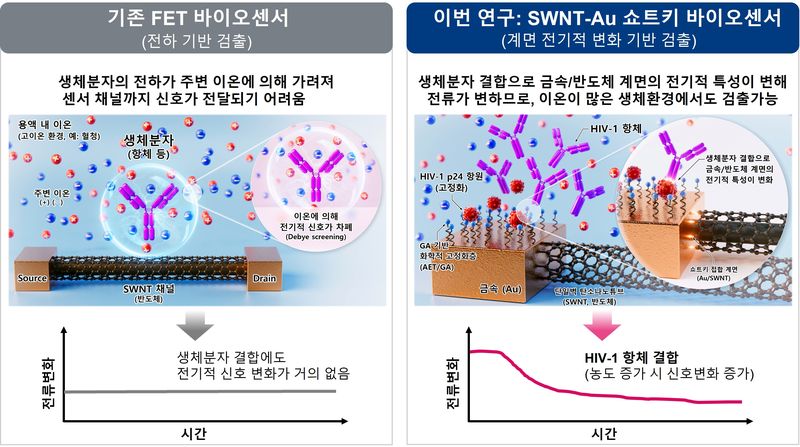
Conventional carbon-nanotube-based biosensors offer high sensitivity, but their detection performance has mainly been tested in solutions with low ion concentrations. In environments with high ion concentrations, such as blood or serum, the electrical signals of biomolecules become weaker, making detection difficult. This has posed a technical obstacle to applying biosensors to actual biological samples.
To address these limitations, the researchers focused on changes in the electrical properties of a “Schottky junction,” which forms where a single-walled carbon nanotube meets a gold electrode. A single-walled carbon nanotube (SWNT) is a nanomaterial in which carbon atoms are arranged in a single-layer cylindrical structure. Its excellent electrical properties make it useful in electronic devices and biosensors. A Schottky junction forms where a metal meets a semiconductor and can be used to detect biomolecules by measuring changes in electrical properties.
The researchers built a sensor using single-walled carbon nanotubes and gold electrodes and used antibodies against the human immunodeficiency virus (HIV-1) as the detection target to assess the platform’s performance. They observed electrical signals generated when antibodies bound to the sensor, even in environments with high ion concentrations, such as serum.
They also found that the electrical signal varied with antibody concentration, demonstrating the potential for quantitative detection. This points to the possibility of overcoming the limitations of conventional biosensors in biological environments and developing a detection technology suitable for use with actual biological samples.
By detecting HIV-1 antibodies, the study confirmed that the technology works. Its significance lies in its potential as a platform for detecting a range of antigens, antibodies and biomolecules by changing the recognition molecules attached to the sensor surface. In particular, the ability to detect targets even in serum conditions that closely resemble the actual biological environment increases the potential for practical applications.
“This study presents a new approach to addressing the technical limitations of conventional biosensors in real biological environments,” said principal researcher Lee Jae-hyeok. “Going forward, we will work to develop it into a toxicity assessment technology that combines with three-dimensional cells and organoids to precisely analyze the effects of drugs and environmental pollutants.”
The study was conducted with support from the National Institute of Toxicological Sciences’ basic research program and the National Research Foundation of Korea (NRF). The findings were published online on September 4 in Biosensors and Bioelectronics, an international journal in the field of biosensors.
[email protected] Yeon Ji-an Reporter