Seoul housing business outlook plunges 23.2 points as interest-rate pressures divide the metropolitan area and provinces
- Input
- 2026-11-12 11:00:00
- Updated
- 2026-11-12 11:00:07
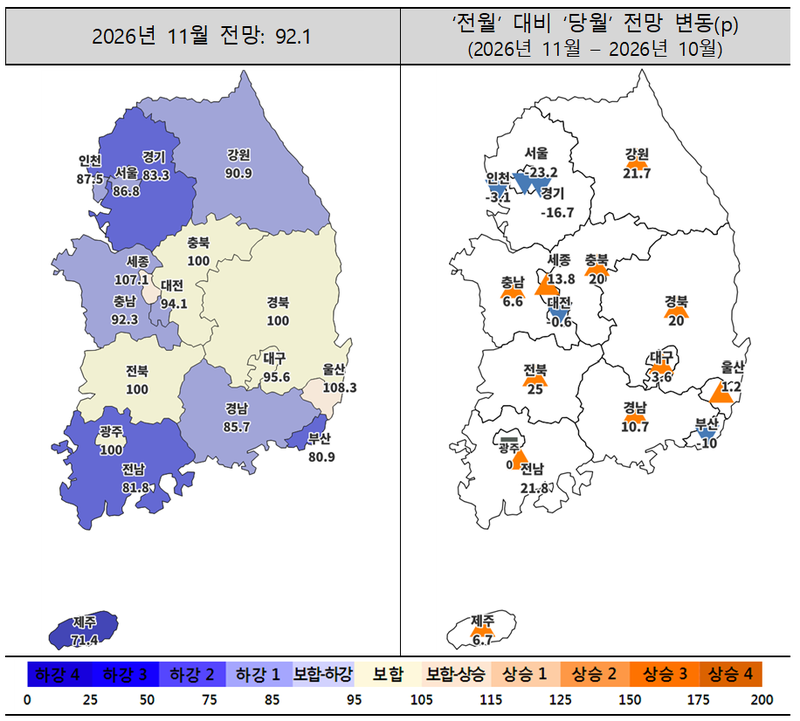
According to the Housing Industry Research Institute (HIRI) on the 11th, the nationwide Housing Business Outlook Index for November, based on a survey of housing businesses, rose 5.7 points from the previous month to 92.1. The index for the Seoul metropolitan area fell 14.4 points to 85.8, while that for non-metropolitan areas rose 10.0 points to 93.4.
In the Seoul metropolitan area, Seoul’s index fell from 110.0 to 86.8 and Gyeonggi’s from 100.0 to 83.3, down 23.2 and 16.7 points, respectively. Incheon’s index also fell 3.1 points, from 90.6 to 87.5.
The institute attributed the decline to the rising burden of buying a home as mortgage rates increased for the fifth consecutive month, along with a spreading wait-and-see stance among buyers, particularly in high-priced areas. It explained that fewer home sales in Seoul, falling apartment prices—especially in the three Gangnam districts of Gangnam, Seocho and Songpa—and a slowdown in overall price increases across Seoul had heightened uncertainty about future demand.
Among non-metropolitan areas, North Jeolla posted the largest increase, rising 25.0 points from 75.0 to 100.0. South Jeolla rose 21.8 points, from 60.0 to 81.8, while Gangwon gained 21.7 points, from 69.2 to 90.9. North Chungcheong and North Gyeongsang also each rose 20.0 points, from 80.0 to 100.0.
Sejong City rose 13.8 points to 107.1, while South Gyeongsang gained 10.7 points to 85.7. Jeju at 71.4, South Chungcheong at 92.3, Daegu at 95.6 and Ulsan at 108.3 were also higher than the previous month. By contrast, Busan fell 10.0 points from 90.9 to 80.9, and Daejeon dropped 0.6 points from 94.7 to 94.1. Gwangju was unchanged from the previous month at 100.0.
The institute said concerns about a prolonged slump had eased somewhat in some regions as home sales recovered and unsold housing declined. It assessed that expectations of a stronger local economy following investment in the semiconductor industry had a positive effect in North Chungcheong, plans for additional relocation of central government agencies did so in Sejong City, and rising apartment sale prices did so in North Jeolla.
However, it said the extent to which the recovery would spread remained to be seen, given large differences in economic conditions between regions and the heavy burden of unsold homes after completion.
The November financing index stood at 69.8, down 11.0 points from the previous month. The institute said expectations had risen the month before on expanded project-financing (PF) guarantees and reduced guarantee fees, among other measures, but the recent rise in corporate loan rates and resulting financial-cost burden had dampened housing businesses’ sentiment.
The materials supply and demand index was forecast at 98.3, up 3.2 points. The institute explained that expectations of lower costs for imported raw materials were reflected in the index after the won-dollar exchange rate fell to the 1,320-won range last month. It added, however, that costs remained burdensome because of volatility in international oil prices amid the prolonged war in the Middle East and high prices for key materials such as rebar.
[email protected] Choi Ga-young Reporter