[Exclusive] Altman acknowledges ‘short-term AI bubble theory’... “Demand will explode in the long term” [OpenAI courts Samsung]
- Input
- 2026-11-11 18:27:51
- Updated
- 2026-11-11 18:27:51
■ “Short-term ups and downs”... Confident in long-term AI demand
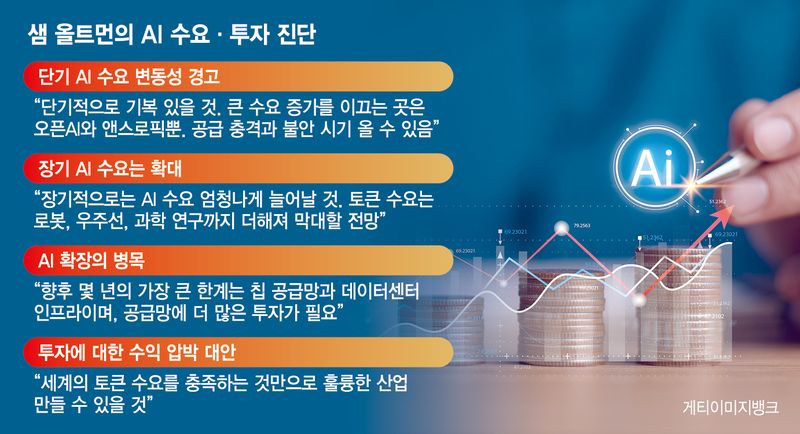
According to Q&A materials from a meeting between Altman and Samsung executives that Financial News obtained exclusively on the 11th, Altman replied, “There are ups and downs in the short term,” when asked whether demand for AI, memory and data centers could reach saturation or slow over the next 5–10 years.
About 50 senior executives from Samsung affiliates in sectors including electronics, finance and biotech attended the meeting, held on the 31st of last month at the Samsung Human Resources Development Center in Yongin-si, Gyeonggi Province.
Altman referred to the debate this year over a bubble in “neoclouds”—emerging cloud providers that rent out infrastructure specializing in AI computing, such as graphics processing units (GPUs)—saying, “There has been double-counting of demand,” and adding, “Only two companies, OpenAI and Anthropic, are actually driving a substantial increase in demand, so there could be supply shocks and periods of instability.”
Some announcements about AI infrastructure do include the same project in multiple tallies, so the bubble concerns Altman pointed to appear to refer to this.
Altman added, “In the long term, AI demand will grow enormously,” and predicted that the use of tokens—the units of information processed by AI models—would increase significantly as AI is used to write customized software in real time and to support robots, spacecraft and scientific research.
He said, “Everyone will increasingly want intelligence that works for them,” adding, “In early 2020, the top token user used about 100,000 tokens a month, but early this year the heaviest user consumed 100 billion tokens a month. The amount of compute one person can consume is astonishing.”
■ “The biggest constraint over the next few years is the chip supply chain”
Asked what the biggest bottlenecks to AI expansion were, Altman named “supply chains,” “funding,” “AI safety and social acceptance,” and “corporate transformation.”
Altman then identified the “chip supply chain” and “data center infrastructure” as the biggest constraints on AI expansion over the next several years. He emphasized, “The biggest constraints over the next few years are the chip supply chain and data center infrastructure,” adding, “More investment in the supply chain is needed.”
Altman's visit to Korea to meet Samsung executives, squeezed into a brief two-day, one-night trip despite his packed schedule, is seen as underscoring the urgency of the memory-chip supply shortage. Samsung Electronics and SK hynix agreed last October to join OpenAI's Stargate Project and pursue cooperation on supplying advanced memory.
Altman said investments in computing efficiency, including internally designed chips, were beginning to pay off, and emphasized that long-term contracts were helping the company achieve high operational efficiency. This is seen as a strategy to lower processing costs per token and generate profits by increasing sales volumes, even when tokens are sold at low margins.
Asked by Samsung executives whether continued large-scale investment was not putting pressure on profitability, Altman replied, “That’s the key,” adding, “With vertically integrated infrastructure that costs less than any other company’s, we can get ahead of the competition by selling tokens at scale on low margins.”
[email protected] Kim Hak-jae, Park Ji-yeon and Lim Su-bin, reporters
[email protected] Lim Su-bin, Kim Hak-jae and Park Ji-yeon Reporter