Next year’s greenhouse gas reduction budget proposal tops 20 trillion won, but funding priorities are out of sync
- Input
- 2026-11-11 18:23:55
- Updated
- 2026-11-11 18:23:55
■ Power sector’s share of the budget lower than transport’s
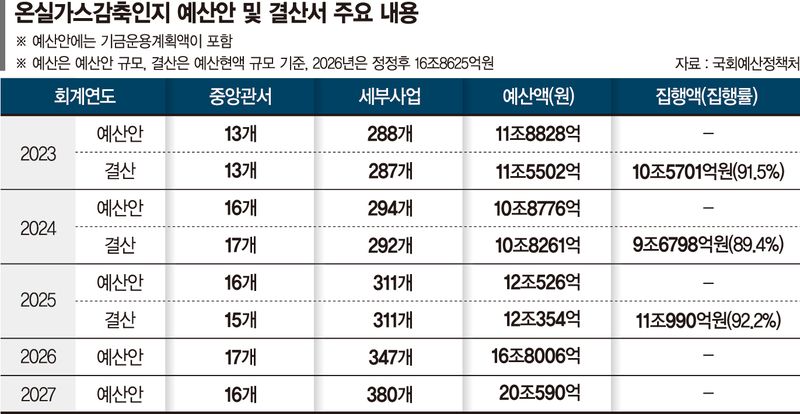
According to a report by the National Assembly Budget Office, “Analysis of the 2027 Greenhouse Gas Reduction Budget Statement,” on the 11th, the total budget for the 380 detailed projects included in next year’s greenhouse gas reduction-tagged budget proposal came to 20.059 trillion won. That is 19.0% more than this year’s 16.8625 trillion won. Of that amount, 15.0551 trillion won is for projects that actually reduce greenhouse gas emissions, up 25.9% from this year’s 11.956 trillion won.
The greenhouse gas reduction budget-tagging system is designed to analyze the impact of government spending on greenhouse gas reductions and reflect it in fiscal management. The government’s 2035 NDC aims to cut greenhouse gas emissions by 53–61% from 2018 net emissions. The power sector must reduce emissions by 194.7 million to 213 million tons, the largest reduction required of any sector. The industrial sector must cut 67.2 million to 85.7 million tons, and the transport sector 59.5 million to 62 million tons.
The transport sector accounts for the largest share of next year’s reduction budget. It has been allocated 5.286 trillion won, or 35.1% of the total. By contrast, the power sector received 3.1154 trillion won, just 20.7%. The industrial sector accounts for 17.6% (2.6541 trillion won), and the buildings sector for 11.1% (1.6639 trillion won).
The power sector’s reduction budget rose by 1.5973 trillion won from this year, an increase of 105.2%. Even so, the Budget Office’s analysis found that next year’s budget-allocation priorities do not match the reductions required by 2035.
■ 839.7 billion won in reduction-related spending omitted from classification
Gaps have also emerged in the system for overseeing the reduction budget. According to the Budget Office, eight detailed projects in the Future Response Fund related to greenhouse gas reductions, totaling 839.7 billion won, were excluded from the reduction-tagged budget proposal.
There were also limits to assessing the cost-effectiveness of reduction projects. The expected greenhouse gas reductions from 112 quantifiable projects for next year totaled about 6.98 million tons. For every 100 million won in reduction-budget spending, the expected reduction was 216 tons in the industrial sector, compared with 48 tons in the transport sector—a difference of more than fourfold.
However, it is difficult to make a straightforward comparison of reduction efficiency across sectors. Subsidies are ultimately borne by public finances, while loans are repaid, limiting the actual fiscal burden to items such as the interest-rate differential. The Budget Office noted that these differences among forms of support are not adequately reflected when comparing reduction effects.
[email protected] Ji-young Park Reporter