Suspected smuggling of NVIDIA chips into China ... Will the U.S. revive its “AI containment” order?
- Input
- 2026-11-11 18:19:35
- Updated
- 2026-11-11 18:19:35
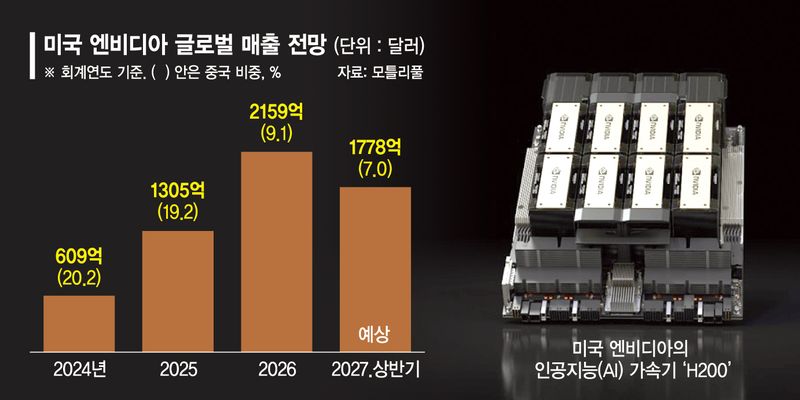
■ Smuggling worth 10 trillion won to evade U.S. sanctions
On the 10th, U.S. tech news outlet The Information, citing two people familiar with the matter and publicly available corporate records, alleged that Chinese businesswoman Alice Huang (Chinese name: Huang Le), known to be the romantic partner of NVIDIA CEO Jensen Huang, smuggled into China NVIDIA AI accelerators whose export the U.S. government had restricted. The amount smuggled is estimated at at least $7.5 billion (about 10 trillion won). An estimated 240,000 high-performance NVIDIA AI accelerators—including H100, H200 and A100 models—were either smuggled into China by Alice Huang or supplied there through leases. Computing capacity from these products was provided to Alibaba and Tencent, as well as small and midsize AI companies in China, and was used to train AI models.
The Information analyzed that Megaspeed, a Singaporean company in which Alice Huang had been the largest shareholder, served as a conduit for the smuggling. The company had been a subsidiary established in Singapore in 2015 by Chinese gaming company Seven Road, but was acquired by Alice Huang in 2023. Alice Huang changed its name to Megaspeed and turned it into an AI cloud provider. Alice Huang and her family used Megaspeed’s Malaysian subsidiary, Speedmatrix, and Shanghai Century Litong, a Chinese company established in June 2023, to bring NVIDIA accelerators whose export to China was banned into the country.
Century Litong, whose founding shareholder list included Alice Huang’s younger sister, Huang Yu, secured “preferred cloud partner” status with NVIDIA in October 2023, just four months after its founding, and received priority supplies of AI accelerators. But when orders for NVIDIA products were halted or delayed due to U.S. export controls on China, Alice Huang stepped in and used her connections at NVIDIA and elsewhere to secure supplies. The U.S. Department of Commerce had been monitoring the distribution of Alice Huang’s AI accelerators since 2024. It found unopened NVIDIA equipment stacked at Megaspeed’s data center, while Taiwanese authorities also monitored Alice Huang’s visits at the request of the United States. Singaporean authorities, investigating Megaspeed, also summoned Alice Huang over alleged offenses including false declarations on import documents, but closed the investigation due to insufficient evidence. Alice Huang later left for Shanghai and was reportedly in China until early this year, but her whereabouts are now unknown.
■ U.S. could resume AI export controls targeting China
Alice Huang, whom the United States has identified as an official of China’s Ministry of State Security (MSS), reportedly met Jensen Huang at locations around the world over the past three years, including Shanghai, Taiwan, NVIDIA’s headquarters in Silicon Valley, and a golf resort south of San Jose, California. The New York Times (NYT) reported on the 10th that U.S. President Donald Trump had been briefed about the affair between Alice Huang and Jensen Huang aboard a private jet bound for China last May, but took no significant action.
Trump’s inaction is ultimately expected to undermine his efforts to improve relations with China. In 2023, the administration of U.S. President Joe Biden barred American companies, including NVIDIA, from exporting high-performance semiconductors such as H200 to China. Trump, however, has allowed H200 exports since January, subject to individual reviews. Still, China had officially imported zero H200s as of February. Western media outlets consequently raised suspicions that China was smuggling H200s.
Zhu Feng, dean of Nanjing University’s School of International Relations, predicted in the Hong Kong-based English-language newspaper South China Morning Post (SCMP) on the 10th that the incident would deepen the decoupling of U.S. and Chinese AI. “It is important that committees in both the U.S. House and Senate will conduct investigations,” he said, adding, “This incident will become a second spy balloon episode in U.S.-China relations.” Relations between the two countries were strained for several months after a Chinese spy balloon crossed over the U.S. mainland in February 2023, was shot down and fell into the sea. Senior Democrats called for a hearing with Jensen Huang and tighter AI regulations related to China in the immediate aftermath of the incident.
Forbes, a U.S. business publication, reported that Jensen Huang’s net worth stood at $146.8 billion (about 197 trillion won) as of the 9th, placing him 12th in the global billionaire rankings. After the scandal, he fell four places and dropped out of the top 10. Jensen Huang, who acknowledged the affair on the 8th, went to work at NVIDIA’s headquarters in California on the 10th and chaired a closed-door meeting. According to the NYT on the 10th, NVIDIA appointed Jun Kim, 55, a second-generation Korean American lawyer (Korean name: Kim Jun-hyeon), to lead the independent investigation into the incident.
[email protected] Park Jong-won Reporter