[Exclusive] Altman: “I want to build an AI device with Samsung” [OpenAI makes an overture to Samsung]
- Input
- 2026-11-11 18:12:56
- Updated
- 2026-11-11 18:12:56
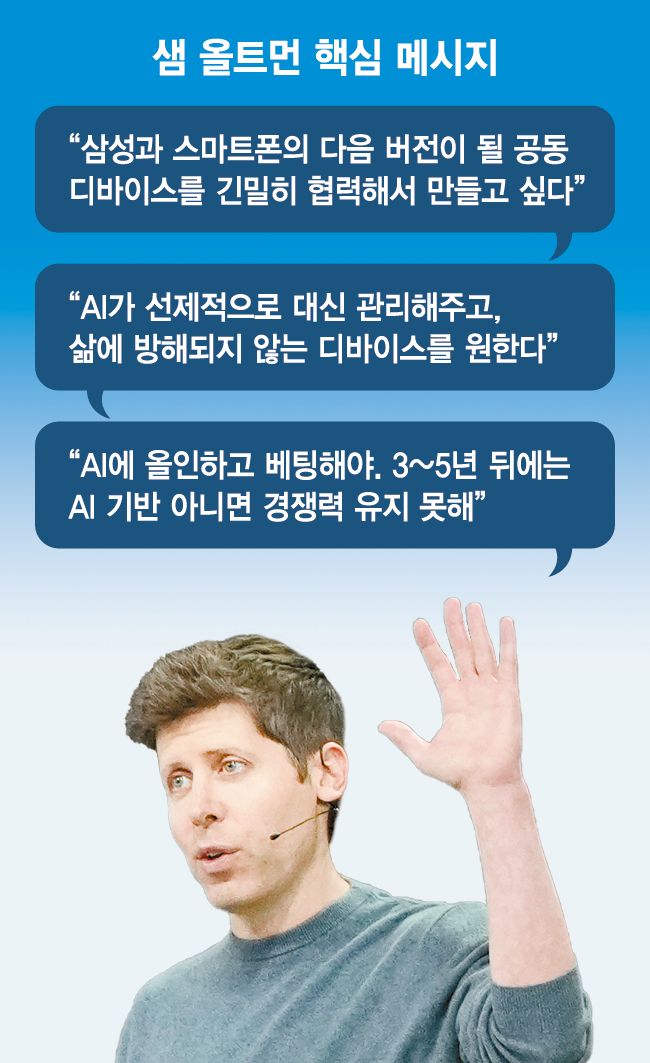
Altman has repeatedly visited Korea this year to discuss AI technology and workplace innovation with Samsung executives, forming an “AI alliance.” Attention is now focused on whether Samsung Electronics will take part in OpenAI’s AI device project.
According to the contents of a Q&A session following a meeting between Altman and Samsung executives on the 31st of last month, obtained exclusively by Financial News on the 11th, Altman was asked by the executives, “What kind of device do you think will become an AI companion?” He replied, “It will be the next version of the smartphone,” adding, “I want a device that is as unobtrusive as possible, with AI—not apps—proactively accessing and managing our physical and virtual lives.”
OpenAI is preparing an AI device with next year as its target, and a screenless smart speaker smaller than a palm is considered the leading candidate.
Altman stressed, “Next-generation devices will bring in information from the physical world,” adding, “However, society needs to manage privacy concerns and excessive dependence on AI.”
On AI glasses, he said, “They would be great for personal productivity, but if the other person is looking at something else during a conversation, it feels like technology is coming between people, and I find that uncomfortable.”
Altman also gave Samsung’s executives emphatic advice, saying that now is the right time to boost corporate competitiveness through a “full-scale AI transformation”: “You have to go all in on AI and bet on it.” The idea is to strengthen Samsung’s competitive edge by entrusting AI with entire work processes, as OpenAI has done.
His reasoning is that if AI remains merely a tool for boosting human productivity, productivity gains will be limited to two to three times, but entrusting it with entire work processes could increase productivity by as much as 100 times. Altman said, “We need to see whether AI can go beyond simply making employees more efficient and lead the entire process, getting things done 100 times faster and at a lower cost.”
He explained that OpenAI, too, began deploying AI across all its work and services three months ago. When OpenAI employees enter their work priorities into AI, it synthesizes the context and handles the tasks.
Altman stressed that OpenAI’s coding agent Codex has reached the point where, when he asks it for additional staff, the AI pushes back and asks him to “prove why that work can’t be done.” AI has advanced to the point where it can even make “management decisions,” a task once considered uniquely human. Altman warned, “Even in the mobile era, companies that moved first survived, while most companies that were one or two years late were left behind. The AI transition needs to be tackled quickly. In three to five years, companies won’t be able to remain competitive unless they are AI-based.”
The meeting that day focused on enhancing the judgment and execution capabilities of the executives who will lead Samsung’s AI transformation (AX). The presidents of Samsung’s electronics, finance and biotech businesses all attended and posed forthright questions to Altman, including, “What is the biggest bottleneck to expanding AI?” and “How do you address pressure to generate returns while investing?”
[email protected] Park So-hyun, Kim Hak-jae and Lim Su-bin, Staff Writers
[email protected] Lim Su-bin, Kim Hak-jae and Park So-hyun Reporter