Ministry of Finance and Economy warns of a “contraction in the government bond market”; financial sector pushes back, saying it is “hard to accept”
- Input
- 2026-11-11 18:08:43
- Updated
- 2026-11-11 18:08:43
According to the financial investment industry on the 11th, securities firms and banks fined by the KFTC are considering administrative lawsuits. Some are also challenging the collusion finding itself, raising the possibility of a protracted legal battle. “The prevailing view is that most companies will file suit,” a securities industry source said, adding, “Quite a few also say it is difficult to accept the collusion finding itself.”
■ Wave of lawsuits expected from financial sector... Clash over “winning bid amount vs. actual profit” puts pressure on BIS and NCR ratios
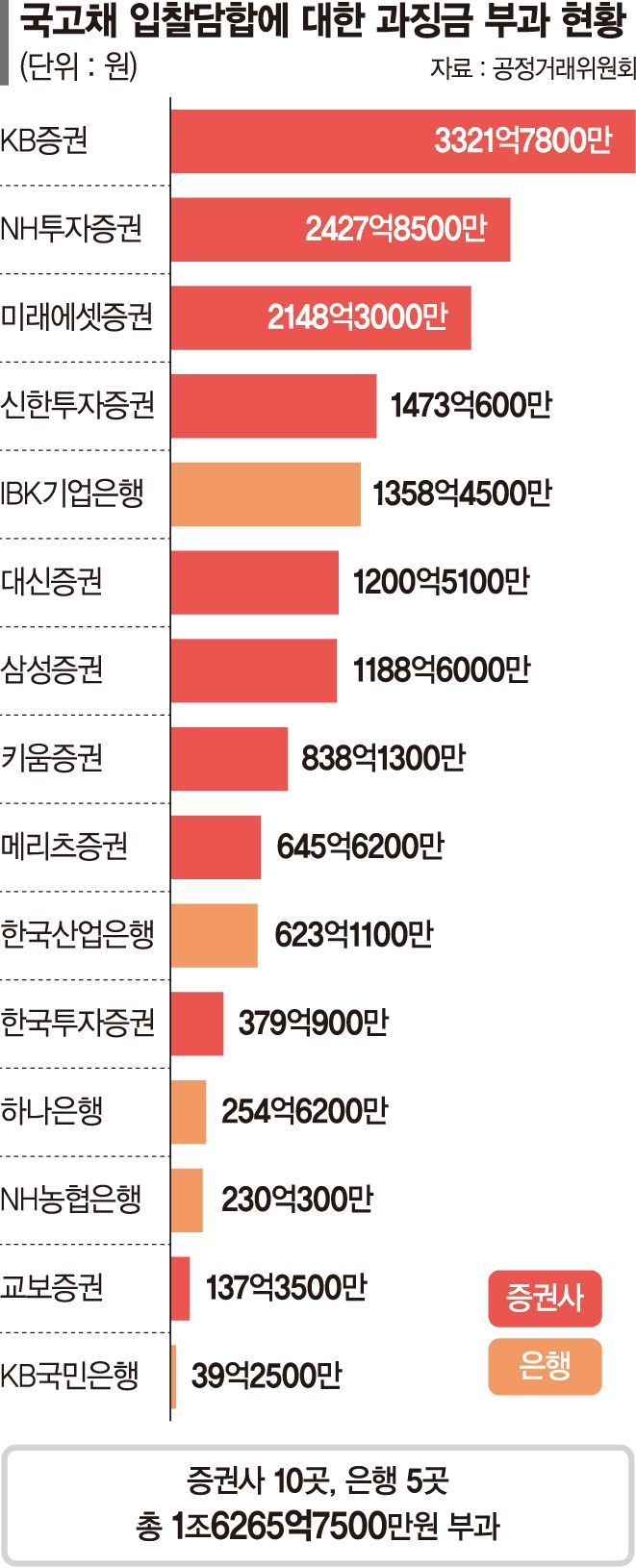
The KFTC decided to impose a total of 1.626575 trillion won in fines on 10 securities firms and five banks. The securities firms’ share is 1.376029 trillion won, while the banks’ share is 250.546 billion won. KB Securities faces the largest fine, at 332.178 billion won, followed by NH Investment & Securities (242.785 billion won) and Mirae Asset Securities (214.83 billion won).
The key issue is the basis for calculating the fines. The KFTC found that collusion or information exchange took place in 150 government bond auctions between January 2020 and June 2023. It applied a 4.5% penalty rate to approximately 54 trillion won in related sales, then reduced the fines in consideration of factors including the particular characteristics of the government bond market. The financial sector, however, argues that since the amount of government bonds won at auction differs substantially from the actual revenue earned, it is necessary to examine whether the former is an appropriate basis for calculating fines.
“Responsibility for collusive conduct and the appropriateness of the fine amounts are separate issues,” a financial investment industry source said. “The amount of government bonds won at auction is the total value of the bonds acquired by a financial firm, not the revenue it actually earned.” The source added, “PD work is not very profitable, and firms sometimes incur losses while making markets,” and explained, “Unless the actual amount of unjust gains or losses avoided is taken into account, there will be a gap between the level of the penalty and the economic reality.”
The banking sector is also reportedly weighing legal action. A Hana Bank representative said, “Our bank’s position differs from the KFTC’s finding that the law was violated,” adding, “After reviewing the written resolution, we plan to consider our response from various angles.” Some banks are even considering lawsuits to avoid controversy over executives’ breach of fiduciary duty and accountability, while others appear inclined to accept the fines because litigation may offer little practical benefit.
The fines also put pressure on capital adequacy. Securities firms could face downward pressure on their net capital ratio (NCR) as their net operating capital declines. Banks, too, could see their capital ratios under Bank for International Settlements (BIS) standards fall if their equity decreases, potentially constraining their capacity to lend to businesses. The actual impact, however, will vary depending on each firm’s capital cushion and the size of provisions it sets aside.
■ Ministry of Finance and Economy also warns of disruptions to government bond issuance... If PDs pull back, corporate finance could take a hit
Notably, even the government ministry responsible for issuing government bonds has expressed concern about the side effects of large-scale penalties, going beyond the financial sector’s opposition. According to industry sources, the Ministry of Finance and Economy attended the KFTC plenary meeting as a witness and conveyed its view that the negative impact of hefty fines on government bond issuance should be taken into account.
“I understand that an official from the Ministry of Finance and Economy attended the plenary meeting in person and conveyed concerns that excessively large fines could seriously disrupt government bond issuance operations,” a financial investment industry source said. Related concerns were also conveyed to the Financial Services Commission and others, and the market burden was reportedly explained through the Korea Financial Investment Association as well.
PDs provide liquidity by underwriting government bonds and quoting both bid and ask prices in the secondary market. The industry is concerned that adding the burden of hefty penalties to work with limited profitability could weaken incentives to make markets.
Government bonds serve as a benchmark for corporate and bank bond rates. If reduced PD activity worsens liquidity in the government bond market, it could put upward pressure on government bond yields, which in turn could raise corporate bond issuance rates and banks’ funding costs. Critics say the burden of the penalties could thus be passed on indirectly to businesses’ and households’ financing costs.
The KFTC says collusion increased the government’s funding costs and that it took the Ministry of Finance and Economy’s views and concerns about a market contraction into account when reducing the fines. The Ministry of Finance and Economy plans to consider whether to suspend or revoke PD status after observing legal proceedings, including financial firms’ lawsuits challenging the decision.
[email protected] Kim Hyun-jung, Park Mun-su Reporter