Lee Hyoung-il: “Next year’s economic growth strategy to focus on easing polarization and raising the potential growth rate”
- Input
- 2026-11-11 18:08:30
- Updated
- 2026-11-11 18:08:30
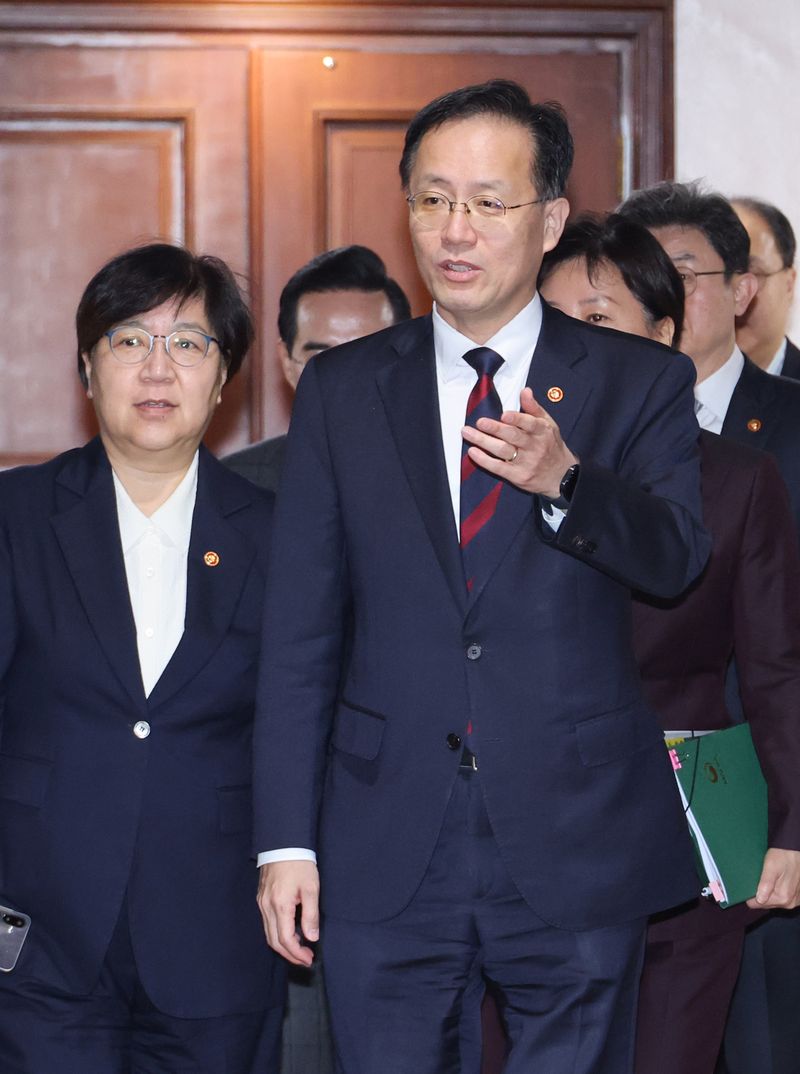
Lee chaired the Emergency Economic Council meeting at Government Complex Seoul on the 11th and said, “The 2027 economic growth strategy, too, will focus on laying the foundations for sustainable growth by easing polarization and raising the potential growth rate.”
He framed efforts to raise the potential growth rate as a drive for greater growth. Lee said, “We will firmly lay the foundations for a major leap forward toward greater growth,” adding, “Along with fostering new industries, including the three mega-projects and seven SEED initiatives that will sustain the momentum of a rebound in the potential growth rate, supporting corporate investment and innovation, and strengthening the competitiveness of the service sector, we will also accelerate the transition to an ultra-innovative economy.” He described easing polarization as “a warmer approach to people’s livelihoods.” Lee said, “We will turn greater growth into a warmer approach to people’s livelihoods,” adding, “We will devote every effort to resolving structural problems, including institutions and practices that deepen inequality and polarization, and to the three major livelihood projects covering housing, jobs and finance for ordinary people, so that everyone can share fairly in the opportunities and benefits of growth.”
Economic growth strategies are usually announced twice a year, in the first and second halves. They include the government’s assessment of economic conditions for the coming year, forecasts for key economic indicators such as the growth rate, and major policy directions. The government plans to increase the number of economic outlooks it publishes from twice to three times a year for the first time in 32 years, enabling it to respond swiftly to rapidly changing domestic and global conditions.
Lee added, “In connection with the revision of the forecast cycle, we will not draw up a second-half economic growth strategy, but will present supplementary measures to address changed economic conditions when we release revised forecasts,” and, “We will prepare to announce them in December through collaboration across government ministries.”
At the meeting, the government decided to extend the fuel tax cuts for two months, through January 31 next year. The measure is intended both to ease the public’s fuel-cost burden and to prepare for uncertainties such as the war in the Middle East. Accordingly, from December onward, the tax cut rates will remain at their current levels: 15% for gasoline and 25% for diesel and butane. Under the extension, fuel taxes including value-added tax will remain at 698 won per liter for gasoline, 436 won for diesel and 152 won for butane. The government will maintain a relatively larger cut for butane, an affordable fuel used by small trucks, including those serving industry and logistics.
The government plans to implement the further extension from the first of next month, following subsequent procedures including submitting amendments to the Enforcement Decree of the Traffic, Energy and Environment Tax Act and the Enforcement Decree of the Individual Consumption Tax Act to a Cabinet meeting.
At the meeting, actuators, a key component for realizing physical artificial intelligence (AI), secondary batteries for humanoids and next-generation sensors were added as new tasks to the Ultra-Innovative Economy Leading Project. The government also decided to establish a task force on polarization, with Lee serving as its head, alongside relevant ministries and state-run research institutes.
[email protected] Seo Yeong-jun, Kim Jun-hyeok Reporter