[Exclusive] Sam Altman warns Samsung executives of volatility: “AI demand has been double-counted, with short-term fluctuations”
- Input
- 2026-11-11 17:30:00
- Updated
- 2026-11-11 17:30:00
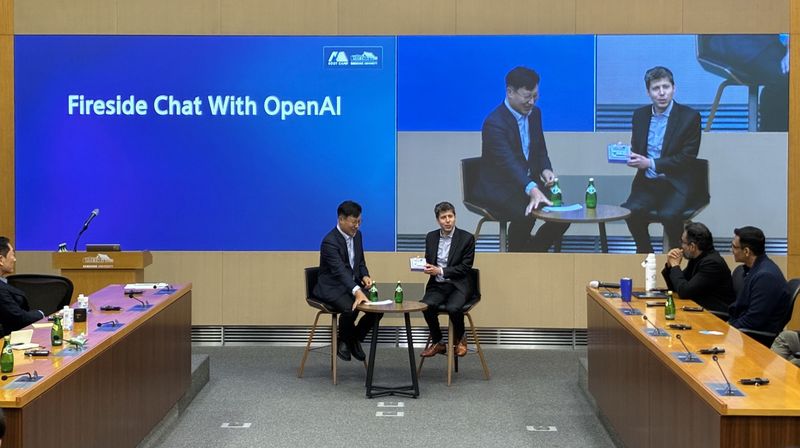
[Financial News] OpenAI CEO Sam Altman warned Samsung executives that demand for AI memory could fluctuate in the short term. He said there had been cases of demand being double-counted in the market in connection with growth in demand for memory semiconductors and data centers. In the long term, he forecast that AI use would surge, leading to shortages of chips and data centers. However, attention is focused on the fact that Altman, who has led efforts to expand AI infrastructure, called for increased investment before executives of global memory suppliers while also expressing caution about the short-term demand outlook.
■ “Short-term fluctuations” ... confident about long-term AI demand
According to Q&A materials from a meeting between Altman and Samsung executives, obtained exclusively by Financial News on the 11th, Altman answered “There are short-term fluctuations” when asked whether demand for AI, memory and data centers could reach saturation or slow over the next 5–10 years.About 50 presidents of Samsung affiliates in electronics, finance, biotech and other sectors attended the meeting held on the 31st of last month at the Samsung Human Resources Development Center in Yongin, Gyeonggi Province.
Altman referred to the debate this year over a bubble among emerging cloud companies known as “neoclouds,” which rent out infrastructure specialized for AI computing, such as GPUs. He said, “There has been double-counting of demand,” adding, “Only two companies, OpenAI and Anthropic, are actually driving major demand growth, so there could be a supply shock and an unsettled period.”
Looking at actual AI infrastructure announcements, some projects appear in multiple tallies, so the bubble concerns raised by Altman seem to refer to this as well.
Altman said, “In the long term, AI demand will grow enormously,” and forecast that use of tokens—the units of information processed by AI models—would also increase substantially if AI writes customized software in real time and is applied to robots, spacecraft and scientific research.
He said, “Everyone will increasingly want intelligence that works for them,” and added, “At the start of 2020, the top token user consumed about 100,000 tokens a month, but early this year the heaviest user consumed 100 billion tokens a month. The amount of compute one person can consume is astonishing.”
■ “The biggest constraint in the coming years is the chip supply chain”
Asked what the biggest bottlenecks to AI expansion were, Altman cited “the supply chain,” “financing,” “AI safety and social acceptance,” and “corporate transformation.”Altman also identified “the chip supply chain” and “data center infrastructure” as the biggest constraints on AI expansion in the coming years. He stressed, “The biggest constraints over the next few years are the chip supply chain and data center infrastructure,” adding, “More investment in the supply chain is needed.”
Altman’s visit to Korea on a short, one-night, two-day trip despite his tight schedule, and his meeting with Samsung executives, are seen as evidence of the urgency of memory chip shortages. Samsung Electronics and SK hynix agreed last October to join OpenAI’s Stargate Project and pursue cooperation on supplying advanced memory.
Altman said investments in computing efficiency, including in internally designed chips, were beginning to pay off, and emphasized that the company was achieving high operational efficiency based on long-term contracts. This is seen as a plan to lower processing costs per token and generate profits by increasing sales volume, even when tokens are sold at low margins.
Asked by Samsung executives whether continued large-scale investment was putting pressure on profits, Altman said, “That’s the point,” adding, “If a company has vertically integrated infrastructure that costs less than any other company’s and sells tokens at scale on low margins, it can get ahead of the competition.”
Altman expressed confidence, saying, “The market is so large that the rules of a commodity business do not apply,” and “Simply meeting the world’s demand for tokens would be enough to build a great industry.”
[email protected] Kim Hak-jae, Park Ji-yeon, Lim Su-bin Reporter