“Will extending the consumption coupon deadline lead people to spend more?”... GPT used to forecast policy effects
- Input
- 2026-11-11 15:06:57
- Updated
- 2026-11-11 15:06:57
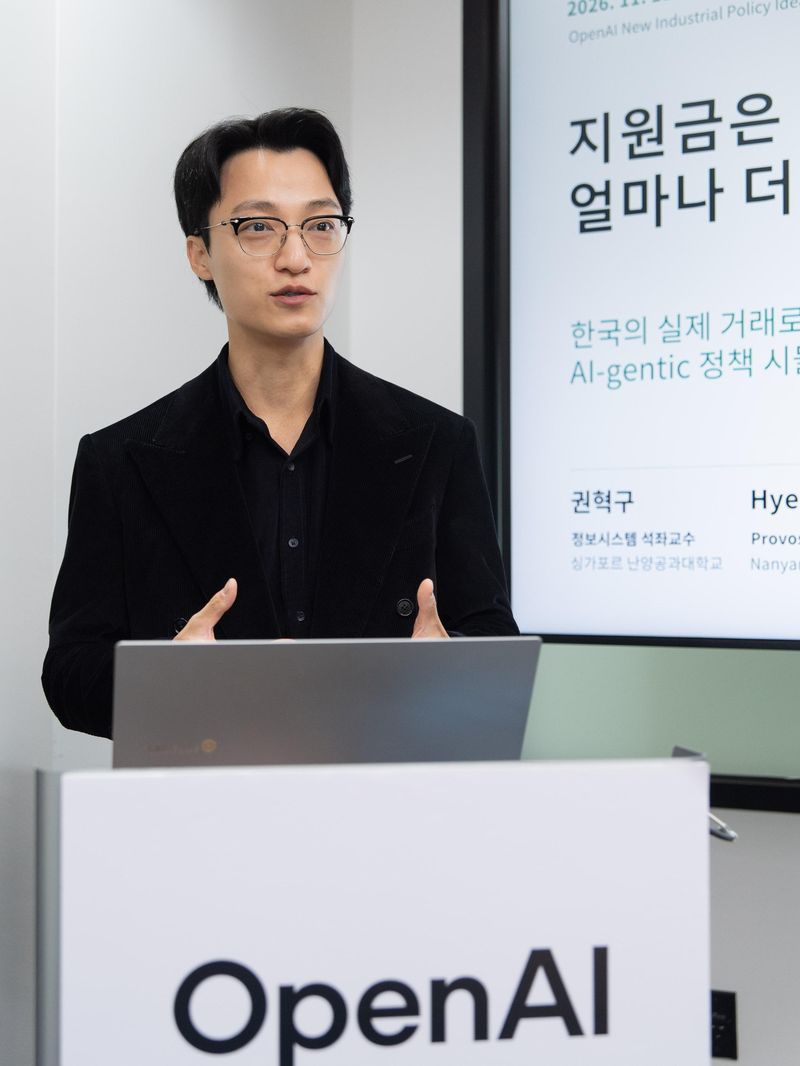
According to industry sources on the 11th, OpenAI held a media session titled “OpenAI Insights: Using AI in Policy Research” at its Seoul office that day and introduced ongoing GPT-based policy simulation research by a team led by chair professor Kwon Hyeok-gu of Singapore’s Nanyang Technological University (NTU).
The research is being conducted with support from OpenAI’s Industrial Policy Research Support Program. Its central aim is to test how accurately AI can predict household consumption responses to the Livelihood Recovery Consumption Coupon, which was introduced in South Korea last year.
The researchers will call GPT models through OpenAI’s application programming interface (API) and simulate consumers’ expected responses. They will input policy terms—including the coupon amount, where it can be used, and its validity period—alongside consumer profiles summarizing income and spending habits before the policy takes effect.
Based on this information, GPT will predict changes in spending, the amount of coupons used, and whether consumers will make additional purchases. The analysis will also examine whether the coupons prompt new spending or replace spending that consumers had already planned.
Unlike conventional rule-based simulations, in which researchers must directly define consumer behavior using equations or rules, this study will have GPT interpret consumer characteristics and policy conditions together to generate predicted responses. The researchers plan to examine whether it can analyze the responses of diverse consumers without separate behavioral rules.
The accuracy of the AI forecasts will be verified against actual spending records. The researchers will compare the spending records of the same users after they receive the coupons with GPT’s predictions, and will also use the Bank of Korea’s survey findings related to the coupons as a point of comparison. They plan to verify not only overall consumption levels but also differences among income groups and individual spending responses.
After completing the validation of its forecasting ability for the actual policy, the team will also run hypothetical simulations with different policy conditions. The simulations will analyze how much spending would change if the coupons’ validity period were extended or the places where they could be used were changed.
In particular, the researchers plan to compare the effects and costs of different policies by determining whether extending the validity period generates additional spending or merely brings forward or delays the timing of purchases that would have happened anyway.
To protect personal information, consumers’ complete transaction histories will not be entered into the AI model. The researchers will use only summary information extracted from transaction records and will also examine how forecasts vary depending on the amount and format of the information provided.
This study is one of 14 projects selected for support by OpenAI from more than 400 proposals submitted worldwide. Through the program, OpenAI supports AI-based research into economic and industrial policies and assessments of their potential for real-world application.
The researchers plan to complete validation of the forecasts for the actual policy by the end of December this year and finish comparing policy alternatives by the end of March next year.
[email protected] Jang Min-kwon Reporter