“Reviving abolished investigative powers through supplementary provisions”... Special Counsel Act on Fabricated Prosecution sparks constitutional debate
- Input
- 2026-11-11 15:08:10
- Updated
- 2026-11-11 15:08:10
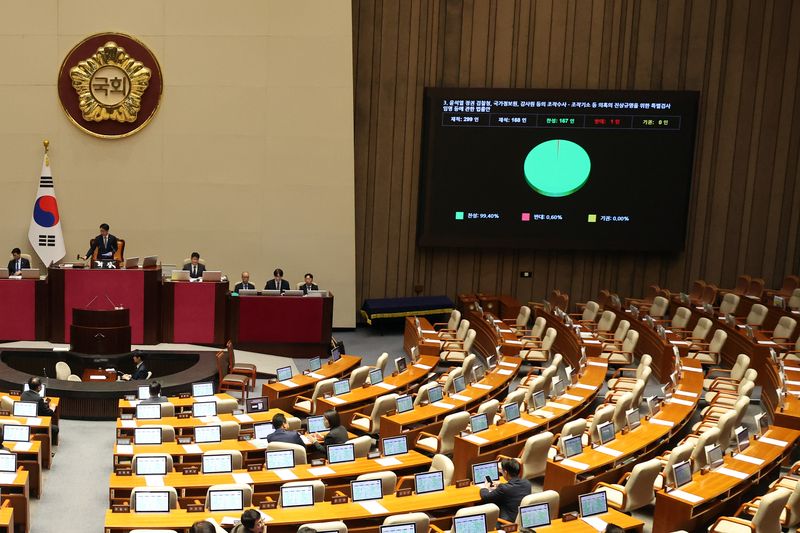
[Financial News] The Special Counsel Act on Fabricated Prosecution, passed by the National Assembly under the ruling party’s leadership, has sparked growing legal controversy by restoring prosecutors’ abolished investigative powers through supplementary provisions. Legal circles have questioned whether it is valid to reapply to special counsel provisions of the Criminal Procedure Act that have already lost effect. Critics warn that constitutional challenges could arise during future special counsel investigations, and that the legality of evidence collected could also be contested in court.
According to legal circles on the 11th, Article 6 of the supplementary provisions to the Special Counsel Act on Fabricated Prosecution, which passed the National Assembly’s plenary session on the 6th, applies the pre-amendment provisions of the Criminal Procedure Act to the investigative and supervisory powers of special prosecutors, assistant special prosecutors and dispatched prosecutors. The revised Criminal Procedure Act, which took effect on the 2nd of last month, abolished prosecutors’ investigative powers, but created an exception allowing the previous provisions to apply to special counsel.
The ruling bloc says there is no legal problem because Article 14 of the supplementary provisions to the amended Criminal Procedure Act also contains a transitional measure applying the previous provisions to the investigative and supervisory powers of special prosecutors and others. Legal circles, however, have raised objections over whether it is appropriate for a separate special counsel law to incorporate by reference provisions that have already lost effect.
Lee Heon-hwan, a professor at Ajou University Law School, said, “When an old law is amended, its previous provisions lose effect and cease to exist as legal norms. There is considerable doubt as to whether incorporating them by reference is sound legislative drafting.” He added, “Because laws must be specific and clear, there is ample room for constitutional controversy.”
Han Sang-hee, an emeritus professor at Konkuk University Law School, also said, “Before the question of constitutionality, this is a matter of the law’s effect and interpretation,” adding, “The issue is whether an old law that has lost effect can be revived through an unclear supplementary provision.” He continued, “Had it at least cited specific provisions, it could have reduced concerns about clarity,” and called it “quite dangerous legislation.”
Lee Geun-woo, a professor of law at Gachon University, criticized the law, saying, “The problem starts with putting in a supplementary provision something that belongs in the main body of the law—the investigative powers.” He added, “Past precedents involved transitional measures when the previous law was still in force, but now they are trying to apply provisions that have already been repealed as if they were still valid.”
The controversy could lead to actual investigations and trials. A person under investigation could challenge the special counsel’s authority itself by filing a constitutional complaint, or request that a court refer the law for constitutional review during trial. Professor Lee Heon-hwan explained that “a person under investigation could also file a constitutional complaint on the grounds that investigative powers were exercised without a legal basis.” Professor Lee Geun-woo likewise predicted that “the constitutionality of the Special Counsel Act could be contested repeatedly from the initial stage of an investigation, starting with warrant applications.”
The admissibility of records prepared by special counsel is also at issue. Article 6, paragraph 2, of the Special Counsel Act’s supplementary provisions applies the previous Criminal Procedure Act to the admissibility of records and documents prepared by special counsel and others during investigations. However, even under the previous Criminal Procedure Act, records of suspect interrogations prepared by prosecutors are generally inadmissible if the defendant does not acknowledge their contents. Professor Han Sang-hee said, “There is a possibility that evidence obtained through special counsel investigations could be ruled invalid by the court,” adding, “It would be advisable for dispatched prosecutors to focus on legal review, bringing charges and maintaining prosecutions, while minimizing their investigative role.”
The scope of the special counsel’s role is also a source of controversy. The question is whether it is appropriate for special counsel to reinvestigate allegations of fabricated investigations and prosecutions in cases that have already been indicted and are on trial. This is because courts can assess the lawfulness of investigative procedures and the validity of indictments in the existing trials. Illegally obtained evidence may be excluded, and the validity of an indictment may also be denied if a prosecutor’s arbitrary exercise of prosecutorial authority causes substantial disadvantage to the defendant.
In October 2021, the Supreme Court upheld a ruling dismissing an indictment after finding that prosecutors had abused their prosecutorial authority in a case involving allegations of violating the Foreign Exchange Transactions Act against Yoo Woo-sung, a victim in the Seoul municipal official espionage case. The appellate court at the time ruled, “The prosecutor’s indictment in the present case cannot be regarded as an ordinary or proper exercise of prosecutorial discretion, and, since it appears to have been based on some motive, it was unlawful as an arbitrary exercise of prosecutorial authority.” In other words, the prosecution had re-indicted him in a case in which it had previously suspended prosecution, without any significant change in circumstances, thereby substantially exceeding its prosecutorial discretion. The Supreme Court upheld the ruling, saying, “There was no error in misunderstanding the legal principles concerning abuse of prosecutorial authority.”
A rank-and-file prosecutor at a regional prosecution office said, “Whether the investigation was lawful and the indictment appropriate are matters for a judge to decide at trial after hearing arguments from the prosecutor and the defendant,” adding, “They are not matters for special counsel to decide first.”
[email protected] Kim Dong-gyu, Choi Eun-sol Reporter