Cho Jeong-sik: “Incumbent President Cannot Serve Consecutive Terms ... Constitutional Revision Will Be Pursued with the National Assembly Taking the Lead”
- Input
- 2026-11-11 14:53:23
- Updated
- 2026-11-11 14:53:23
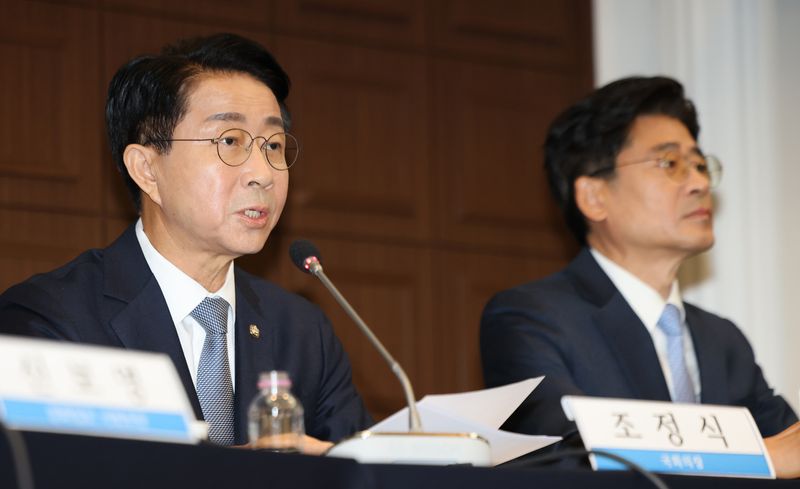
At a Kwanhun Club debate held that day at the Korea Press Center in Jung District, Seoul, Cho said he intended to pursue constitutional revision and set out as one of his principles that an incumbent president cannot serve consecutive terms.
“As stipulated in Article 128, Paragraph 2 of the Constitution, whether an incumbent president can serve consecutive terms is not up for discussion in a constitutional amendment,” he said. “We must stop making this an issue for political strife.”
At his first press conference since taking office, held at the National Assembly last July, Cho had stirred controversy by saying that the issue of amending the Constitution to allow an incumbent president to serve consecutive terms was “a matter of public opinion and the people’s choice as sovereign.” The conservative camp, including the People Power Party, characterized his remarks at the time as leaving open the possibility of President Lee serving consecutive terms and unleashed sharp criticism.
That day, Cho again explained what he had meant by his earlier remarks. “At my last press conference, I did not mean to leave open the possibility of consecutive terms. I regret, as a politician, that I unintentionally caused misunderstanding and controversy,” he said. “The controversy involving the incumbent president is over. I have made that absolutely clear.”
Cho also made clear that he would pursue constitutional revision led by the National Assembly. He announced that an advisory committee on constitutional revision, directly under the Speaker of the National Assembly, would be launched soon. “We will work through the issues step by step, starting with those that have a high level of agreement between the ruling and opposition parties and broad public support, such as including the spirit of the May 18 Democratic Uprising in the Constitution’s preamble and strengthening the National Assembly’s oversight of martial law,” he said.
He also said, “Next year is a year without nationwide elections. It is the right time to discuss constitutional revision in a measured way,” calling 2027 the golden time for constitutional revision. Cho left all possibilities open, however, saying that a referendum on constitutional revision could be held next year or alongside the 2028 general election, depending on how much agreement the ruling and opposition parties reach on its contents.
That day, Cho also gave his view on the ongoing debate within the government and ruling party over the comprehensive real estate holding tax for non-resident owners of a single home. The Democratic Party of Korea reportedly recently urged the Blue House and the government to raise the tax threshold for such owners from 1.2 billion won to 1.4 billion won. The Blue House and the government have reportedly shown displeasure with the party’s position, which runs counter to the original real estate tax principle of “increasing the tax burden on non-residents.”
“I think things that need reasonable adjustment should be adjusted,” Cho said. “People lead many different kinds of lives, and if this is handled mechanically, omissions could occur in the process.” His remarks were seen as effectively backing the Democratic Party’s position.
[email protected] Kim Hyeong-gu Reporter