88,982 Sign Petition to Bring Public Institutions to Jeju; Province Delivers It to Presidential Committee
- Input
- 2026-11-11 14:27:51
- Updated
- 2026-11-11 14:27:51
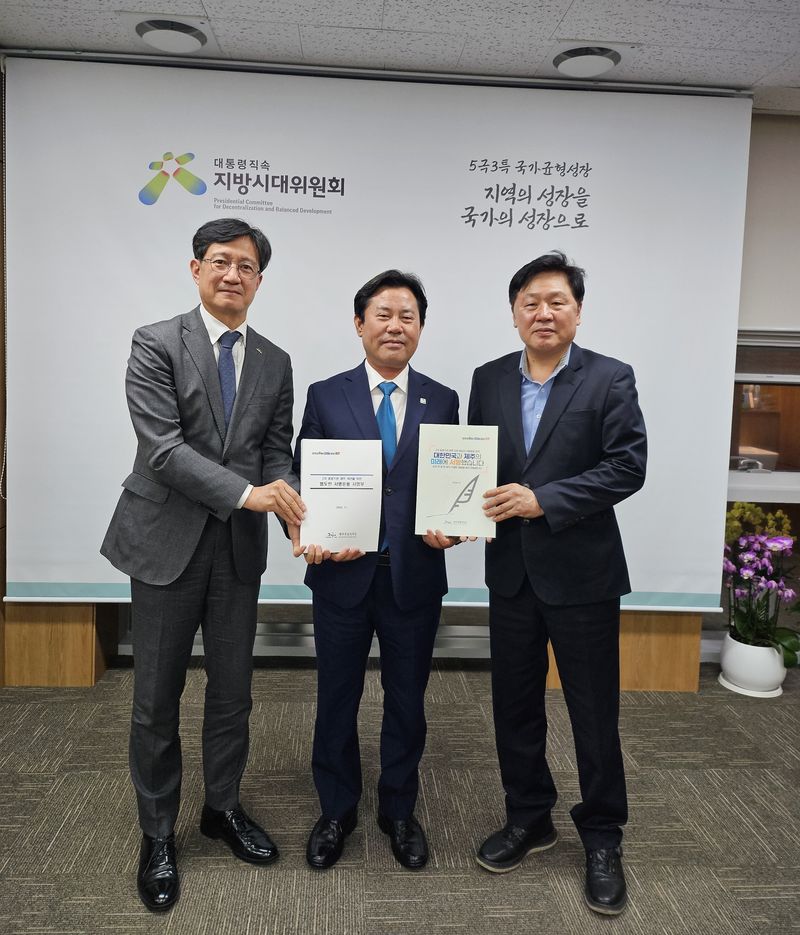
【Financial News Jeju = Jeong Yong-bok】 Ahead of the government’s finalization of its plan for the second round of public institution relocations to provincial areas, Jeju Province delivered to the Presidential Committee for the Era of Local Autonomy a petition signed by 88,982 residents calling for the institutions to be brought to Jeju. It also requested institutional and financial support for the government’s new balanced-growth strategy, along with the relocation to Jeju of the Korea Racing Authority, Korea Airports Corporation and Korea Institute of Energy Technology Evaluation and Planning.
According to Jeju Special Self-Governing Province on the 11th, Lee Chang-heum, Jeju Province’s vice governor for climate and economy, met with Park Jung-hyun, chair of the Presidential Committee for the Era of Local Autonomy, on the afternoon of the 10th and called for government support on key issues, including public institution relocation, fostering new regional growth engines and operating the Future Fund. Kim Dong-man, chair of Jeju Province’s Committee for the Era of Local Autonomy, also attended the meeting.
The petition delivered by the vice governor had a total of 88,982 participants from August 21 to November 8: 72,411 online and 17,471 in person.
Jeju Province emphasized that, during the first round of public institution relocations to provincial areas, the number of institutions and workers relocated to Jeju was small compared with other innovation cities, limiting the impact on the regional economy.
In particular, it raised the issue that the impact of public institution relocation had weakened after the Overseas Koreans Foundation, which moved to Jeju Innovation City in Seogwipo City in 2018, was dissolved in 2023 during the establishment of the Overseas Koreans Agency.
In a report released last April, titled “Performance and Implications of the First Public Institution Relocation Program to Provincial Areas,” the National Assembly Budget Office also noted that the successor organization to the Overseas Koreans Foundation carried out its work in Seoul, and highlighted the need to improve follow-up management of public institution relocations to provincial areas.
Jeju Province named the Korea Racing Authority, Korea Airports Corporation and Korea Institute of Energy Technology Evaluation and Planning as priority targets for relocation. The plan is to strengthen Jeju Innovation City’s role by linking the island’s industrial base—including its horse industry, air transport and renewable energy demonstrations—with the work of each institution.
When the government announced its direction for the second round of public institution relocations to provincial areas last September, it set out principles including minimizing the number of institutions remaining in the Seoul metropolitan area, prioritizing existing innovation cities and linking regional universities with industries.
The government is gathering views from relevant institutions and stakeholders with the aim of finalizing the relocation plan in the fourth quarter of this year, and plans to begin initial relocations in 2027. The institutions and regions selected for relocation will be determined following reviews by the relevant ministries and deliberation and approval by the Presidential Committee for the Era of Local Autonomy.
At the meeting that day, Jeju Province also conveyed its position that Jeju’s development priorities should be adequately reflected in the government’s “Five Mega-Regions and Three Special Self-Governing Provinces Strategy” for balanced national growth. The strategy is a policy to foster growth industries in each region, centered on five mega-regions and three special self-governing provinces, including Jeju, Gangwon and Jeonbuk.
The three growth engines proposed by Jeju are a renewable energy convergence system, a small satellite system, and clean bio and wellness. Jeju Province called for these industries to be included in national statutory plans and for improvements to national funding support and the special subsidy system.
Jeju Province also called for stable fiscal management and local government autonomy to be guaranteed in the Future Fund the government is seeking to establish.
The government is pursuing the creation of the Future Fund in its 2027 budget proposal, using additional tax revenue and other sources. However, local governments have raised concerns that the funds allocated to local allocation tax could shrink as the fund’s resources are secured.
Jeju Province conveyed concerns about a reduction in local allocation tax resources and the possibility of increased local government contributions to projects funded by the national government, and asked that local governments’ views be reflected in the design and operation of the fund.
Vice Governor Lee Chang-heum said, “This petition reflects the residents’ aspiration to open up new opportunities for the region through the relocation of public institutions to Jeju,” and added, “We will work to ensure the residents’ wishes are reflected in government policy and prepare for a growth strategy that builds on Jeju’s strengths to deliver tangible results.”
[email protected] Jeong Yong-bok Reporter