Former superintendents of education also call for preserving the link to domestic tax revenue as opposition to grant reform spreads
- Input
- 2026-11-11 14:21:06
- Updated
- 2026-11-11 14:21:06
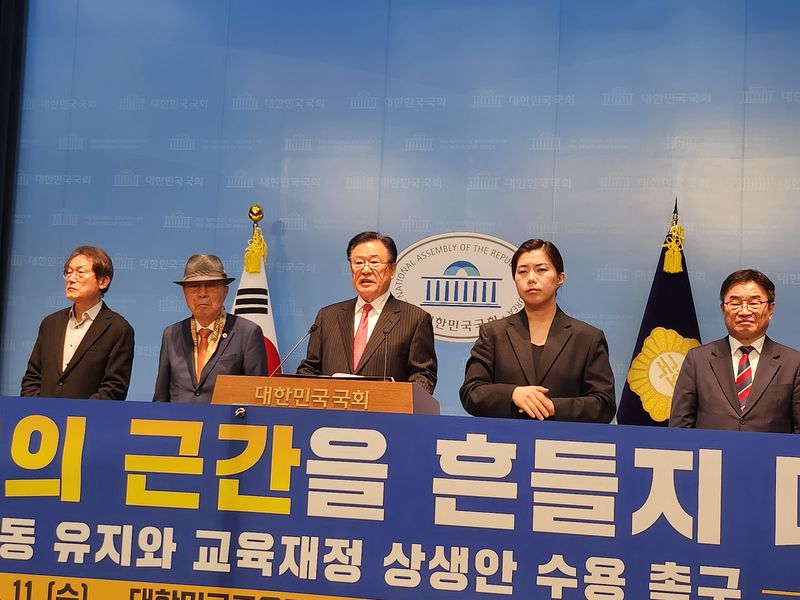
Four people, including former Seoul superintendents Kwak No-hyun and Cho Hee-yeon, former Gyeongsangnam-do Superintendent of Education Go Yeong-jin, and former Gyeonggi-do Superintendent of Education Cho Seong-yun, held a press conference at the National Assembly Communication Center in Yeouido, Seoul, on the 11th and issued a joint statement opposing the government’s overhaul of the grant system. Sixteen people, including former Gyeonggi-do Superintendent of Education Im Tae-hee, former Ulsan superintendents Kim Seok-gi and Cheon Chang-su, and former Gwangju Superintendent of Education Lee Jung-sun, also signed the statement. Geun-sik Chung, chair of the Korean Council of Superintendents of Education, and Kwon Sun-gi, chair of the Special Committee of Superintendents on Local Education Finance, were also present.
In their statement, the former superintendents said, “The domestic tax revenue linkage system, introduced in 1972, is not simply a way of allocating budgets but a promise that the nation will guarantee equal educational opportunities for every child,” expressing concern about efforts to abolish the system. They argued that changing a system linking grants to domestic tax revenue that has been in place for 55 years could undermine the stability of education finance.
They estimated that if the government’s proposal takes effect, grants in 2027 would be about 31 trillion won lower than the amount calculated under the current system. They also projected a funding shortfall of about 7.4 trillion won during the preparation of 2027 budgets by the 16 city and provincial offices of education nationwide. They expected that most of next year’s increase in grants, about 2.5 trillion won, would go toward essential expenses such as higher personnel costs for education staff. As a result, they warned, less funding could be available for other projects, including school facility upgrades and education welfare.
■ Call for acceptance of current superintendents’ council’s win-win proposal
The alternative proposed by the former superintendents is the win-win education finance proposal previously announced by the Korean Council of Superintendents of Education. It would maintain the current rate of 20.79% of domestic tax revenue linked to grants. If grants increase by more than 5% from the previous year, two-thirds of the increase above that threshold would be used for national future investment; if they fall by more than 5%, the government would make up one-third of the decrease beyond that threshold.
The former superintendents explained, “The idea is to share when grants increase substantially and take responsibility together when they fall sharply,” calling it “a reasonable alternative that can secure funding for the nation’s future investments while also protecting the stability of education finance.”
They also called for a legal guarantee of about 11.7 trillion won in grant settlements estimated to result from increased tax revenue in 2026. The aim is to ensure that funds meant for education finance are not reduced or omitted during the system overhaul. They also called for the National Assembly to deliberate fully and ensure that the views of people in the education sector are meaningfully reflected.
■ Education finance should not be cut solely because student numbers are falling
The former superintendents also said that declining student numbers alone should not be the basis for deciding to cut education finance. In materials outlining anticipated questions and answers, representatives of the superintendents explained that while student numbers had fallen 17% compared with 2015, the number of classes had decreased by just 0.5%. They also cited the fact that 90% of education office expenditures are fixed costs unrelated to student numbers.
Representatives of the superintendents estimated that if the government’s proposal takes effect, grants would fall by 114.9 trillion won over four years compared with the current system. Under the win-win proposal, the decrease over the same period would be 44.5 trillion won. Under the plan, these funds would be legally contributed to the Future Response Fund. However, representatives of the superintendents called for the law to specify how the fund can be used so that it can also support elementary and secondary education.
The former superintendents urged the government and National Assembly to maintain the link to domestic tax revenue and accept the win-win education finance proposal, saying, “What we are trying to protect is not a particular fiscal system, but the public’s belief that every child can learn without discrimination, no matter where they are born.”
[email protected] Kim Man-gi Reporter