Corporate demand for security hires falls 18% in three years...Expanded security disclosures must lead to real investment [Minus Day, Security Has Become a Matter of Survival 3]
- Input
- 2026-11-11 17:17:20
- Updated
- 2026-11-11 17:17:20

[Financial News] Hacking techniques are growing more sophisticated by the day, but corporate demand for security personnel and the share of investment devoted to information security have both declined. With mandatory information security disclosures set to expand next year to all companies listed on KOSPI and KOSDAQ, observers say companies should use the change as an opportunity to increase security investment and go beyond simply disclosing information to build real defensive capabilities.
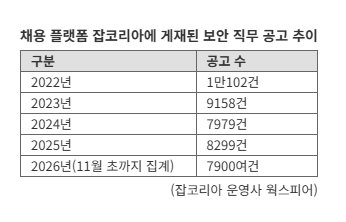
On the 11th, Financial News commissioned workphere, the operator of the recruitment platform JOBKOREA, to tally job postings for “security” positions listed on JOBKOREA from 2022 through this year. The number of postings fell 18%, from 10,102 in 2022 to 8,299 last year. The cumulative total for this year stood at around 7,900 as of early November, and more postings are expected by year-end.■ Security personnel demand has declined over three years; entry-level hiring has halvedThis is thought to reflect a broader slump in the information technology (IT) hiring market, as well as changes in how companies manage security personnel. Recently, amid growing cyberattack threats, the DevSecOps methodology—which integrates security throughout software development and operations—has been gaining ground. A small number of experienced workers are taking on a broad range of security duties from development through operations, while the influx of large numbers of new workers appears to be dwindling.
In fact, postings for entry-level security positions declined from 552 in 2022 to 403 in 2023, 327 in 2024 and 252 in 2025. Meanwhile, experienced-hire postings rose as a share of all job postings, from 92% in 2022 to 96% last year.
For medium-sized and small businesses, outsourcing work to external specialist firms rather than hiring security personnel directly is also cited as a reason for the decline in hiring. The explanation is that even when demand for security work increases, it does not necessarily lead to direct hiring. However, this tally is an indicator of companies’ hiring demand and may differ from actual hiring figures.■ “Expanded disclosures next year should be an opportunity to strengthen security capabilities”Companies’ investment in information security is also declining, in addition to demand for security personnel. According to the Korea Internet & Security Agency (KISA), 826 companies disclosed information security information this year, 53 more than the 773 reported the previous year. However, information security investment as a share of the disclosing companies’ total information technology (IT) investment fell by 0.13 percentage points, from 6.28% last year to 6.15% this year.
Starting January 1 next year, the requirement to disclose information security information will expand from listed companies with revenue of at least KRW 300 billion to all companies listed on KOSPI and KOSDAQ. Companies required to obtain Information Security Management System (ISMS) certification, as well as financial companies and public institutions that were previously exempt from disclosure, will also be included. Observers say that making security investment levels visible to the public could prompt companies to pay more attention to expanding information security budgets and hiring specialist personnel.
However, observers say companies need systems that enable them to manage investment and personnel effectively if expanded disclosure requirements are to lead to stronger security capabilities in practice. Even if companies adopt security solutions or hire specialists, their real defensive effectiveness may be limited unless they properly assess vulnerabilities, apply patches and respond to security incidents.
A cybersecurity industry expert said, “In addition to securing investment and personnel, companies need to accurately identify their key IT assets and proactively discover and address risks through continuous vulnerability assessments and simulated exercises.” The expert added, “They should make basic security practices—such as security updates and patches, access-rights management and data backups—part of routine work, and establish systems that enable them to respond and recover quickly when a security incident occurs.”
The expert went on to stress, “It is also important to clarify security-related decision-making and accountability, with senior management and the chief information security officer (CISO) at the center.” The expert added, “Companies should use disclosures not merely to fulfill an obligation, but as an opportunity to review their security systems and improve their real-world response capabilities.”
[email protected] Choi Hye-rim Reporter