Four years of achievements by university basic research institutes to be shared
- Input
- 2026-11-11 14:04:15
- Updated
- 2026-11-11 14:04:15
[Financial News] Around 600 researchers and other stakeholders affiliated with university basic research institutes at 24 universities nationwide will gather to share research achievements from the past four years and discuss how to foster early-career researchers.
The Ministry of Education announced on the 11th that it will hold the Third University Basic Research Institute Support (G-LAMP) Project Festival at the Enford Hotel in Cheongju, North Chungcheong Province, from the 12th to the 13th.
Lee Hyun-sik, a professor at Kyungpook National University (KNU) and chair of the consortium of participating project groups (universities), said, "As the G-LAMP project enters its fourth year, the enthusiasm of early-career researchers is producing tangible basic research results." He added, "I hope this event will go beyond simply sharing achievements and become a forum for exchange where universities break down their boundaries and work together toward the future of basic science."
The event was organized to share research achievements from the past four years of the project, which has been carried out with the consortium of participating project groups at its center, and to strengthen research management capabilities in basic science through exchanges among the project groups.
On the first day, the program will begin with the presentation of five Minister of Education commendations for distinguished contributions and 17 Young Star Awards, including Minister of Education Awards. Four Young Star Award recipients will then present their outstanding achievements. The program will also include presentations of achievements by each project group, introductions to newly launched project groups, and presentations of research results in poster form by graduate students and postdoctoral researchers.
Tailored support booths will also be set up at the venue to help researchers plan their career paths and make use of research infrastructure. These will include a booth run by the Korea Institute of Human Resources Development in Science and Technology (KIRD) offering self-assessments of career types and consultations on job application documents, a research equipment support booth operated by the National Research Facilities & Equipment Center (NFEC), and a consultation booth run by the National Research Foundation of Korea.
On the second day, programs for early-career researchers—including the KIRD Career Talk Concert, roundtables and group mentoring—will feature working researchers from fields such as academia, government-funded research institutes, private companies and policy planning. They will offer participants opportunities to share field experience with senior researchers, and explore future career paths.
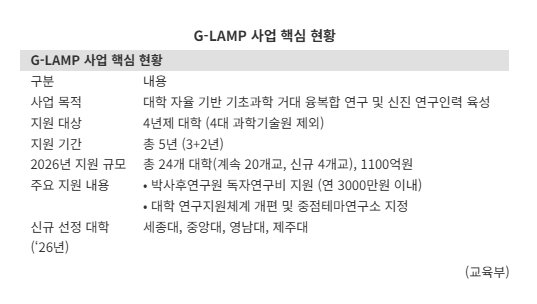
The G-LAMP project is an initiative launched by the Ministry of Education in 2023 to enable early-career researchers to focus on research in a stable environment and give researchers in the field access to diverse research opportunities, while respecting universities’ autonomy. The support period is five years in total (3+2 years). This year, the ministry will provide a total of 110 billion won to 24 universities: 20 receiving continued support and four receiving new support. In particular, the project is building a research ecosystem in which researchers can develop their capabilities and advance their careers through independent research funding for postdoctoral researchers, among other forms of support.
Lee Hae-suk, head of the Ministry of Education’s Higher and Lifelong Education Policy Office, said, "The G-LAMP project has helped strengthen universities’ research capabilities in basic science and enabled many early-career researchers to emerge." She added, "The Ministry of Education will continue to support efforts to build a research ecosystem in basic science and secure future growth engines, while respecting universities’ autonomy."
[email protected] Kim Man-gi Reporter