“I Should Have Borrowed to Buy a Home Back Then”: Choi Kyoung-hwan Blasts ‘Crazy Regulations’ at Opposition Real Estate Forum
- Input
- 2026-11-11 14:54:46
- Updated
- 2026-11-11 14:54:46
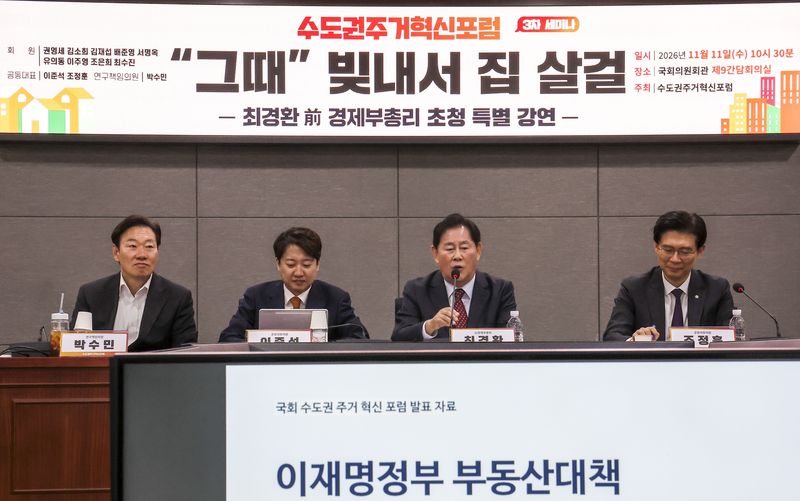
[Financial News] The broader opposition camp joined former Deputy Prime Minister for Economic Affairs Choi Kyoung-hwan, who designed real estate policy as the economic chief under the Park Geun-hye administration, in mounting a fierce attack on the Lee Jae Myung administration’s real estate policies. Choi is the figure behind “Choinomics,” which called on people to “borrow money to buy a house” while radically easing restrictions on real estate loans. He proposed easing lending restrictions to boost transactions in existing homes rather than focus on new housing supply. The opposition also proposed cooperation to ruling-party lawmakers from the capital region, targeting disagreements between the ruling party and the presidential office over the comprehensive real estate holding tax (CREHT).
The Capital Region Housing Innovation Forum, a research group of lawmakers affiliated with the People Power Party and the Reform Party, held a seminar at the National Assembly Members’ Office Building on the 11th under the title “I Should Have Borrowed to Buy a Home Back Then.” Choi was a speaker. As deputy prime minister for economic affairs in 2014, during the Park Geun-hye administration, he eased the loan-to-value (LTV) and debt-to-income (DTI) ratios. The policy line at the time—“borrow money to buy a house”—was a defining catchphrase of “Choinomics.”
Choi gave a special lecture on “Why Is the Lee Jae Myung Administration’s Real Estate Policy Failing?” He strongly criticized the administration’s tighter lending restrictions, calling them “crazy loan regulations that no one who understands economics could impose.” His argument was that blocking transactions in existing homes would undermine the point of new housing supply, which takes 10–15 years or more to deliver.
Choi argued that lending restrictions should be eased dramatically. He said the absolute cap on mortgage loans should be abolished and the LTV for genuine homebuyers raised to 70–80%. He also called for scrapping the proposed real estate tax overhaul, including the phased abolition of the long-term holding special deduction (LTSD), and urged the government to substantially revoke land transaction permit-zone designations made under measures such as the October 15 Real Estate Measures. On housing supply, he proposed that it be led by the private sector rather than the public sector.
With real estate expected to become a key issue in the next general election, the opposition appears set to step up its offensive. Forum co-chair and People Power Party lawmaker Cho Jung-hun criticized the government and ruling party’s real estate policy as “all over the place.” Fellow co-chair and Reform Party lawmaker Lee Jun-seok said, “The president, too, must have dealt with jeonse and loans at some point in his life and enjoyed all the benefits available,” adding, “It is too cruel to block the next generation from following us up the ladder.”
Meanwhile, calls are also emerging within the Democratic Party, particularly among its lawmakers from the capital region, to ease the comprehensive real estate holding tax burden on owners of a single home who do not live in it. Lawmaker Park Soo-min, the forum’s lead research member, said, “With the failure on real estate clear, I am calling for a public test of where the Democratic Party stands and what it intends to do.” The People Power Party and the Reform Party also urged anyone opposed to the government’s real estate policy direction to join them at any time.
[email protected] Lee Hae-ram Reporter