“They charge whatever they want, yet people line up to eat it” ... The ‘gold-priced’ Japanese amberjack craze as it comes into season
- Input
- 2026-11-12 08:32:08
- Updated
- 2026-11-12 08:32:08
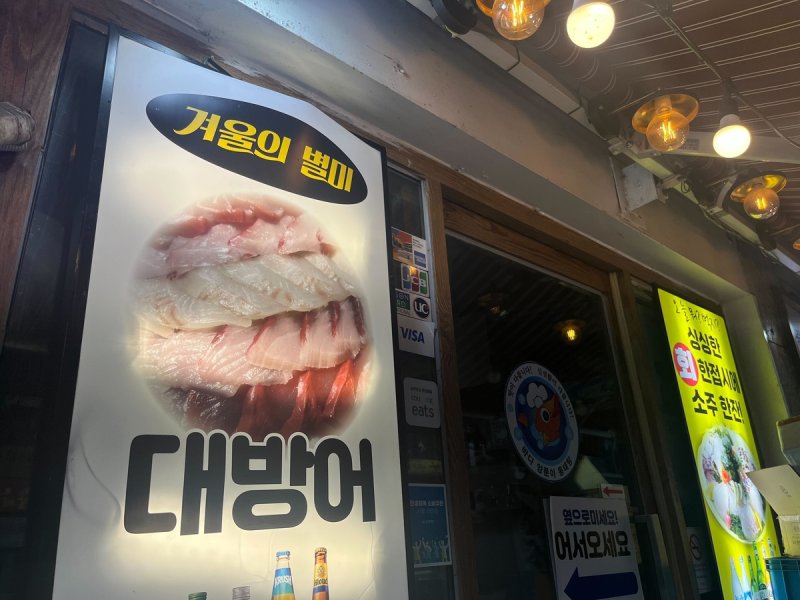
[Financial News] Japanese amberjack has become a signature winter sashimi fish, but its prices are alarming again this year. After soaring last year, wholesale prices have climbed more than 20% this year amid supply uncertainty, reviving the so-called gold-priced Japanese amberjack crisis. Yet despite the sharply higher prices, enthusiasm for sharing recommendations for Japanese amberjack restaurants is spreading, particularly on social media, and the fish remains popular.
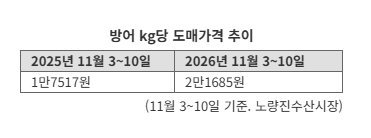
According to Noryangjin Fisheries Wholesale Market, the average auction price for Japanese amberjack per kilogram from the 3rd to the 10th of this month was 21,685 won, up 4,168 won (23.8%) from 17,517 won in the same period last year. Its price has risen even higher than last winter, when it had already soared once, leaving consumers with little choice but to pay a premium to enjoy Japanese amberjack again this winter. Since retail prices at Japanese restaurants and sushi restaurants typically run 1.5 to 2 times the wholesale price, the increase consumers feel is bound to be much greater.
The sharp rise in Japanese amberjack prices stems from supply-demand imbalances caused by the prolonged heat wave and unusually warm waters this summer. According to the Korea Meteorological Administration (KMA), the average sea-surface temperature in Korean waters from July to September this year was 26.95°C, 1.49°C higher than the average of 25.46°C. This was the second-highest temperature recorded since satellite observations began, following last year’s record high of 27.75°C.
As climate change has warmed the waters around the Korean Peninsula, catches of wild Japanese amberjack have become far more variable. The warm-water species, which lives at depths of around 200 meters and used to migrate around Jeju Island and the southern coast, has moved north as far as Gangwon Province and the offshore waters of the East Sea as temperatures have risen. As its main fishing grounds shifted and conditions at sea changed rapidly, domestic catches also became erratic.
Damage to the aquaculture industry has compounded the problem, worsening the supply shortage. This summer, high-water-temperature and red-tide advisories were repeatedly issued along the southern coast, including South Gyeongsang Province, and large numbers of farmed fish died shortly before they were due to be shipped. With farmed supplies that should have made up for poor wild catches also plunging, the impact on the entire domestic Japanese amberjack supply chain became unavoidable. As a result, imports from Japan surged to make up for the domestic shortfall. From January to September this year, cumulative imports of Japanese amberjack from Japan totaled $33.38 million, up $10.29 million (44.6%) from $23.09 million in the same period last year.
Despite soaring prices, more consumers are seeking out Japanese amberjack. With the peak season getting underway, social media is filling with posts sharing well-known sushi restaurants around the country. Instagram has seen a string of posts listing Japanese amberjack spots by area, including Seoul and Busan. There are now about 356,000 posts tagged “#JapaneseAmberjack” and about 282,000 related posts tagged “#AmberjackSashimi.”
Industry insiders say the fish’s distinctive rich flavor and the varied textures of its different cuts have captured the gourmet appetites of people in their 20s and 30s. Japanese amberjack grows fattier in winter, when its characteristic rich, tender flavor is at its best. Its cuts—from the belly and back to the navel—each have a different texture, making it especially enjoyable to compare them, as with tuna.
An industry official assessed, “The rarity of being able to enjoy it only in season, along with the pleasure of savoring the varied flavors of its different cuts, has struck a chord with young consumers who value new culinary experiences.” The official added, “Although climateflation has driven up the price of the fish considerably, demand for Japanese amberjack as a winter delicacy is unlikely to ease much this winter.”
[email protected] Park Kyung-ho Reporter