“You Can’t Survive on PCs Alone” ... Global Hardware Companies Scale Up AI Server Businesses
- Input
- 2026-11-15 13:06:37
- Updated
- 2026-11-15 13:06:37
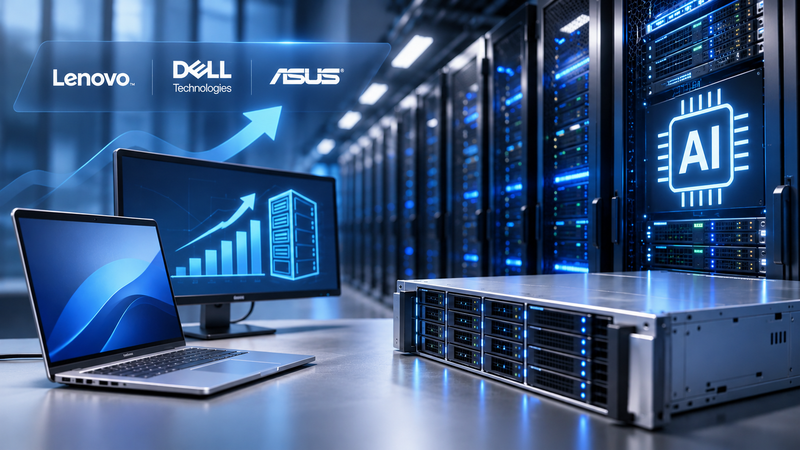
[Financial News] Companies that have traditionally made PCs and peripherals are making AI infrastructure a key growth driver. As corporate investment in AI infrastructure rises rapidly while the consumer PC market slows, they are connecting their existing hardware design and manufacturing capabilities to their enterprise businesses. The move is seen as an effort to diversify revenue streams by adding server and AI deployment capabilities to businesses built around PCs.■Expanding businesses through AI infrastructure investment as the PC market slowsAccording to industry sources on the 15th, companies such as Lenovo, Dell Technologies and ASUS are making servers and enterprise systems needed for AI computing a growth area. While the PC market is weak, investment in AI infrastructure is on the rise.
Global market research firm Gartner reported that worldwide PC shipments totaled 55.4 million units in the third quarter of 2026, down 22.4% from a year earlier. The decline in demand is attributed to rising memory and storage prices being passed on to PC prices. By contrast, Gartner forecast that global AI-related spending would rise 49.5% from the previous year to $2.67 trillion this year, with spending on AI infrastructure reaching $1.484 trillion.
Lenovo is pursuing a “Hybrid AI” strategy that combines PCs and smart devices with servers, storage and AI services. AI-related revenue in the first quarter of fiscal 2026 was $9.3 billion, accounting for 35% of total revenue. That figure includes not only AI servers but also PCs and smartphones with AI features, as well as AI services. Revenue for its Infrastructure Solutions Group (ISG) rose 98% year over year to $8.5 billion, while its AI server order pipeline grew to $54 billion.
Dell is combining AI systems and operational solutions with its existing enterprise server and data center business. Revenue from AI-optimized servers in the second quarter of fiscal 2027 was $16.4 billion, up 100% from a year earlier. AI server orders totaled $60.9 billion in the same quarter, and the order backlog stood at $95 billion at quarter-end. Dell said that, as of October, more than 6,500 companies had adopted its AI Factory, which it offers with NVIDIA.
ASUS is extending the hardware expertise it has built through products such as PCs and motherboards into data center servers and industrial edge equipment. At a second-quarter investor briefing held on August 12, executives said revenue from the server business had doubled year over year and that they had raised its target for annual growth this year to 150%. ASUS also supplies industrial edge equipment used in factory automation, machine vision and video analytics.■From hardware supply to enterprise AI deploymentThese companies are focusing on AI infrastructure because it gives them a way to broaden their enterprise businesses by leveraging their existing capabilities. AI servers require not only high-performance computing hardware but also storage, networking and cooling systems. The hardware and supply-chain experience they have gained by designing and manufacturing PCs and components can be put to use in supplying these systems.
Enterprise AI businesses can expand from equipment deliveries to data center construction, systems integration and operational support. Rather than stopping at the sale of a single PC, companies can broaden the scope of their business and expand their customer touchpoints by participating in the process of adopting AI. They can also diversify their revenue streams to offset volatility in the PC market.
Industry observers expect demand for AI infrastructure to remain strong this year despite rising memory prices. As AI data centers expand and businesses continue to adopt AI, investment in related equipment and systems is expected to continue. However, market growth alone does not guarantee profitability for individual companies, and the view is gaining traction that their ability to turn orders into actual revenue will determine their business performance.
“AI infrastructure can extend beyond supplying a single server to include data center construction, on-site deployment and operational support. The ability to leverage the design, manufacturing and supply-chain capabilities built up in the traditional hardware business is a strength, but the key will be whether companies can turn orders into stable revenue and profits,” an industry source said.
[email protected] Yoon Hong-jip Reporter