“Democrats’ landslide victory in U.S. midterms is no ‘boon’ for South Korea” ... Special seminar at Seoul National University (SNU)
- Input
- 2026-11-11 11:24:14
- Updated
- 2026-11-11 11:24:14
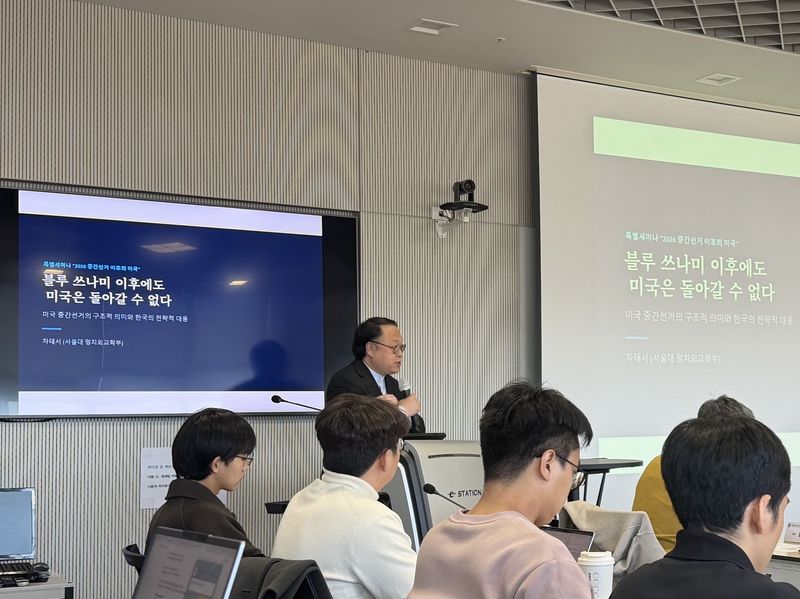
[Financial News] The Democrats won a major victory in the U.S. midterm elections, but one analysis cautioned against interpreting it as the end of Trumpism or a return to the liberal order. The assessment is that President Trump could take a hard-line approach after his election defeat, and that U.S. foreign strategy could also be reshaped around containing China and increasing the burden on allies.
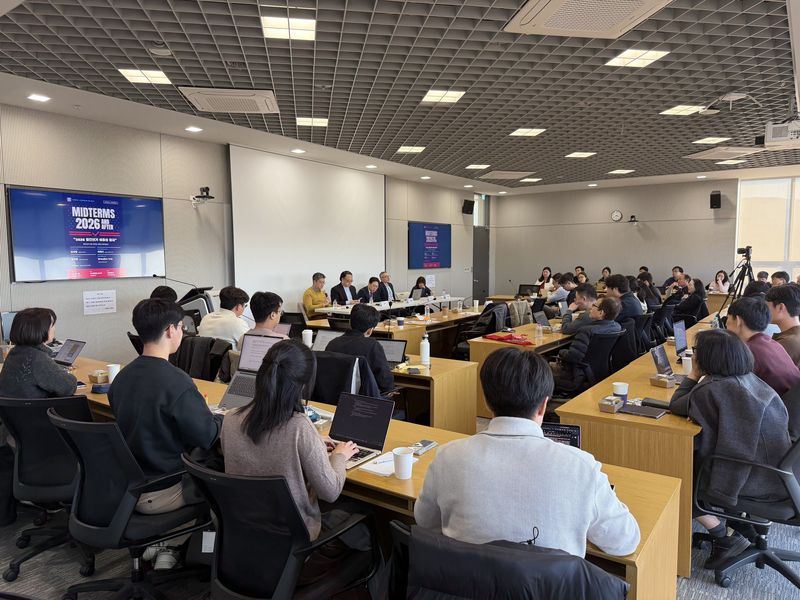
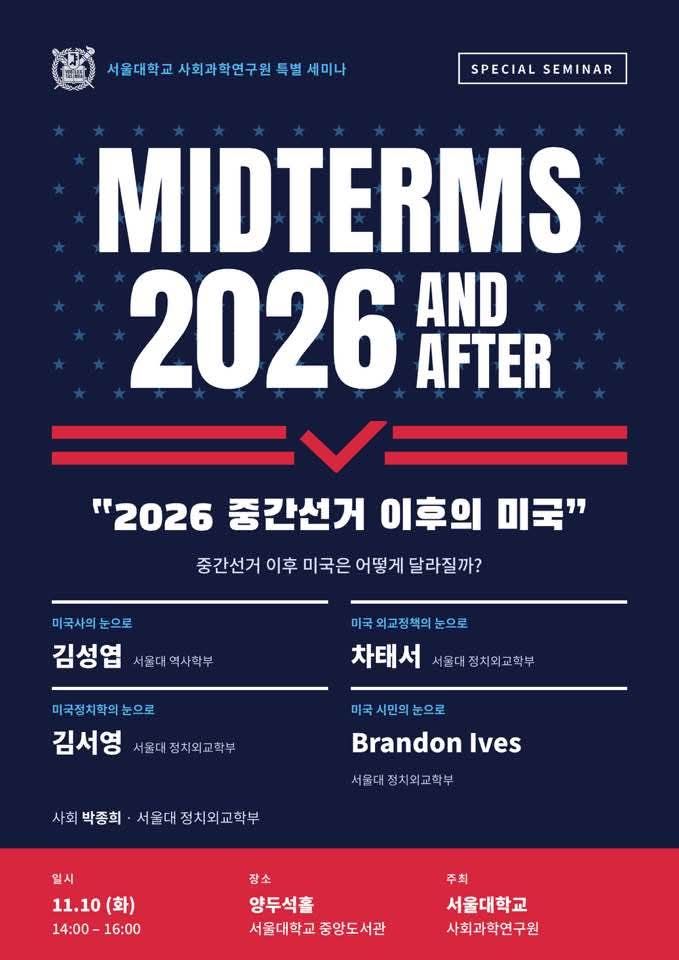
Professor Cha Tae-seo of the Department of Political Science and International Relations at Seoul National University said at the special seminar “America After the 2026 Midterm Elections,” held at Seoul National University’s Wooseok Economy Hall on the 10th, “It is more accurate to view this result as Trump’s defeat than as a Democratic victory.” Tariffs and the war with Iran drove up living and energy costs, straining the finances of ordinary households, which he explained led to the Republicans’ crushing defeat.
“‘Vetocracy 2.0’ ... Trump may become fixated on foreign-policy achievements”
Professor Cha forecast that instability in U.S. domestic politics would continue despite the Democrats’ victory. He said “vetocracy (veto power + democracy) 2.0” could emerge, with the two parties focused on blocking each other’s policies and Congress and the executive branch at an impasse. “When both sides focus on obstructing each other, it is easy to end up deadlocked, with nothing getting done,” he said. “After the election, President Trump may act more like a hard-line ‘angry duck’ than a weakened ‘lame duck.’” The analysis is that the harder it becomes for Trump to achieve results in domestic politics, the more likely he may be to pursue diplomatic achievements to leave a legacy.
Professor Cha also said the election result did not signal a return to the existing liberal order. Pointing to the long-term shifts toward a post-unipolar, multipolar international order and the rise of left- and right-wing populism in the United States, he said, “Trump was defeated, but it is difficult to say that the Trump era is over.” Even under a Democratic administration, he said, trends emphasizing competition with China, protectionism and economic security, and allies’ defense burdens could continue.
“South Korea must deal with both the White House and a Democratic-controlled Congress”
These changes could also place a burden on South Korea. The outlook is that a Democratic victory will not create an international environment favorable to South Korea. Demands raised during the Trump era—including burden-sharing for defense costs, countering China, and increasing investment in the United States—could continue under a future Democratic administration. Professor Cha added that South Korea may instead have to deal with the White House and a Congress controlled by the Democrats at the same time, complicating its diplomatic calculations.
Professor Cha stressed, “As polarization in U.S. politics and policy volatility increase, South Korea should develop a long-term diplomatic and security strategy rather than rely on short-term changes in government.”
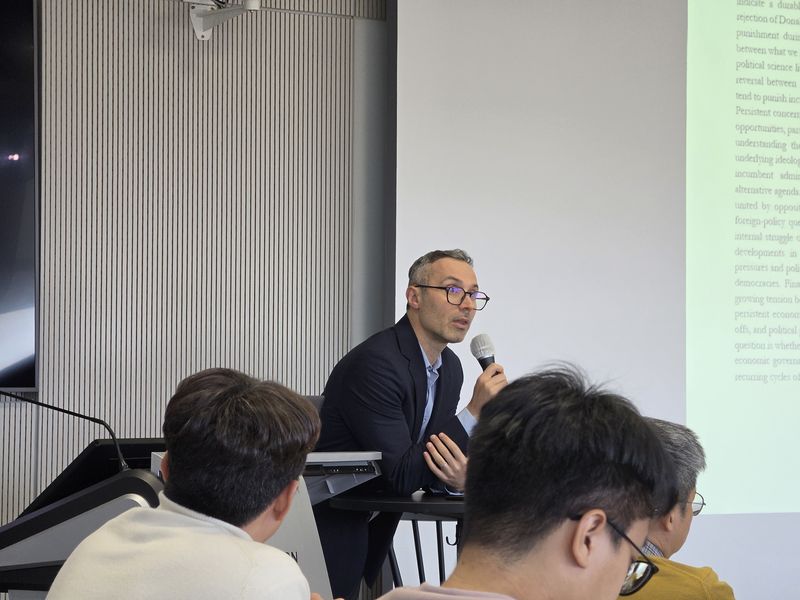
Brandon Ives, a professor in the Department of Diplomacy, also said that divisions within the Democratic Party and political deadlock in the United States could make it difficult to advance policies after the election. Differences over issues such as Israel, transgender policies, and data-center construction could become difficult to resolve through compromise. He said U.S. voters pay little attention to specific security issues involving South Korea, adding that if decision-making in the U.S. government slows, negotiations between the United States and South Korea could also take longer.
“The blue tsunami was driven by ‘turnout,’ not ‘persuasion’”
One analysis attributed the Democrats’ “blue tsunami,” which swept the House and Senate races as well as gubernatorial contests, to a gap in turnout between the two parties’ supporters. Some voters who had cast ballots for President Donald Trump in the 2024 presidential election stayed home, while voters who had supported former Vice President Kamala Harris turned out to vote for Democrats in the midterms.
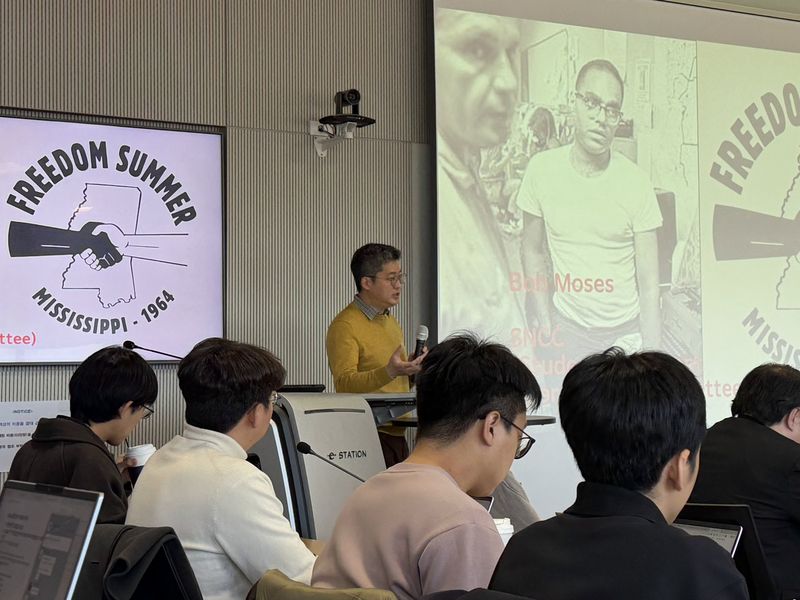
Professor Kim Seong-yeop of SNU’s Department of History pointed to Super PACs as a factor behind the recent intensification of plutocratic politics, in which money sways elections. A Super PAC is a political committee that raises unlimited funds from individuals, businesses, labor unions, and others and spends them on advertisements supporting or opposing particular candidates.
Nevertheless, the Democratic Senate primary in Michigan showed the limits of Super PACs’ big spending in changing voters’ choices. A Super PAC linked to the pro-Israel lobbying group the American Israel Public Affairs Committee (AIPAC) backed Representative Haley Stevens, but the primary was won by candidate Abdul El-Sayed.
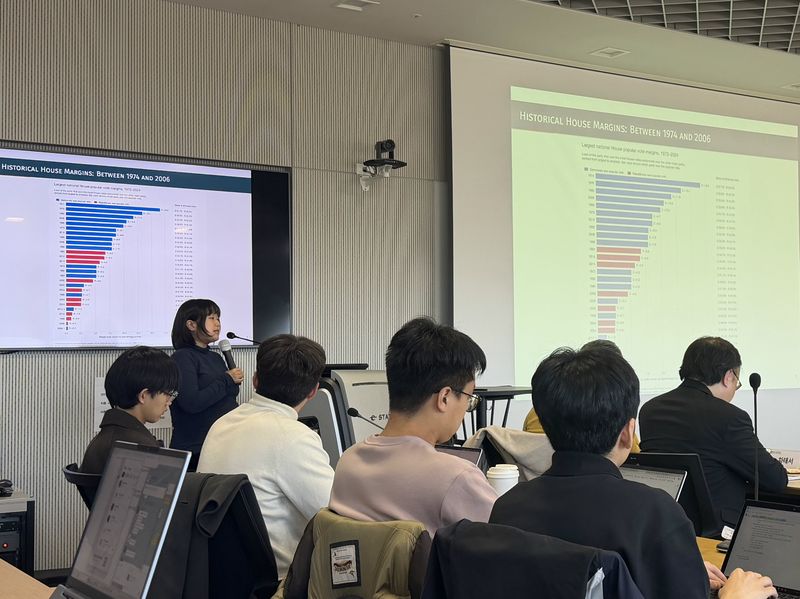
The Democratic wave was not confined to any one region. Professor Kim Seo-young of SNU’s Department of Political Science and International Relations presented a graph comparing the House and Senate results and said, “A very strong trend toward nationalization has emerged.” Nationalization means that voters in multiple regions moved in the same direction despite differences in local candidates and issues. In the Senate races, compared with Trump’s vote share in the 2024 presidential election, voters in many regions shifted toward the Democrats. A similar pattern appeared in the House, across both Republican- and Democratic-leaning districts. Among voter groups, the shift was most pronounced among 18-to-29-year-olds, while Latino men who had leaned Republican in 2024 also moved toward the Democrats this time.
A further analysis, however, found that the Democrats’ landslide resulted from a turnout gap between the two parties’ supporters rather than from persuading Republican voters to change their minds. Voters who had cast ballots for Trump in 2024 generally chose Republicans again if they voted this time, but more people stayed home altogether, leading to the Republican defeat.
“What was different from 2022 was a ‘disaster of the government’s own making’”
An analysis also examined why the midterms this time led to voters punishing the party in power, even though ordinary people faced heavy economic burdens during the 2022 midterms, held four years ago, amid the COVID-19 pandemic and other challenges. Professor Kim Seo-young said, “In 2022, voters accepted the pandemic as something unavoidable, like a natural disaster,” adding, “This time, before they had fully recovered from the pandemic’s impact, the tariff war and the war with Iran added to the burden.” Professor Kim’s analysis was that voters’ anger grew as they came to see this as a disaster the government had brought upon itself.
[email protected] Lee Hwan-joo Reporter