[Exclusive] Even small apartments cost over 1 billion won ... yet the price cap for PF support is 900 million won
- Input
- 2026-11-12 11:19:56
- Updated
- 2026-11-12 11:19:56
According to the National Assembly Land, Infrastructure and Transport Committee’s review report on the Ministry of Land, Infrastructure and Transport’s 2027 budget proposal, obtained by Financial News on the 12th, 330 of the 5,773 apartments offered for sale in Seoul from September 2025 through this October met the criteria of an exclusive-use area of 85 square meters or less and a sale price of 900 million won or less. That was about 5.7% of the total, and all were small units with exclusive-use areas of 59 square meters or less.
The PF interest subsidy for residential facilities is a follow-up program to the government’s plan to accelerate housing supply, announced on August 13. It aims to encourage construction to start earlier by lowering financing costs for private housing projects in Seoul and Gyeonggi Province. A new 169.6 billion won allocation was included in next year’s budget proposal. The program supports up to 500 housing units per project site, covering 1 percentage point of the loan interest rate if construction starts by the end of 2027, or 0.5 percentage points if it starts by the end of 2028. Support is provided for one year during the loan term.
Eligible homes are those at project sites that have received PF loans for residential facilities and meet the requirements of an exclusive-use area of 85 square meters or less and a sale price of 900 million won or less. The program covers not only apartments, row houses, multi-unit houses and multi-household houses, but also quasi-housing such as officetels, dormitories and gosiwon.
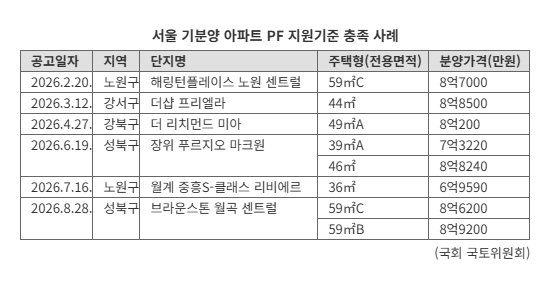
However, recent apartment offerings in Seoul show that even small homes have struggled to meet the price requirement. At “Jangwi Prugio Mark One” in Seongbuk District, the 39- and 46-square-meter units were priced at 732.2 million won and 882.4 million won, respectively, meeting both the size and price criteria. The 51-square-meter unit, however, was priced at 1.0686 billion won, exceeding the cap. The 44-square-meter unit at “Hillstate Isu Station Central” in Dongjak District and the 36-square-meter unit at “Acro River Sky” were also small, but their respective prices of 1.0685 billion won and 1.1637 billion won far exceeded the limit.
Even in Gyeonggi Province’s overheated speculative districts, only 2,738 of the 9,386 apartments offered for sale during the same period met the size and price requirements, or about 29.1%. Given that annual increases in construction and labor costs are added to sale prices, the number of newly supplied homes meeting the support criteria could fall further.
The committee said MOLIT’s decision to apply a single set of criteria to apartments and non-apartment housing across Seoul and Gyeonggi Province failed to reflect price differences by region and housing type. It said this could result in policy funds being concentrated in non-regulated areas of Gyeonggi Province or in villas and officetels. Analysts say high-demand apartments in Seoul are blocked by the price cap, while eligible projects may hesitate to begin construction because of the risk of unsold units.
The committee called for the government to “explore ways to refine the criteria for balanced support, such as applying different support standards by region and housing type,” and urged a review of the detailed implementation plan given that this is a new program.
[email protected] Choi Ga-young, Lee Hae-ram Reporter