Nationwide medical school intake rises by 492, but regular general admissions fall by 21
- Input
- 2026-11-11 10:13:25
- Updated
- 2026-11-11 10:13:25
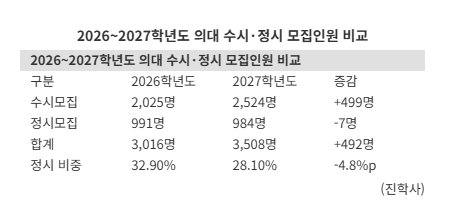
[Financial News] This year, the number of places at medical schools nationwide rose by 492 from last year, but the number of places in the regular general admission track—which is open to applicants regardless of where they live—fell by 21. This means that even though medical schools are admitting more students, applicants seeking admission through the regular track have not gained more opportunities. An analysis by Jinhaksa on the 11th of admissions for the 2027 academic year at 39 medical schools nationwide found that this year’s intake within the enrollment quota totaled 3,508, up 492 from last year. Of these, early admissions accounted for 2,524 places, an increase of 499, while regular admissions accounted for 984, a decrease of seven. In effect, all the additional places were allocated to early admissions. The share of total places filled through regular admissions also fell by 4.8 percentage points, from 32.9% last year to 28.1% this year.
The number of places in the regular general admission track fell from 747 last year to 726 this year, while the existing regional talent track also dropped by 16, from 244 to 228. Combined, the two tracks saw a decrease of 37 places. The regional doctor track, introduced this year, will fill 30 places through regular admissions, bringing the overall decline to just seven. Of the 488 places in the regional doctor track, 458, or 93.9%, were allocated to early admissions. The regional doctor track’s entire regular-admission intake consists of 30 places at three universities: 13 at Chungbuk National University, nine at Chonnam National University (CNU), and eight at Jeju National University.
Woo Yeon-cheol, head of Jinhaksa’s Admissions Strategy Research Institute, said, “The fact that medical school quotas have increased alone should not lead anyone to conclude that opportunities to apply through regular admissions have also expanded.”
By university, the number of places in the regular general admission track fell at seven universities, rose at six, and remained unchanged from last year at 26. Soonchunhyang University had the largest decrease, with its intake falling by 20, from 30 to 10.
By contrast, Dankook University increased its intake by nine, from seven to 16. In the regional talent track, places at Chonnam National University fell from 18 to 10, while those at Jeonbuk National University declined from 28 to 21. Dankook University admitted seven students through the regular regional talent track last year, but will not do so this year.
The final number of places available through regular admissions may change. Woo explained, “Medical schools often set high minimum CSAT score requirements for early admissions. If the CSAT is difficult and more applicants fail to meet those requirements, the number of places that go unfilled through early admissions may also increase.” Places left unfilled when applicants admitted to multiple universities do not register also carry over to regular admissions.
He advised, “Since the actual number of places available through regular admissions may change depending on the difficulty of the CSAT and the results of early-admission waitlist offers, applicants must be sure to check the final intake figures announced after early-admission offers are filled, as well as the eligibility requirements for each admission track.”
[email protected] Kim Man-gi Reporter