“Tightening the reins on pine wilt disease control”... Korea Forest Service to inject 200 billion won in emergency funding
- Input
- 2026-11-11 10:07:16
- Updated
- 2026-11-11 10:07:16
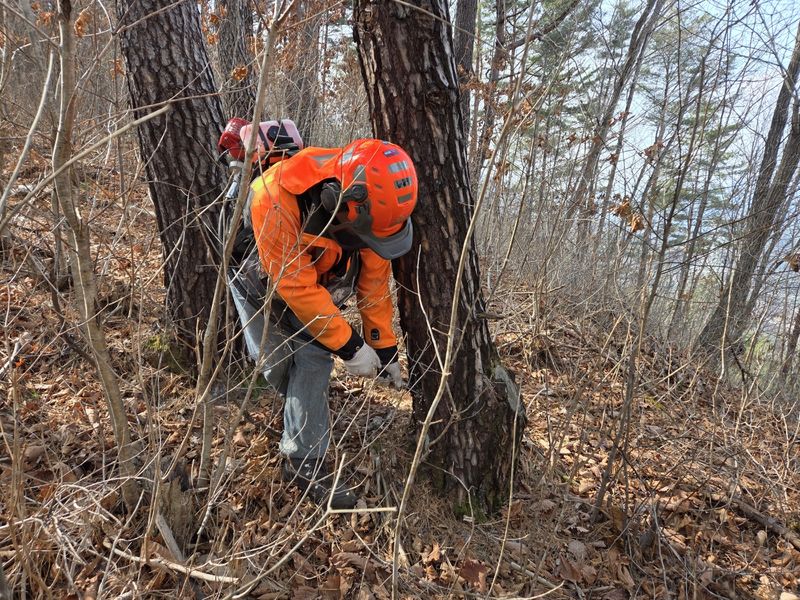
The KFS said on the 11th that it plans to provide additional state funding for control measures as local governments face mounting financial burdens from pine wilt disease and worsening conditions for responding on the ground. The additional funding is intended to address demand for control measures in areas where damage is worsening and to support sites struggling with control work because of local governments’ financial constraints and other factors. Following the injection of 170 billion won in the first half of the year, the KFS plans to expand support to a total of 200 billion won, including 11.5 billion won in September and 14 billion won in November.
Taking local governments’ needs into account, the KFS plans to help ensure that control projects to remove damaged trees and prevent the disease from spreading are carried out on time in the hardest-hit areas. It will also bolster support for areas where damage has risen sharply in recent months to minimize gaps in control efforts across regions.
As temperatures rise, the period when the insect vectors are active grows longer and their range of activity expands, a trend that, alongside climate change, tends to accelerate the spread of pine wilt disease. Control work requires substantial manpower and equipment for surveying infected trees, felling them and disposing of them, and local governments’ financial circumstances can easily lead to differences in their level of response. It has also been pointed out that a consistent national response is important, since delays in controlling the disease in one area can allow it to spread to neighboring areas.
In this regard, alongside state funding, the KFS plans to support local governments with expertise and pest-control personnel, with the National Pine Wilt Disease Control Response Team, launched last September, at the center of those efforts. It also plans to strengthen quality management and performance reviews of control projects.
Lee Won-hee, head of the KFS’s Forest Pest Control Division, said, “With pine wilt disease spreading more rapidly and local governments facing increasingly difficult conditions for controlling it, we plan to secure additional resources at the national level and actively support field operations.” He added, “We will not stop at budgetary support. Centering on the National Control Strategy and the National Pine Wilt Disease Control Response Team, we will focus our efforts on improving the implementation and quality of control projects and preventing the spread of pine wilt disease.”
[email protected] Kim Won-jun Reporter