“A Base Station in the Sky” ... Korean-Made UAV Completes 170 Hours of Continuous Flight
- Input
- 2026-11-11 15:00:00
- Updated
- 2026-11-11 15:00:00
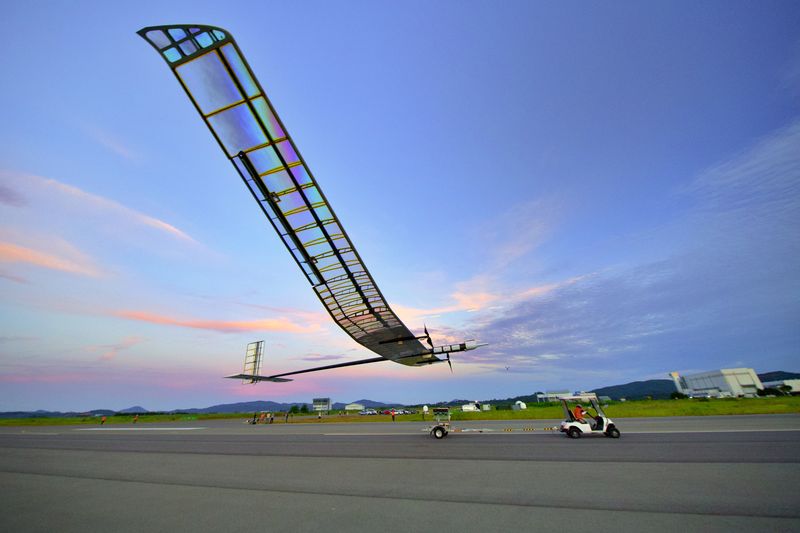
[Financial News] A domestically developed solar-powered UAV has set a new national record for the longest flight, completing 170 hours of continuous flight. That is more than three times as long as the previous record. During the flight, it also carried out missions to detect wildfire ignition points and track the paths of their spread. KASA plans to advance long-endurance flight technology for stratospheric UAVs while also developing hybrid aircraft that can take off and land without a runway.
On the 11th, KASA said the stratospheric solar-powered UAV EAV-4 completed a continuous flight of 170 hours and 5 minutes (7 days, 2 hours and 5 minutes) during a flight test conducted between August 18 and 25. This is more than three times the national record of 53 hours set by EAV-3 in 2020. KASA said the flight ranked second in the world, behind Zephyr, made by Europe’s Airbus SE.
The test verified not only the UAV’s ability to fly for extended periods but also its disaster-monitoring capabilities. Using electro-optical and infrared cameras, EAV-4 demonstrated how it could locate wildfire ignition points within seconds and track and predict the direction of smoke spread and the movement of embers.
A stratospheric solar-powered UAV is an aircraft developed to fly for extended periods using solar energy at an altitude of about 20 kilometers above the ground. It can observe a wider area from a higher altitude than conventional aircraft. Unlike a satellite, it also has the advantage of allowing mission equipment to be replaced and repairs to be made in the event of a malfunction.
It has a range of potential uses. It can monitor disaster areas, such as wildfire zones, for extended periods or serve as an airborne base station in island and mountainous areas with limited communications infrastructure. Because it operates closer to the ground than a satellite, it can also capture clearer images. However, commercialization of stratospheric UAVs is still at an early stage overseas as well.
Changheon Han, director general of KASA’s Aviation Innovation Division, said, “Stratospheric flight is still rarely used internationally, and compared with satellites, it has the advantage of allowing mission equipment to be replaced and repairs to be made in the event of a malfunction.” He added, “It shows promise for commercialization in communications platforms and with Airbus, as well as for military applications.”
KASA plans to build on the results of this flight test to advance long-endurance flight technology for stratospheric solar-powered UAVs. Its future goal is to achieve continuous flights of up to 100 days.
Separately, development of a “hybrid vertical takeoff and landing aircraft” is also planned as part of future air mobility efforts. Like a helicopter, a hybrid vertical takeoff and landing aircraft can take off and land without a runway, while using both an engine and batteries. The goal is for it to carry more passengers and cargo and travel longer distances than electric vertical takeoff and landing aircraft powered solely by batteries.
KASA envisions using the aircraft for emergency logistics in island and mountainous regions, transporting emergency patients, and air taxi services between regions. It plans to pursue the selection of projects for related research and development (R&D) next year, with full-scale development set to begin in 2028.
[email protected] Yeon Ji-an Reporter