“₩37.9 billion wiped out in forced liquidations” ... Why retail investors were blindsided by the market crash
- Input
- 2026-11-11 07:43:40
- Updated
- 2026-11-11 07:43:40
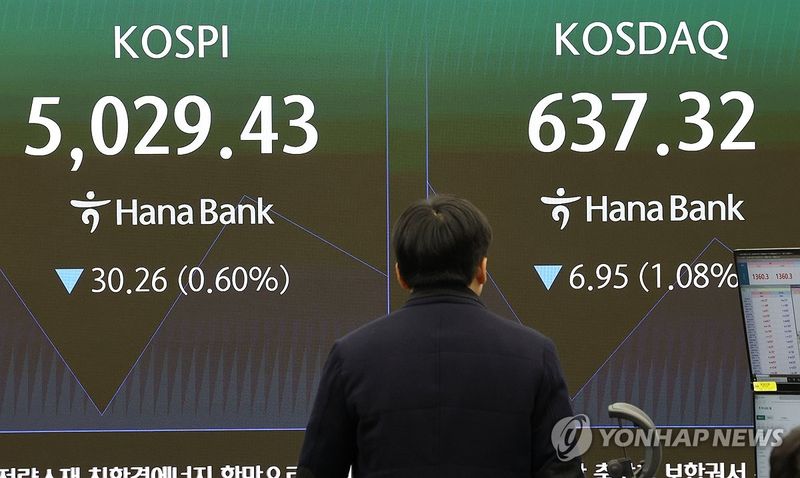
[Financial News] As the domestic stock market continues to decline, stocks forcibly liquidated after investors failed to repay balances owed to brokerage firms have surged again, reaching the 30-billion-won range.
Forced sales of stocks totaled 37.9 billion won on the 9th, five times the previous session’s level
On the 10th, the Korea Financial Investment Association (KOFIA) said that, as of the 9th, unpaid balances from brokerage transactions—amounts individual investors owed brokerage firms after buying stocks through them but had not paid by the settlement date—totaled 1.1051 trillion won, up about 200 billion won from the previous session.
In particular, stocks forcibly sold on the 9th because investors failed to repay these balances by the settlement date (T+2) were worth 37.9 billion won. That was well over five times the 7 billion won recorded in the previous session, the 6th, and the highest level since 54.2 billion won on the 19th of last month. The ratio of forced sales to unpaid balances also stood at 4.2%, more than five times the previous session’s 0.8%.
If investors fail to repay unpaid balances, their stocks are forcibly liquidated as the market opens on the settlement date. The problem was that after the KOSPI plunged 5.28% and 6.02% on the 5th and 6th, respectively, large volumes of stocks were forcibly sold as soon as the market opened on the 9th.
On the 9th, the outstanding balance of margin loans, an indicator of “debt-financed investing” (investing with borrowed money), stood at 28.0705 trillion won, down 315.2 billion won from the previous trading day (28.3856 trillion won). In effect, the balance—which stood at 29.216 trillion won on the 2nd of this month—fell by 1.1455 trillion won in just five trading days.
Given that margin-loan balances rise when share prices climb, the recent increase in market volatility—including three consecutive trading-day declines in the KOSPI—is seen as having dampened investor sentiment.
Financial authorities temporarily waive brokerages’ requirement to maintain collateral ratios of at least 140% on credit extensions
From the 9th through January 31 next year, financial authorities temporarily exempted brokerage firms from the requirement to maintain a collateral ratio of at least 140% on credit extensions. The move is intended to prevent a vicious cycle in which shares are forcibly liquidated when the collateral ratio for margin trading falls below the required level, adding selling pressure that drives prices further down during a sharp market decline.
This refers to forced selling due to insufficient collateral for margin loans, which is distinct from forced selling due to unpaid balances on brokerage transactions. Major brokerage firms have also moved to lower collateral ratios or defer the timing of forced sales.
However, some warn that while easing collateral requirements may reduce immediate pressure from forced selling, if margin-loan balances do not decline sufficiently, a fresh wave of sell orders could emerge if share prices fall again in the future.
Heo Jae-hwan, a researcher at Eugene Investment & Securities, said, “With this measure curbing forced sales, the pace of decline in margin loans is likely to slow,” adding, “Even if there is a short-term rebound, it will be necessary to see an inflow of cash buyers able to absorb the remaining leveraged positions and a moderation in foreign selling.”
Investor deposits, funds waiting on the sidelines of the stock market, also fell by 2.0802 trillion won from the previous trading day to 88.254 trillion won, hitting a four-trading-day low, the lowest since the 3rd.
[email protected] Kim Hee-sun Reporter