Samsung–Hyundai alliance expands to ‘joint design’ of all-solid-state batteries
- Input
- 2026-11-11 07:33:12
- Updated
- 2026-11-11 07:33:12
[Financial News] Battery cooperation between Samsung and Hyundai Motor Group is expanding beyond simple supply contracts to joint design and the development of next-generation technologies. After jointly developing technology to improve the safety and energy density of electric-vehicle battery packs, the two companies are broadening their cooperation on all-solid-state batteries—often called the “dream battery”—from materials research to mass-production processes.
On the 11th, according to KIPRIS, a patent information search service, a patent jointly filed by Hyundai Motor Company and Kia Corporation and Samsung SDI Co., Ltd., titled “Battery Pack and Vehicle Including the Battery Pack,” was published on the 22nd of last month.
The patent’s key feature is an outlet at the bottom of the battery cell for releasing gas, along with a separate passage beneath the battery pack. This approach vents the high-temperature gas produced during thermal runaway to the outside while combining the previously separate spaces for gas discharge and impact protection, thereby increasing energy density.
The design centers on prismatic batteries, Samsung SDI’s flagship product, and lists five researchers from Hyundai Motor Company and Kia Corporation and two from Samsung SDI as inventors. The collaboration is significant because it has expanded beyond battery supply to the joint design of battery packs optimized for vehicles.
Samsung SDI signed its first electric-vehicle battery supply contract with Hyundai Motor Company in 2023. For seven years, from this year through 2032, it will supply prismatic batteries made at its plant in Hungary for electric vehicles sold by Hyundai Motor Company and Kia Corporation in Europe.
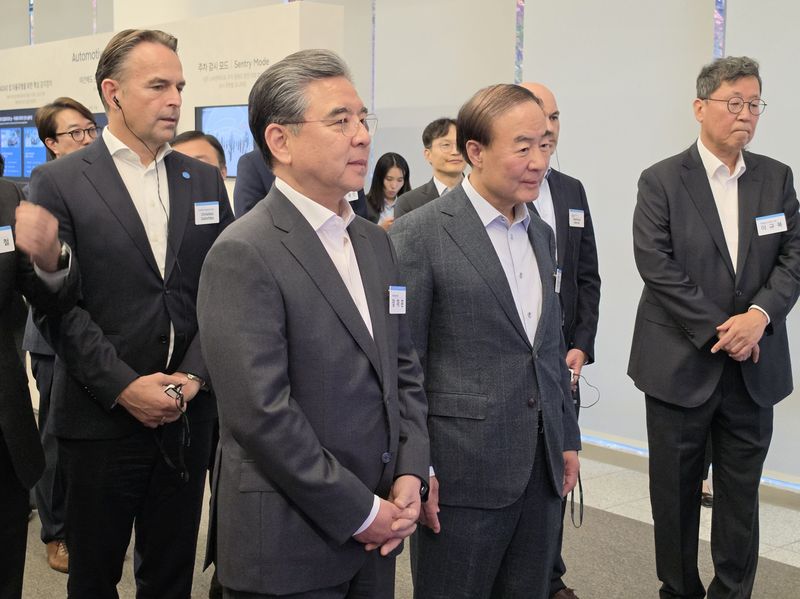
At Samsung’s HMG Appreciation Day on the 9th, Hyundai Motor Group Vice Chairman Chang Jae-hoon said, “Samsung and Hyundai Motor Group are expanding the possibilities for cooperation beyond vehicle components such as automotive electronics, audio and batteries, into future industries such as robotics and energy. We hope to respect each other’s strengths, pool our efforts and take on the challenges ahead together.”
Cooperation is also taking shape in the next-generation all-solid-state battery field. From 2022 through last year, Hyundai Motor Company and Kia Corporation and Samsung SDI jointly filed a total of nine patents related to all-solid-state batteries, including divisional applications. Two of these patents were registered last year.
Initially, the companies focused on coating technology to protect sulfide-based solid electrolytes, which are vulnerable to moisture. Since 2023, however, they have broadened their research to include improving battery life and mass-production processes. In particular, they jointly filed patents for temperature-measurement technology for the high-temperature isostatic pressing (WIP) process required to manufacture all-solid-state batteries, as well as battery-cell preheating and transfer devices.
All-solid-state batteries can improve safety and energy density by replacing conventional liquid electrolytes with solid ones. Their potential applications may expand beyond electric vehicles to include humanoid robots.
Hyundai Motor Group Chairman Euisun Chung said last August, in connection with the company’s electrification strategy, “EVs will continue on their own track, but we are also researching all-solid-state batteries, so once that part comes through, we could move toward greater efficiency.”
The industry is watching to see whether the companies’ joint research leads to actual vehicle applications and the development of mass-production technology. The collaboration, which began with battery supply, is now extending to securing competitiveness in next-generation electrification technologies.
[email protected] Kim Dong-ho Reporter