“If you swallow painkillers thinking it’s stomach cramps...” Overnight, your intestines rot black inside you: ‘intestinal infarction’ [The Body’s Off the Record]
- Input
- 2026-11-10 20:00:00
- Updated
- 2026-11-10 20:00:00
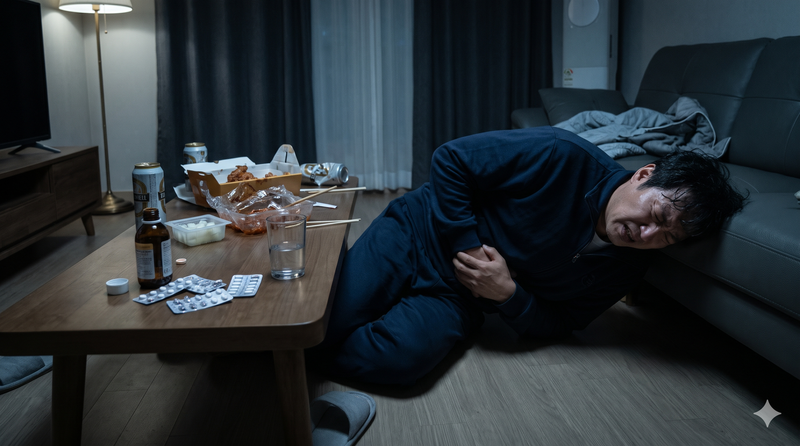
[Financial News] Tuesday night, November 10. A breadwinner in his 40s or 50s, who has started the week with grueling overtime, drags his tired body home late. To ease his stress and sense of emptiness, he forces down his fatigue with spicy, greasy takeout for a late-night meal and a shot of soju. But just before bed, unimaginable, excruciating pain strikes, as if squeezing his entire abdomen from below the breastbone.
Cold sweat pours off him and it is hard even to breathe, but he cannot pass stool when he goes to the bathroom, and all he can do is feel nauseated. Most men in their 40s and 50s make the most terrible, potentially irreversible self-diagnosis of their lives at this point: “I ate something greasy late at night, so I must have really bad indigestion. Or maybe it’s stress-induced stomach cramps.”
He rummages through a drawer and, out of habit, tosses digestive aids, stomach medicine and painkillers into his mouth, then curls up in bed clutching his abdomen. He clings foolishly to the hope that if the medication dulls the pain and lets him fall asleep, he’ll wake up feeling completely better. But this complacent response is an unmistakable act of self-harm, causing his small and large intestines to rot black inside him.
It is not simple indigestion or stomach cramps. The medical name for this excruciating pain is “acute mesenteric ischemia,” commonly known as “intestinal infarction.”
In the heart of a middle-aged man who has long neglected frequent drinking and smoking and high cholesterol, while unknowingly suffering from atrial fibrillation (an arrhythmia), a blood clot forms. The crisis erupts when the clot breaks away, travels through the bloodstream and completely blocks the superior mesenteric artery, the most important blood vessel supplying the stomach, small intestine and large intestine.
From that moment, the organs in the abdomen, deprived of 100% of their blood and oxygen supply, begin to rot at a furious pace. The patient complains of extreme pain, as if his abdomen were being torn apart, but one of the disease’s cruelest features is that there is no clear rebound tenderness (pain that is worse when the pressure is released than when it is applied) when the abdomen is pressed. Since the abdomen does not visibly swell or become hard, patients may mistake it for imagined symptoms or ordinary abdominal pain and try to tough it out with painkillers.
The golden window for acute intestinal infarction is only around six hours. If the patient does not reach an emergency room and have the blocked blood vessel reopened within that time, the intestinal tissue will die completely. The consequences of swallowing digestive aids and painkillers and waiting out the night at home are horrific. Even if the patient is taken by ambulance the next morning and undergoes open abdominal surgery, as much as two meters or more of the small and large intestines, already rotted black, may have to be removed in one piece to prevent death from sepsis.
Patients who have lost at least half their intestines will never again be able to digest food or pass stool normally. Even if they survive, they will have to live for the rest of their lives with an “artificial anus” (a stoma, or fecal collection bag) that collects waste through an opening made in their abdomen.
Breadwinners in their 40s and 50s in South Korea want to appear unfailingly strong in front of their organizations and families, but when it comes to their own health, they are astonishingly ignorant and stingy. The harsh reality of medicine is that a few painkillers swallowed under the assumption that it is just stomach cramps can come back as a fecal bag that utterly destroys their social dignity and pride as breadwinners.
If you are struck late at night, after a late-night meal, by excruciating pain as if your abdomen were being torn apart, don’t swallow painkillers—call 119 immediately. That is the only way to protect a tomorrow without humiliation.
[email protected] Jeon Sang-il Reporter