[Editorial] A minister’s lament after seeing China’s progress: Did the National Assembly hear it?
- Input
- 2026-11-10 18:33:44
- Updated
- 2026-11-10 18:33:44
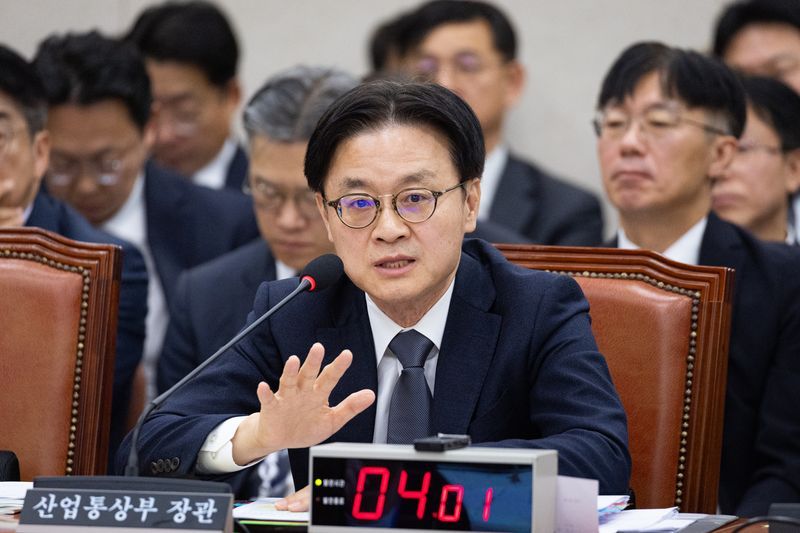
Minister Kim recounted that a Korean businessperson he met there had posed a painful question: “We’re in an economic war right now, and isn’t it the state that wages a war? In China, the whole country steps up to help businesses compete. Are we doing that?” He lamented, “Shouldn’t the government feel even more urgency than businesses?” and “If companies have to wait years to get even one regulation lifted, how far ahead will businesses in competing countries get in the meantime?”
Minister Kim has repeatedly argued, including in National Assembly audits and at the Kwanhun Forum, that labor exemptions such as exceptions to the 52-hour workweek must be included in relevant legislation to ensure the success of “Mega-Zones,” hubs for advanced industries, and secure global competitiveness. In that context, he also referred to China’s “996 work schedule,” an ultra-long-hours, high-intensity work pattern involving starting work at 9 a.m., finishing at 9 p.m., and working six days a week.
Minister Kim faced fierce criticism from progressives and labor groups at the time for his remarks about 996. But his comments should not be interpreted as advocating the adoption of Chinese-style long working hours. Rather, as the minister responsible for industrial policy, he was raising the concern that uniform working-hour regulations could prevent research staff in advanced industries—where global competition is fierce—from working autonomously and with focus.
In advanced technology fields such as semiconductors and AI, the intensity of early-stage research and development (R&D) and the speed of development determine who wins. China is rapidly catching up, backed by financial and administrative support at the national level and a flexible industrial environment. China’s ChangXin Memory Technologies (CXMT) cemented its position as the world’s fourth-largest player as its DRAM revenue in the second quarter of this year grew more than eightfold in a year. In some fields, it has already overtaken South Korea. Chinese battery makers such as CATL surpassed 50% of the electric-vehicle market outside China from January to September this year, while South Korea’s three battery makers fell into the 20% range.
Even so, South Korea remains trapped in an outdated, rigid regulatory structure, with inter-ministerial buck-passing and political infighting sometimes taking years to remove even a single regulation. Making working hours more flexible is not simply a matter of extending work hours; it is one of the institutional tools for securing an overwhelming global technological edge.
The struggle for technological supremacy must not become a lonely battle for individual companies. Major countries, including the United States and China, are deploying every tool at their disposal—tax incentives, subsidies, permits and labor exemptions—to strengthen their domestic companies’ competitiveness. Even so, some in the government and ruling party remain reluctant to improve the system, citing concerns that easing the 52-hour workweek could lead to a decline in overall working conditions. Protecting workers is important, but securing industrial competitiveness is also a task that cannot be compromised.
If the minister responsible for industry is appealing for urgency this strongly, it means warning lights are flashing for the South Korean economy. We must remove blanket labor regulations and outdated labor practices, end inter-ministerial buck-passing, and pass the Mega-Zone Act during this regular session of the National Assembly. Regulatory exemptions in the bill, including labor exemptions for R&D and professionals and streamlined permitting, must create conditions that allow companies to invest and conduct research even a day sooner. It is time to swiftly resolve differences within the government and activate an all-out, national-level support system.