National Education Commission rejects motion to launch mediation process on ‘3 p.m. dismissal’ for lower elementary grades ... concrete rollout put on hold
- Input
- 2026-11-10 18:26:19
- Updated
- 2026-11-10 18:26:19
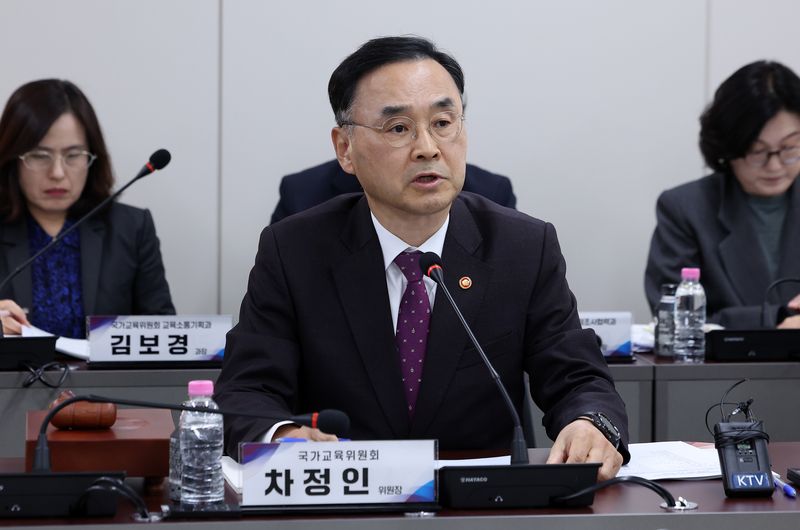
[Financial News] The National Education Commission has decided not to proceed with a formal public-opinion gathering and mediation process on a proposal to move dismissal time for first- and second-graders to 3 p.m. As a result, concrete efforts to advance the policy, including incorporating it into a draft of the mid- to long-term National Education Development Plan scheduled for release at year-end, will be put on hold for the time being.
On the 10th, the National Education Commission held its 12th plenary meeting at Government Complex Seoul and put to a vote a motion to begin a public-opinion gathering and mediation process on the opposition to the “3 p.m. dismissal policy for elementary school students.” The motion was rejected, with 5 votes in favor and 11 against, ending the formal process for gathering public opinion and mediation on the petition.
Before the vote, National Education Commission Chair Cha Jeong-in explained, “We cannot include it in the National Education Development Plan without holding public deliberations,” adding, “This is a decision on whether to proceed now. Whether to hold public deliberations again in the future on care issues for lower-grade students is something to decide when the need becomes concrete.” The decision did not formally withdraw or permanently scrap the 3 p.m. dismissal plan itself; rather, the motion to launch a formal mediation process on the current proposal failed.
The motion originated with an opposing opinion posted on the National Education Commission’s public-opinion platform on Aug. 26. Citing the burden on students from longer class hours and increased teacher workloads, among other reasons, the proposal called for the policy to be withdrawn. As of Nov. 9, it had received 57,385 endorsements, meeting the requirements for the commission to deliberate and vote on it: at least 50,000 endorsements within 90 days.
Before the meeting, the National Education Commission’s Expert Committee on Public-Opinion Gathering and Mediation said that the policy’s direction and key issues had not been clarified. Choi Yeong-tae, co-chair of the expert committee, said, “While we agree that the issue of gaps in care needs to be discussed, it would be reasonable to go through a more thorough preparation process, develop alternatives, and then ask the public if we are to pursue public deliberation.”
Concerns on the ground, as well as issues involving facilities and teacher supply, also affected the vote. The meeting heard research findings that about 10,000 additional teachers would be needed if subject-specialist teachers were assigned the extra classes. It also cited a survey by the Korean Teachers and Education Workers Union (KTU) of 22,768 elementary school teachers, in which 99.1% of respondents opposed introducing the policy. Reasons for opposition included increased teacher workloads and worsening student fatigue and stress.
Committee members also continued to criticize the conditions for implementing the policy and urge caution. Member Jeon Eun-young said, “To implement the 3 p.m. dismissal plan as regular classes, the curriculum and teacher assignment system would need to be reviewed,” adding, “Preparations are still inadequate, so it is too early to hold public deliberations.” Member Lee Bo-mi also criticized the proposal, citing issues such as overcrowded classes and saying it failed to consider the negative effects on children and the difficulties faced by schools.
Others, however, called for continuing the formal mediation process or discussions on alternatives. Member Kim Yong said the process, which can last up to nine months, could be used to develop concrete alternatives, while member Yeon Chwi-hyeon proposed a comprehensive discussion that would also take into account the circumstances of parents who rely on private academies because of gaps in care.
The proposal for 3 p.m. dismissal for lower-grade elementary students was put forward as a way to reduce gaps in care by extending regular class hours. It had previously been proposed by the Presidential Committee on Ageing Society and Population Policy in 2018, but was not adopted. Because public deliberations could not proceed on the current proposal, which is not a finalized policy, developing concrete alternatives remains a challenge, including considering ways to address gaps in care other than extending regular class hours.
[email protected] Kim Man-gi Reporter