Applying Twice, Even Thrice, to Join an Investment Club... Stock Fever Grips Vietnam’s 20- and 30-Somethings
- Input
- 2026-11-10 18:13:31
- Updated
- 2026-11-10 18:13:31

■Vietnam’s stock-market newbies, F0: “We invest by reading financial statements... We favor retail and distribution, energy, and port stocks”
In Vietnam’s financial sector, the term “F0” (pronounced “eff zero”), used collectively for new individual investors, originated in the public health authorities’ infection-control system during the early days of the COVID-19 pandemic. The medical term, which then meant the “first confirmed case” in infection tracing, became an established financial term for new individual investors who, during quarantine, began entering the stock market of their own accord and without prior ties, as banks maintained low interest rates.
Unlike the F0 investors of 2020, who were swept up in the herd mentality and engaged in so-called “blind investing,” Vietnam’s MZ-generation F0 investors have evolved into sophisticated investors armed with thorough data and macroeconomic analysis.
Dương Phương Đan, a third-year student in financial investment at the National Economics University, said, “When I first bought stocks, I didn’t know enough and blindly bought shares recommended by social media communities. I had the painful experience of seeing the stock price move in the exact opposite direction.” She added, “Now I cross-check specialist investment media such as Vietstock and VnEconomy against brokerage research reports, and make investment decisions after intense discussions with senior and junior members of campus clubs.” Minh, a second-year fintech student, said, “Interest rates on savings accounts and time deposits can’t keep up with inflation, so if you just hold on to cash, your assets lose value. I started poring over companies’ business reports and financial statements on their websites.” They identified stocks related to retail and distribution, energy, and ports as promising.
■Vietnam’s market gets a double boost... “It will break through its previous high again next year”
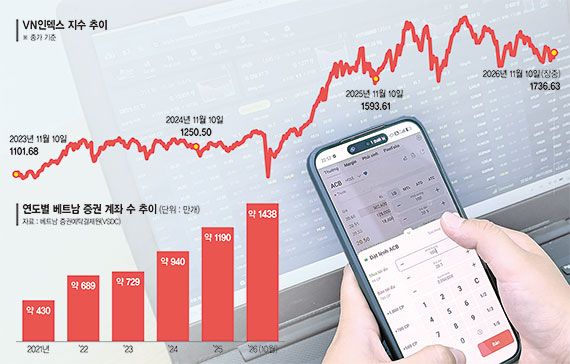
The evolution of these savvy retail investors is closely connected to the course Vietnam’s stock market has taken over the past two years. The VN-Index, the benchmark index for Vietnam’s stock market, rose about 41% over 2025, led by gains in large-cap stocks such as Vingroup. This year, however, net selling by foreign investors and currency volatility combined to push the index into a range-bound correction. The market is now seeing stocks diverge according to corporate earnings and profit growth.
Among individual stocks, Hoa Phat Group is unquestionably considered a Vietnamese retail favorite. Southeast Asia’s largest steelmaker, Hoa Phat has more than 44% of its shares held by domestic individual investors, underscoring its status as a national favorite. FPT is also a top pick among young Vietnamese retail investors, with its foreign ownership limit fully reached.
Thuan, a teacher in their 30s, said, “Hoa Phat’s share price corrected this year, but I think it’s temporary.” They added, “I read in the news that South Korea’s SK hynix has grown significantly, and I hope Hoa Phat will become a tenbagger next year,” expressing optimism.
Securities market analysts expect a period of change, with large inflows of foreign capital returning from year-end through 2027. Vietnam’s stock market was recently upgraded by FTSE Russell to “Next-Generation Emerging Market” status following regulatory reforms, including the abolition of the prefunding requirement. Global financial institutions expect the market’s inclusion in the emerging-market category to bring in at least $3.5 billion to $5 billion in passive and active funds in the short term.
In particular, global asset managers such as Vanguard plan to gradually increase their investments in Vietnamese stocks to around $2.5 billion over the next several years. To reduce the market impact of index inclusion, portfolio adjustments will be carried out in four phases, starting at year-end and continuing in March, June and September 2027. Once the final inclusion is completed in September 2027, Vietnamese stocks will account for around 0.5% of the FTSE Emerging Markets Index. Accordingly, research centers at major securities firms are issuing optimistic forecasts that the VN-Index will challenge the 1,940-point level, near its historical high, sometime in 2027.
■“Win over Vietnam’s retail investors”: Korean securities firms scramble
Korean securities firms are also stepping up efforts to win over young F0 investors in Vietnam’s growing capital market. In a local market where brokerage and margin lending are central, they are touting large capital injections and advanced mobile trading systems (MTS) as their key advantages. Mirae Asset Securities Vietnam, which entered the market in 2007, has cemented its position in the top 10, with 11 branches nationwide and a ninth-place ranking among the 15 largest local securities firms by taxes paid. Korea Investment & Securities Vietnam has also sharply increased its capital this year to around 230 billion won, closing in on Mirae Asset while demonstrating strong sales capabilities, including arranging privately placed paid-in capital increases.
[email protected] Kim Jun-seok Reporter