“Even Saturdays meant going to school. Remember the metal delivery box?” ... Online erupts over the ‘monster theory’ about people born in the 1980s and ’90s
- Input
- 2026-11-11 04:50:00
- Updated
- 2026-11-11 04:50:00
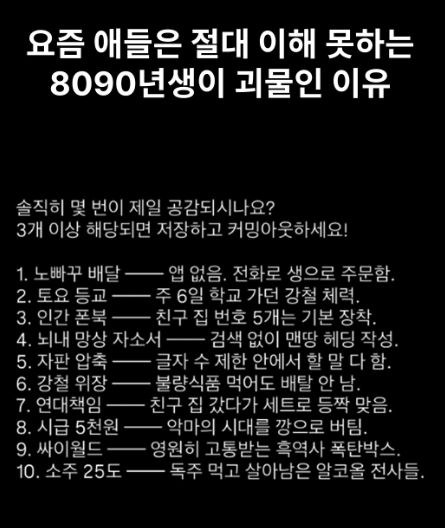
[Financial News] A post highlighting the past everyday lives of people born in the 1980s and 1990s—who grew up going to school on Saturdays, memorizing their friends’ landline numbers, and ordering food from flyers instead of delivery apps—is drawing major attention online. While the post has prompted an outpouring of agreement by stirring up childhood nostalgia, older generations born in the 1970s have also joined in, saying “those days were nothing by comparison,” turning it into a lighthearted trip down memory lane.
A post titled ‘Why people born in the 1980s and 1990s are “monsters”—something kids these days could never understand’ has been spreading rapidly across major online communities and social media (SNS).
Saturday school, character limits on text messages, Cyworld and more prompt reactions: “That was my childhood”
The author listed 10 aspects of everyday life at the time. The main examples included: ▲a delivery culture where people ordered by phone using flyers instead of delivery apps ▲Saturday classes, when students went to school six days a week ▲memorizing at least five landline numbers for friends’ homes ▲80-byte short message service (SMS) texts, with words shortened to fit character limits ▲writing personal statements from scratch without search engines or AI ▲corporal punishment at school (“the rod of love”) ▲stomachs that could handle junk food ▲low-paid part-time jobs in the “5,000 won an hour” era ▲Cyworld mini-homepages full of sentimental quotes and embarrassing memories ▲the era of “25-degree soju,” a strong liquor well over 20 degrees.
Internet users born in the 1980s and 1990s who saw the post enthusiastically agreed, saying, “Someone copied my school days down exactly,” “All 10 items apply to me,” and “I remember leaving the empty jajangmyeon bowl outside the front door.” Before mobile phones became widespread, if a friend failed to show up at the meeting place, people had to page them and then wait for a reply by a public phone booth. And until the full implementation of a five-day school week in 2012, following the introduction of “No-School Saturdays” (one school-free Saturday a month) in 2005, going to school on Saturdays was an ordinary part of life.
But after older generations born in the 1970s and 1980s who saw the post pushed back, the online discussion turned into what was dubbed a lighthearted “back-in-my-day battle.” They felt that the lifestyle described was a much milder version of the conditions they had actually experienced.
“5,000 won an hour? You had it easy,” “Have you ever tried 25-degree soju?” ... A lighthearted “back-in-my-day battle” spreads
On the “5,000 won an hour” item in particular, one internet user scoffed, “Isn’t 5,000 won an hour way too recent? In the early 2000s, it was in the 2,000-won range.” In fact, the statutory minimum wage was around 1,600 won an hour in 2000 and 3,100 won in 2006. Another internet user recalled, “There was even a time when I got 1,800 won because I was a minor and had an exploitative boss.”
Comments also poured in about the “25-degree soju” item, including, “Few people born in the 1990s—and even in the 1980s—have ever tried 25-degree Jinro soju, the kind you open with a bottle opener, after becoming adults,” and, “People born in the 1970s really had it tough during the International Monetary Fund (IMF) foreign-exchange crisis, leaving for work at dawn and getting home at dawn, until even their children’s faces from when they were young became a blur.”
The backdrop to the way the everyday lives of people born in the 1980s and 1990s, now ranging from their late 20s to their mid-40s, are being recounted as such unfamiliar old stories is South Korea’s compressed digital transformation. As smartphones and the platform economy rapidly became part of everyday life, even what life was like just 10 to 20 years ago can feel like the distant past.
Experts say this is a natural cultural response, allowing people to affirm their sense of connection amid rapid social change. Professor Lee Hongjoo of the Department of Consumer Economics at Sookmyung Women’s University explained, “It is less that a particular generation aged quickly than that the pace of technology adoption and changes to digital infrastructure in Korean society were extraordinarily rapid. People feel surprise and nostalgia that ordinary life from the past became a memory in the blink of an eye, and it has become an opportunity for those who shared the same experiences to affirm their generational bonds and solidarity.”
[email protected] Mun Yeong-jin Reporter