“Directions appear right before your eyes” ... Next-generation AR glasses technology developed
- Input
- 2026-11-12 01:00:00
- Updated
- 2026-11-12 01:00:00
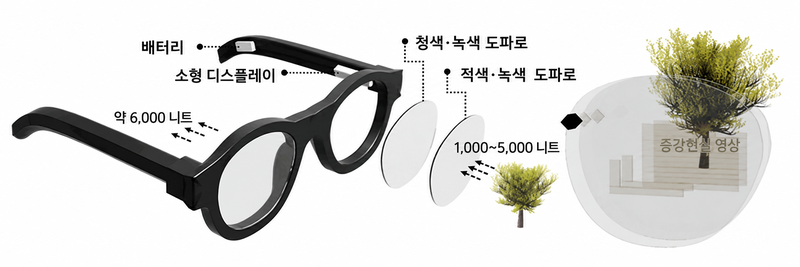
[Financial News] Technology has been developed to make augmented reality (AR) glasses—which overlay directions or text onto the scene in front of the wearer—more convenient for everyday use. South Korean researchers have created a glasses prototype that reduces light loss within a thin lens, making text visible even outdoors in bright conditions.
The Ministry of Science and ICT announced on the 12th that a research team led by Professor Junsuk Rho of Pohang University of Science and Technology (POSTECH), in collaboration with Samsung Research at Samsung Electronics, had developed an optical technology that dramatically reduces light loss inside a metasurface waveguide, producing bright images even when the eye’s position changes.
A metasurface is an optical structure that controls the phase and direction of light by arranging nanostructures smaller than the wavelength of light. A waveguide is an optical structure that guides light along a specific path without letting it escape. The research findings were published on November 12 in Nature, one of the world’s most prestigious international academic journals.
According to the research team, for AR glasses to be used in everyday life, they need to be thin and lightweight like regular glasses, while also displaying images clearly in bright environments. However, existing technology has made it difficult to achieve thinness, brightness and ease of use all at once.
The research team focused on the path light takes through the entire waveguide. They demonstrated theoretically and experimentally that precisely designing the entire path of light at the nanoscale can dramatically reduce unwanted light loss while maintaining bright, sharp images even when the eye’s position changes.
They also added a design to display color images. By layering one layer that primarily transmits blue and green light over another that primarily transmits red and green light, they reduced differences in light-transmission efficiency across colors.
The research team combined the two layers to create a metasurface-based waveguide, 1.5 mm thick in total, that directs light to the eye. Using a glasses prototype incorporating the waveguide, they overlaid white text on the real-world scene outdoors in bright conditions and color images indoors. The design allowed users to see images even when their eye position shifted within a certain range.
The significance of this achievement is that it shows bright images can be produced even with a thin optical system by reducing light loss inside a metasurface waveguide. The technology is expected to be used in everyday glasses that display directions or work-related information right before the wearer’s eyes. It could also help reduce power consumption while maintaining screen brightness through more efficient use of light.
Professor Junsuk Rho of Pohang University of Science and Technology said, “This research demonstrates that by precisely controlling the path light takes inside a lens, bright, sharp images can be produced outdoors even with a thin lens.” He added, “Going forward, we will work to improve rainbow-like blurring caused by light and establish mass-production technology, while integrating the glasses with AI-based personalized image processing to develop AR glasses that are comfortable to wear in everyday life.”
[email protected] Yeon Ji-an Reporter