Jeju joint logistics center built with 25.6 billion won to open on the 18th; a test of whether it can cut logistics costs for SMEs
- Input
- 2026-11-10 16:18:51
- Updated
- 2026-11-10 16:18:51
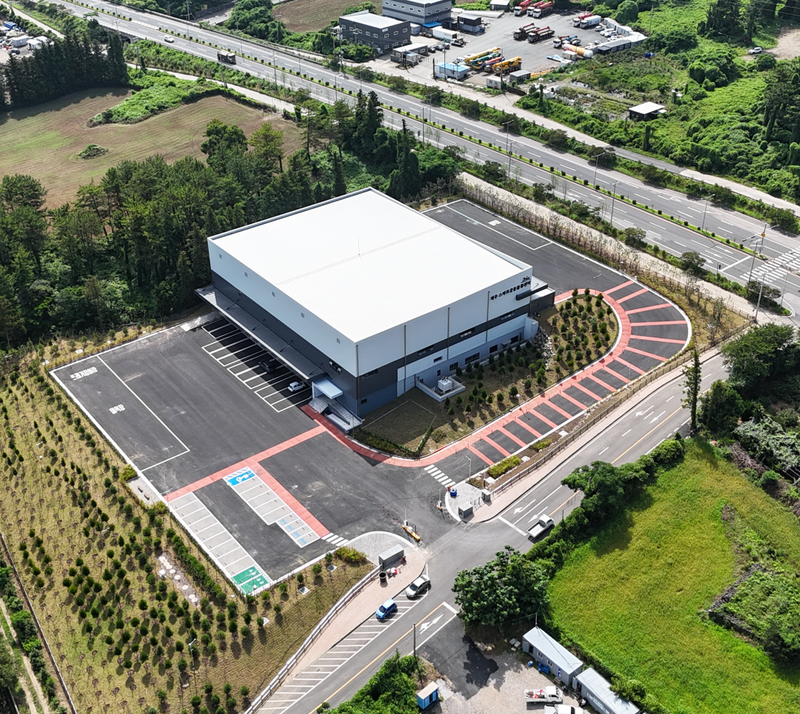
【Financial News, Jeju = Jeong Yong-bok】 A smart logistics center with capacity for 1,800 pallets, available for joint use by small and medium-sized businesses in Jeju Province, will open on the 18th. Built with a total investment of 25.6 billion won, the facility is designed to reduce companies’ logistics costs by connecting services from product storage to inventory management, vehicle dispatching and joint delivery.
According to the Jeju Special Self-Governing Province Economic and Trade Promotion Agency on the 10th, the Jeju Smart Joint Logistics Center, built in Ara-dong, Jeju City, is recruiting businesses to use its storage facilities ahead of its opening on the 18th. The first goods can be brought in starting on the 13th, before the official opening.
The center has one basement level and two floors above ground, with a total floor area of 5,601.05 square meters. It has an ambient-temperature warehouse measuring 2,998.61 square meters and a low-temperature warehouse measuring 1,492.53 square meters. Its total storage capacity is 1,800 pallets: 1,400 at ambient temperature and 400 in refrigerated and frozen storage. A pallet is a platform used to stack goods for transport by forklifts and other equipment.
Because of Jeju’s geographic separation from the mainland, goods must be transported by sea or air, resulting in high logistics costs. Small and medium-sized manufacturers with low shipment volumes and processors of agricultural, fishery and livestock products have particularly struggled to secure their own warehouses and delivery networks, creating a longstanding need for shared logistics facilities.
The center will bring together goods from multiple businesses for storage and jointly handle the processes of dispatch and delivery. It has installed a warehouse management system (WMS), transportation management system (TMS), warehouse control system (WCS) and Internet of Things (IoT)-based equipment to manage inventory, inbound and outbound shipments, and transportation information in an integrated manner.
It will also be linked to the existing Jeju shared logistics platform, Modang. The system is designed to let businesses apply for storage space online and use inventory management and joint delivery services.
Eligible users are small and medium-sized manufacturers in Jeju Province, as well as corporations and organizations involved in producing, processing or distributing agricultural, fishery and livestock products. For seafood and livestock products, businesses that handle only unprocessed goods are excluded; eligibility is limited to those handling first-stage processed products packaged on pallets.
The fee per pallet per day is 700 won for ambient-temperature storage and 1,900 won for refrigerated or frozen storage. Loading and unloading cost 6,000 won per operation, and storage fees must be paid in advance. If goods are dispatched before the scheduled end of the storage period, the fee for the remaining period will be refunded.
The Jeju Economic and Trade Promotion Agency incorporated a demand survey of 222 businesses in the province into its operating criteria. To prevent individual businesses from monopolizing storage space or use of the low-temperature warehouse from becoming concentrated in certain product categories, it will apply storage-volume limits for each business and allocation criteria by product group.
A total project budget of 25.6 billion won was spent on building the center. Jeju Province announced this past June that construction of the facility had been completed and set September as the target for operations, but the actual opening was scheduled for November 18. The center will be operated by the Jeju Economic and Trade Promotion Agency.
With construction of the facilities complete, the focus now shifts to whether they deliver tangible logistics-cost savings. The utilization rate of the center’s 1,800-pallet storage capacity, the number of businesses participating in joint delivery, and changes in each business’s storage and transportation costs will be key indicators of the project’s performance.
Applications opened on the 4th. Businesses can join the Modang electronic application system as corporate members, select “shipper” and submit their business registration certificate. Applications may close early once the available places have been filled.
Go Byeong-gi, head of the Jeju Economic and Trade Promotion Agency, said, “We will ease the logistics-cost burden on more businesses in the province through fair usage criteria.”
[email protected] Jeong Yong-bok Reporter