From 8.8 billion to 30 billion won: Lowering the bar for regional construction firms to participate in government projects
- Input
- 2026-11-11 09:00:00
- Updated
- 2026-11-11 09:00:00
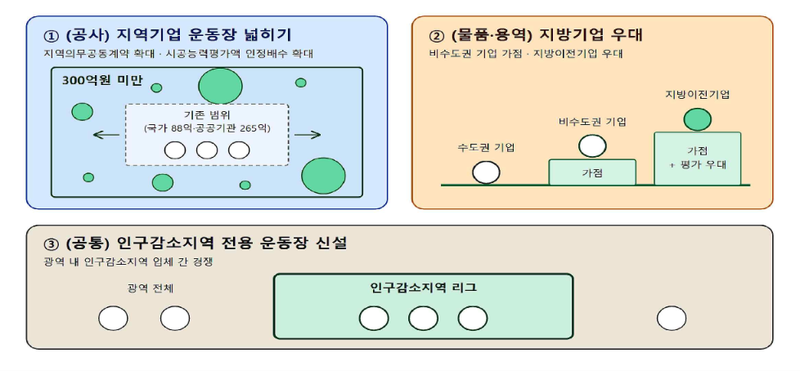
[Financial News] The government plans to substantially lower the barriers to participation for companies outside the Seoul metropolitan area in construction projects commissioned by the central government and public institutions. The key measures are to expand the projects covered by mandatory regional joint contracting to those worth less than 30 billion won and raise the cap on the construction participation ratio to twice the current construction capability assessment value.
The Ministry of Economy and Finance announced the measures, titled “Preferential Measures for Companies Outside the Seoul Metropolitan Area Through Government Contracts,” at an Emergency Economic Council meeting chaired by Lee Hyeong-il, Deputy Prime Minister and Minister of Economy and Finance, on the 11th.
The government will first substantially expand the scope of projects covered by mandatory regional joint contracting under government contracts. This system requires local companies to participate in a joint venture for construction projects below a certain size. It currently applies to projects commissioned by the national government worth less than 8.8 billion won and projects commissioned by public institutions worth less than 26.5 billion won, but the threshold for both will be raised to projects worth less than 30 billion won.
The government plans to help local companies build up their construction track records and expand the scale of their businesses through these measures. It expects the value of contracts awarded to local companies as a result of the expansion to increase by at least 500 billion won and up to 800 billion won.
The government will also ease the criteria for factoring local companies’ shares of construction work into evaluations for large-project bids. Currently, the participation share of each joint venture member is recognized only up to the limit of that company’s construction capability assessment value. As a result, even when a local company takes part in the actual construction, any share exceeding its assessed value is not counted in bid evaluations. The government will raise the cap on the construction participation ratio recognized in evaluations from one times to twice the construction capability assessment value, and, when necessary, allow it to reach up to three times, taking into account the project’s size and complexity and the status of local companies.
In the goods and services sectors, bid bonus points for companies outside the Seoul metropolitan area will vary according to local conditions. Based on the Ministry of the Interior and Safety’s Local Preference Index, basic local governments nationwide will be divided into four regions. Companies that relocate from the Seoul metropolitan area to Zone 4, a less-developed region, will receive the highest bonus.
The government will also introduce evaluation benefits for small and medium-sized businesses that relocate outside the Seoul metropolitan area. For two years after relocation, they will receive full marks in the financial standing assessment, and the period for which delivery records are recognized will be extended from five years to seven. Restricted competitive bidding among companies based in the relevant cities, counties, or districts will also be allowed in provincial-level governments that include population-decline areas.
The government has also prepared safeguards against nominal headquarters relocations and local companies’ token participation. It will introduce an evaluation criterion comparing a local company’s share in a joint venture with its actual construction record, and establish requirements for recognizing a company’s headquarters location in the goods and services sectors. Companies that apply for bonus points based on a false relocation will be excluded from consideration for contract awards or have their eligibility to bid restricted.
An official from the Ministry of Finance and Economy (MOEF) explained, “This measure is intended to use government contracts as leverage to restore vitality to local economies and ease the concentration of activity in the Seoul metropolitan area.” The official added, “We plan to revise the Enforcement Decree and Enforcement Rules of the State Contracts Act, relevant administrative rules, and directives and guidelines issued by the Public Procurement Service (PPS), among other things, and complete the institutional improvements by the first half of next year.”
[email protected] Kim Chan-mi Reporter