Tokyo office rents surge 20% ... ‘Head downtown to attract talent’
- Input
- 2026-11-10 16:01:29
- Updated
- 2026-11-10 16:01:29
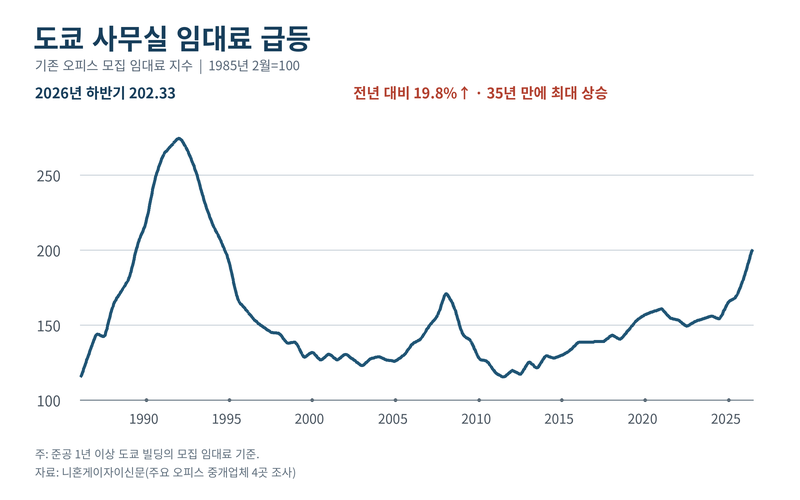
【Financial News | Tokyo = Correspondent Seo Hye-jin】Office rents in Tokyo, Japan, rose about 20% in a year, recording their largest increase in 35 years, the Nihon Keizai Shimbun (The Nikkei) reported on the 10th. As companies grappling with labor shortages seek well-located offices to secure talent, reduced remote work and delays in new supply have added to the pressure.
According to The Nikkei, the asking-rent index for existing offices in Tokyo stood at 202.33 in the second half of this year, up 19.8% from the same period a year earlier. The increase was the steepest since the first half of 1991, near the end of Japan’s bubble economy. The index also reached its highest level since the second half of 1994.
The Nikkei surveyed asking rents quoted by landlords through four major office brokerage firms and indexed them with February 1985 set at 100. Existing offices are buildings completed at least a year ago and account for most of the Tokyo market.
During the bubble economy, rising land prices drove up rents, but this time the main factor is competition to secure talent. As population decline makes hiring more difficult, companies are increasing investment not only in wages but also in improving working environments. Efforts to scale back remote work, which spread during the COVID-19 pandemic, and bring more employees back to the office have also fueled demand.
“As labor market mobility increases, creating a better work environment alongside raising wages is directly linked to securing talent and retaining employees,” said Iwama Yuji, a senior director at real estate services firm CBRE.
The most expensive rents were in the Yaesu, Kyobashi and Nihonbashi areas east of Tokyo Station. The median monthly asking rent for existing buildings jumped to 67,000 yen (about 567,000 won) per 3.3 square meters (one pyeong), nearly double the level a year earlier. In the Marunouchi and Otemachi areas west of Tokyo Station, rents rose 37% to 62,500 yen (about 528,000 won). Rents also increased 40% in Kasumigaseki and Uchisaiwaicho, near government offices.
Major companies are also continuing to move their headquarters to the area around Tokyo Station, which is well served by public transportation. Japan Pulp & Paper Company is moving its headquarters to TOFROM Yaesu Tower, completed last February. Yoshida Shinichiro, who is overseeing the relocation project, described the move as “part of an investment in human capital” and said the company would use its spacious offices and shared spaces to encourage more communication among employees.
ANA Holdings said last month that it plans to move its headquarters to Yaesu Core, scheduled for completion in 2029. Honda and Chugai Pharmaceutical are also expected to move in. “When a large company relocates, demand also arises from small and midsize companies that do business with it to set up offices in nearby existing buildings,” said Imazeki Toyokazu, a chief analyst at Sanko Estate.
Supply, meanwhile, remains tight. According to Miki Shoji, the office vacancy rate in central Tokyo’s five wards—Chiyoda, Chuo, Minato, Shinjuku and Shibuya—was 1.85% in September. That is far below the 5% considered the benchmark for a balance between supply and demand. New supply is also being delayed by a sharp rise in construction costs.
Building owners are raising asking rents and negotiating increases with existing tenants when their leases come up for renewal. Contracts that link rent increases to the rise in the consumer price index are also becoming more common in buildings owned by major real estate developers. The rent index for newly built Tokyo buildings completed less than a year ago reached 250.81, its highest level since 1992.
The rent index for existing buildings in Osaka also rose 12.7% year over year to 194.13, its highest level since 1994. Rents for newly built buildings climbed 28.8% to 271.07, setting a new record.
With the completion of major development projects such as Grand Green Osaka largely wrapped up, new supply in Osaka is expected to remain limited until around 2030. Companies that previously occupied their own buildings are also moving into well-located leased offices, worsening the shortage of space in the city center.
[email protected] Seo Hye-jin Reporter