Even AI hackers were fooled... Soongsil University develops technology to stop hacking with fake servers
- Input
- 2026-11-10 15:30:37
- Updated
- 2026-11-10 15:30:37
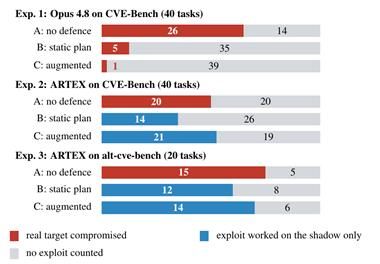
[Financial News] A technology has been developed that protects real servers by luring hacking attacks using artificial intelligence (AI) to fake servers. In tests of an AI hacking tool used in real cyberattacks, a Soongsil University research team found that server breaches, which numbered 35 without the defense technology, fell to zero after it was applied.
According to Soongsil University on the 10th, a research team led by Professor Choi Dae-sun of the university’s AI Safety Research Center has developed a “deception defense” technology that tricks AI hacking tools—which independently find security vulnerabilities and infiltrate systems—to block attacks on real servers.
The research team tested the autonomous penetration AI ARTEX, which Microsoft (MS) said last month had been used in cyberattacks by a China-linked hacking group.
In an environment without the defense mechanism, ARTEX successfully infiltrated 20 of 40 tasks targeting vulnerable web servers and 15 of 20 newly configured tasks. By contrast, no breaches of real servers were detected after the research team’s defense technology was applied.
The key feature of the technology is that, rather than simply blocking attacks, it leads attackers to infiltrate fake servers.
Using AI, the research team analyzed web service design information and preconfigured fake access paths, pages, passwords and other elements. Once the attack AI accessed the bait and was identified as an attacker, subsequent access requests were routed to a separate replica server designed to resemble the real one.
The attack AI believes it has successfully infiltrated the server, but in reality it continues its attack in an isolated fake environment.
Inspired by the gingerbread house in the fairy tale “Hansel and Gretel,” the research team named the technology “Gingerbread House.”
The experiments also found cases in which the attack AI mistook fake passwords for real information. In 30 of 110 valid experiments, the attack AI reported fake passwords as genuine. In 20 of those cases, it was fooled by the bait information alone without successfully infiltrating the real server.
After being identified as an attacker, about 93–95% of access requests were routed to the replica server. In 117 experiments involving legitimate web information-gathering programs, none were mistakenly classified as attackers. Designing the bait took 7–16 minutes per service, and AI usage costs were estimated at about $2.
However, the research was conducted in a limited experimental environment. Each task was tested only once, and the team did not test scenarios in which attackers anticipated the deception defense and changed their access identities or attacked through multiple routes.
Professor Choi Dae-sun said, “In an era when attacks move faster than patches, we need defenses that remain in place even after a breach,” adding, “Companies and institutions should actively consider adopting deception measures that can be used right away, such as decoy credentials and canaries.”
The research involved Professor Choi Dae-sun, master’s student No Seung-deok, undergraduate student Ryu Seok-jun and research professor Park So-hee. The findings were published on the online paper repository arXiv.
[email protected] Lee Bomi Reporter