‘AI Science Research’: K-Moonshot to Double Research Productivity by 2030
- Input
- 2026-11-10 15:45:05
- Updated
- 2026-11-10 15:45:05
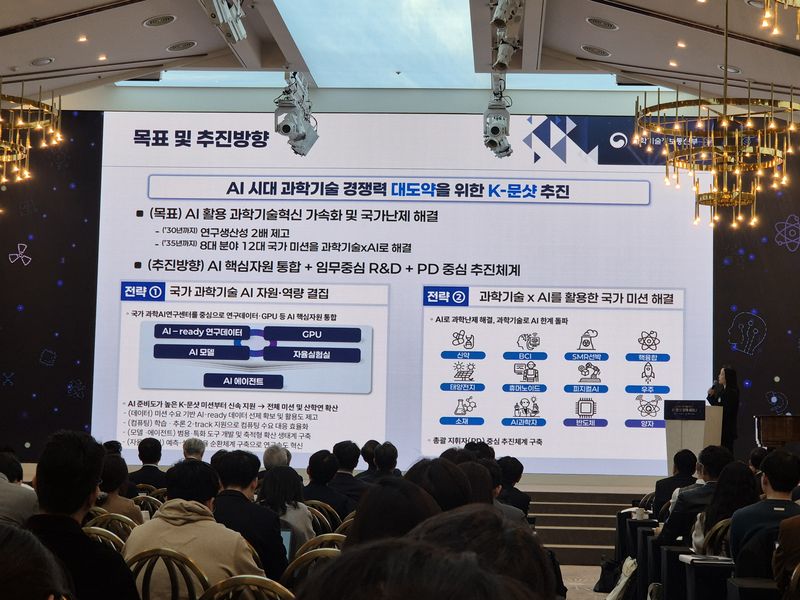
The Ministry of Science and ICT held the K-Moonshot Policy Seminar on the afternoon of the 10th at Peace & Park Convention in Yongsan, Seoul, and announced these policy plans. The seminar was organized to review the environment for AI use, as well as the systems and infrastructure needed to ensure the smooth implementation of the K-Moonshot Strategic Roadmap, approved at the Ministerial Meeting on Science and Technology last September.
K-Moonshot is a policy and R&D program that aims to help Korea become a global leader in science and technology by harnessing the AI-based scientific research paradigm. It comprises the pooling of national scientific AI resources and 12 national missions. The seven SEED initiatives will help overcome the scientific and technological hurdles that MEGA needs to clear in order to grow.
“The goal is to double research productivity by 2030 through K-Moonshot and solve the 12 national missions with science, technology and AI by 2035,” said Kim Hyun-ok, director of the Future Strategic Technology Policy Division at the Ministry of Science and ICT.
To that end, the plan is to use “AI-ready research data” integrated from 23 government-funded research institutes, institutes of science and technology, and other organizations, and to bring together all of the country’s science and technology AI capabilities, including graphics processing units (CPU) centered on the sixth supercomputer and autonomous labs in areas of strength such as biotechnology and materials.
According to the Ministry of Science and ICT, K-Moonshot’s 12 national missions are new drugs, brain-computer interfaces (BCI), solar cells, nuclear fusion, small modular reactor (SMR) ships, humanoids, physical AI, space, materials, AI scientists, semiconductors and quantum technology. The seven SEED projects are SMRs, nuclear fusion, renewable energy, quantum technology, aerospace, advanced biotechnology and advanced supply chains. Each mission is being led by a top expert in the field, known as a program director (PD). Since their appointment in June, the PDs have been developing “strategic roadmaps for each mission” as specific implementation plans.
Director Kim said, “The national missions pursued through K-Moonshot fall into three categories: △ Bio and science; △ advanced foundations and AI innovation; and △ energy and large-scale systems.” She explained, “For the new-drug mission, we will first develop a human-mimicking foundation model in 2029, then build a model at the tissue and organ level in 2032, followed by a model of the entire human body in 2035.”
The BCI mission also aims to commercialize BCIs to overcome paralysis of all four limbs and brain diseases by 2035. The physical AI plan is to make physical AI commonplace in daily life, including caregiving and household chores, through general-purpose behavioral intelligence. Other K-Moonshot goals set for 2035 include nurturing global humanoid companies, boosting semiconductor performance 100-fold, developing the world’s most advanced quantum computers, and laying the groundwork for large-area solar cells and space data centers.
Director Kim added, “The materials mission will pursue the development of the world’s highest-performing rare-earth materials and permanent-magnet technologies, while the nuclear fusion mission aims to secure key technologies for fusion reactor design and power demonstration.” She continued, “We will also prepare the designs for SMR ships and the necessary construction approvals, with the aim of beginning construction of SMR ships in 2035.”
Government support for the initiative will also continue. Oh Dae-hyun, a director at the Ministry of Science and ICT, said, “K-Moonshot is a policy to overcome the scientific and technological challenges facing the country by using AI. It requires support not only for R&D but also for the scientific AI ecosystem and the systems and infrastructure behind it. The government will do its utmost to support researchers as they pursue national missions with a sense of purpose, ensuring no obstacles arise in the use of AI or in systems and infrastructure.”
[email protected] Yeon Ji-an Reporter