“Loans denied because of non-regular employment; that has to change” ... Finance and labor sectors sign MOU
- Input
- 2026-11-11 14:00:00
- Updated
- 2026-11-11 14:00:00
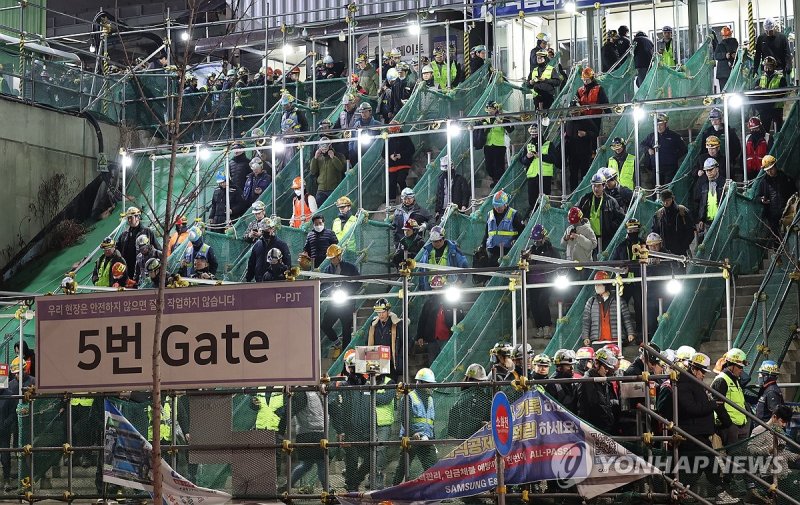
On the 11th, the Financial Services Commission, the Ministry of Employment and Labor, and the Financial Supervisory Service signed an MOU on inclusive finance for construction workers and labor service providers at the Construction Workers Mutual Aid Association in Jung District, Seoul. The agreement was joined by the Korea Federation of Banks, Korea Credit Information Services, the Construction Workers Mutual Aid Association, the Korea Workers' Compensation and Welfare Service, the Federation of Korean Trade Unions' Korean Construction Workers' Union Federation, the Korean Confederation of Trade Unions' National Construction Industry Trade Union Federation, the Korea Platform Freelancers' Mutual Aid Association, Labor Mutual Aid Federation Pulppang, and others.
The agreement was drawn up to improve access to financial services for construction workers, platform workers, freelancers, and other labor service providers. Its aim is to ease the difficulties they face when using financial services from banks, credit card companies, and other providers because they are not regular employees.
Construction workers and freelancers have irregular incomes and work under a range of employment arrangements. Financial companies have difficulty assessing their credit and reviewing loan applications because they lack sufficient data. Although these workers have actual work and labor-service histories, no single company holds all of that information, meaning it cannot be fully used in credit assessments.
The government has decided to establish a financial support system that reflects the characteristics of construction workers and labor service providers by combining the expertise and information held by various institutions. A key part of the agreement is to lay the groundwork for alternative credit assessments using work and labor-service histories. The expectation is that tailored credit assessments will enable higher loan limits and lower interest rates. Specifically, the parties will explore ways to use non-financial information in the financial sector, including records of mutual aid contributions held by the Construction Workers Mutual Aid Association and the Korea Workers' Compensation and Welfare Service, as well as labor service providers' work activity records. They will work together to ensure that work and labor-service histories are taken into account in credit assessments and loan reviews.
Other measures will include developing financial products and services tailored to the circumstances of those concerned, such as irregular incomes and different employment arrangements; linking debt-adjustment programs run by financial companies and relevant institutions such as the Credit Counseling and Recovery Service; strengthening financial and money-management counseling; and expanding financial education.
Tailored financial products using work-history information provided by the Construction Workers Mutual Aid Association and the Korea Workers' Compensation and Welfare Service are scheduled to launch in 2027. A tailored alternative-data credit assessment system for construction workers will be established this year.
Lee Eog-weon, chair of the Financial Services Commission, said, “I ask financial companies to develop a range of inclusive finance products and make proactive, preemptive efforts to restructure debt.” He added, “If financial companies can also obtain information from the Korea Workers' Compensation and Welfare Service and the Construction Workers Mutual Aid Association—such as assessment data on employment and industrial accident insurance premiums, records of retirement mutual aid contributions, and information from the Construction Workers' Skills Grade System—and use it in loan reviews, workers’ diligent work histories and skills could be recognized as credit.”
Minister of Employment and Labor Kim Young-hoon said, “Opportunities to access financial services should not differ simply because people work in different ways.” He added, “We will work closely with relevant institutions to ensure that the work and labor-service histories of construction workers and other labor service providers are fairly assessed in the financial sector, enabling more people to access the financial services they need.”
Financial Supervisory Service Governor Lee Chan-jin also stressed, “Inclusive finance begins with recognizing the value of diverse economic activities and ensuring that everyone can access financial opportunities suited to their ability to repay. We will work to improve access to financial services for financially vulnerable groups as a whole.”
[email protected] Park Mun-su Reporter