North Korea signals operational deployment of new high-speed torpedo next year... South Korea and the United States must strengthen intelligence-sharing and joint anti-submarine warfare capabilities
- Input
- 2026-11-11 12:08:33
- Updated
- 2026-11-11 12:08:33

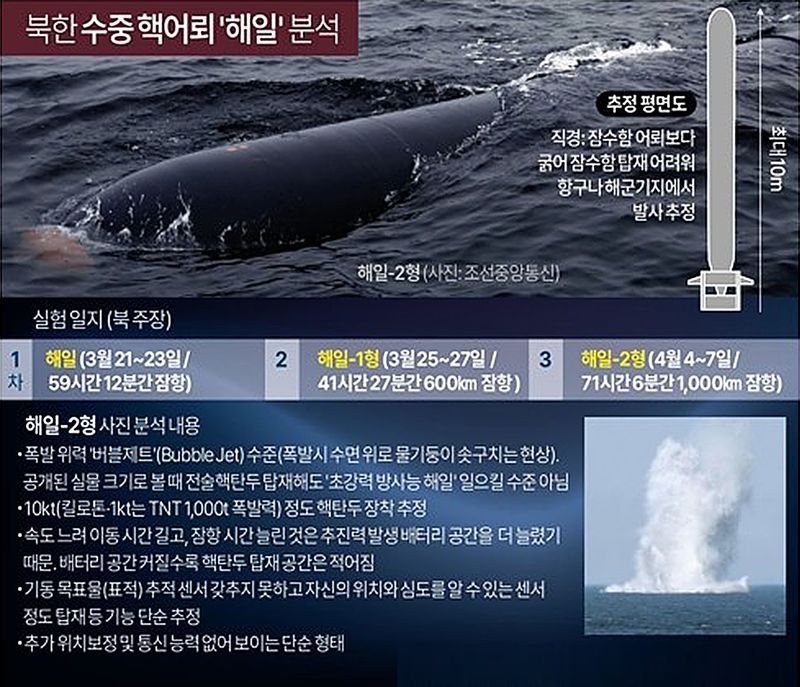
According to reports on the 10th by North Korean state media, including the Korean Central News Agency (KCNA), North Korea’s Academy of Defence Sciences, Missile General Bureau and Torpedo Weapons Research Bureau claimed they had successfully completed a test on the 9th to verify the combat effectiveness of a new torpedo weapons system. North Korean authorities insisted that the test was part of the defense science research institutions’ “regular and obligatory activities,” but the underwater threat in waters around the Korean Peninsula is growing as they set early next year as the date for operational deployment. The Republic of Korea Joint Chiefs of Staff (ROK JCS) said it was closely monitoring North Korean weapons development and maintaining its current state of readiness.■ How supercavitation torpedoes work and their destructive powerA supercavitation torpedo is known as an “underwater missile”: to reduce drag underwater, the torpedo itself forms an air tunnel that envelops its entire surface, allowing it to strike a target at overwhelming speed beneath the water.
Air bubbles generated underwater—known as “cavitation”—were a source of physical drag that reduced the propulsion efficiency of ship propellers and caused noise. Historically, many naval engineers worked to reduce this effect. Modern military science, however, turned it to its advantage, creating “supercavitation technology” by forming an artificial air tunnel at the front of the torpedo to dramatically offset friction with the water.
While conventional underwater weapons have been limited by physical constraints to speeds of 65–110 km/h, as with the South Korean Navy’s Baek Sang-eo and Beom Sang-eo, supercavitation torpedoes are reportedly capable of striking targets at overwhelming speeds exceeding 800 km/h. Given that even the Japanese Navy’s Type 91 oxygen torpedo, which boasted the best performance of its time during World War II, could not break the 100 km/h barrier, a supercavitation torpedo is quite literally an “underwater supersonic missile.” However, it remains unclear, given the limited information available, whether North Korea has fully developed a weapons system of this caliber.■ The dilemma of Russia’s Shkval and North Korea’s claimsThis dream weapon has a fatal weakness. The extreme noise from the rocket motor needed for high-speed travel, combined with the bubble shroud it generates, makes underwater guidance using the torpedo’s own sensors technically impossible. As a result, it has a relatively short range and can only travel in a straight line; the Shkval, developed by the Soviet Union during the Cold War, was the only such weapon to have been deployed operationally.
What merits attention is North Korea’s claim that the latest test combined “AI-based target detection and guidance technology” with “rocket propulsion technology tested 180 times over five years.” If this claim, which appears to present a technological contradiction, is true, North Korea may have overcome the guidance limitations of supercavitation—or it may be exaggerated propaganda. The military authorities should therefore conduct objective and rigorous verification before assessing the actual operational capabilities of the system North Korea has pledged to deploy in early 2027.■ North Korea’s underwater threat grows... Detection and response systems must be strengthenedYoo Ji-hoon, a member of the Korea Institute for Defense Analyses (KIDA), said North Korea’s recent moves were “a military effort to modernize its new destroyers and submarine forces while focusing on improving the performance of its underwater weapons systems.” He assessed that “increasing torpedo speed and enhancing precision-strike capabilities are clearly intended to bolster its relatively outmatched naval forces and constrain South Korea’s naval operations.”
Yoo warned in particular that “if North Korea equips submarines, surface ships and other platforms with these new high-speed torpedoes, the range and complexity of the underwater threat could expand uncontrollably.” The concern is that as torpedo speed and accuracy improve, the survivability of South Korean vessels could drop sharply. The ROK JCS, for its part, is also closely monitoring North Korean weapons development and refining its state of readiness.
Military authorities believe a comprehensive response is needed to North Korea’s supercavitation threat, viewing it not as an individual weapons system but in the broader context of the modernization of North Korea’s naval forces.
Yoo said underwater surveillance and anti-submarine warfare capabilities should be strengthened, and that torpedo detection and response systems and the survivability of naval vessels should continue to be improved. He also said South Korea and the United States should strengthen underwater intelligence-sharing and joint anti-submarine warfare capabilities. In the long term, the development of underwater forces, including Korean-designed nuclear-powered submarines, needs to be linked to stronger combined defense capabilities. He stressed that this would enable an effective response to North Korea’s asymmetric underwater threat while maintaining stability in maritime security on the Korean Peninsula and in the region.


[email protected] Lee Jong-yoon Reporter