“If I sell, it looks like the market will rebound; if I hold on, it looks like it will fall further”: Retail investors trapped by memories of past rebounds
- Input
- 2026-11-10 15:50:04
- Updated
- 2026-11-10 15:50:04
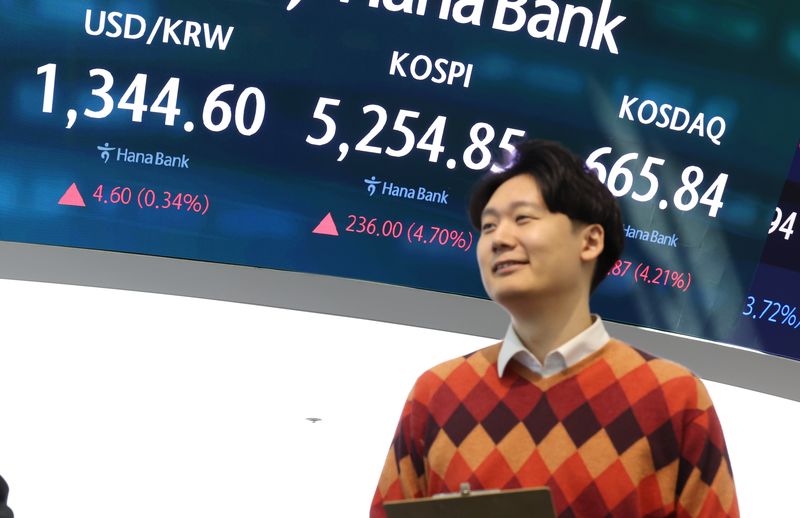
Financial investment industry sources said on the 10th that individual investors are increasingly wrestling with whether to sell as the domestic stock market has recently undergone a sharp correction. The KOSPI closed at 5,059.69 on the 6th, down 324.11 points (6.02%) from the previous trading day. It fell as low as 4,911.28 intraday, breaking below the 5,000 mark, and sell-sidecars and circuit breakers were triggered. The KOSPI, which also dipped below 5,000 intraday on the 9th, rebounded on the 10th on the strength of U.S. stock markets, triggering a buy-sidecar intraday this time.
As KOSPI volatility has increased, more individual investors are unsure whether to sell or hold. Hwang, a 29-year-old office worker, wants to keep holding the large-cap stocks in which Hwang has invested for more than a year, trusting the companies’ competitiveness and earnings, but grew more concerned about further declines after the share price fell below even its 60-day moving average. “Since July, I’ve bought stocks whenever my paycheck came in because I thought we’d hit the bottom, but each time they fell further,” Hwang said. “If I sell now, it feels like they’ll rebound; if I keep holding, it feels like they’ll fall further, so it’s hard to decide.”
Some investors have sold part of their holdings to prepare for further declines. Lim, a 32-year-old office worker, decided to secure cash and wait for future investment opportunities. “It wasn’t easy to lock in the loss, but constantly watching stock prices was stressful, too,” Lim said, adding, “I think I’d regret it if prices rebounded sharply.”
Past experience of stock prices rebounding after sharp drops is seen as one reason investors hesitate to sell in a downturn. During the COVID-19 crisis, the KOSPI fell as low as 1,457.64 on March 19, 2020, but set a record closing high of 2,602.59 in November that year. After falling to 2,155.49 in 2022 amid concerns over global monetary tightening, the KOSPI later rebounded. Last March, it also plunged in the wake of U.S. and Israeli airstrikes on Iran, but regained its upward momentum in April, rebounding quickly and breaking above 9,000 for the first time in KOSPI history.
The psychological burden of locking in losses also makes investors hesitate to sell. In behavioral economics, the tendency to feel losses more strongly than gains is called “loss aversion.” As a result, investors tend to hold on to losing stocks rather than sell them, a tendency known as the “disposition effect.” Regret and psychological strain over acknowledging a loss delay the decision to sell.
The problem is that past rebounds do not guarantee future recoveries. Past market downturns—including the 2020 COVID-19 shock, concerns over global monetary tightening in 2022, and the Middle East war triggered this year by U.S. and Israeli airstrikes on Iran—arose from different causes and market conditions. The liquidity conditions, corporate earnings, and growth outlook for individual industries that supported rebounds at the time are also unlikely to be the same as they are now. And even if the index as a whole rebounds, not every individual stock will recover its previous high.
Experts advise investors to first review their investment goals and how long they can keep their money invested, rather than trying to predict the bottom. Ryu Du-jin, a professor of economics at Sungkyunkwan University, recommended, “Rather than being swayed by short-term rebounds or sharp drops, investors need to take a long-term view and invest in line with what they can afford.” Yang Jun-seok, a professor of economics at the Catholic University of Korea, said, “When deciding whether to invest, people should consider not only the returns they could earn but also the possibility of losses and how large they could be.”
[email protected] Seo Ji-yun Reporter