“Gender pay gap three times the OECD average” ... Labor and civic groups urge passage of Employment Equality Disclosure System legislation by year-end
- Input
- 2026-11-10 15:32:44
- Updated
- 2026-11-10 15:32:44
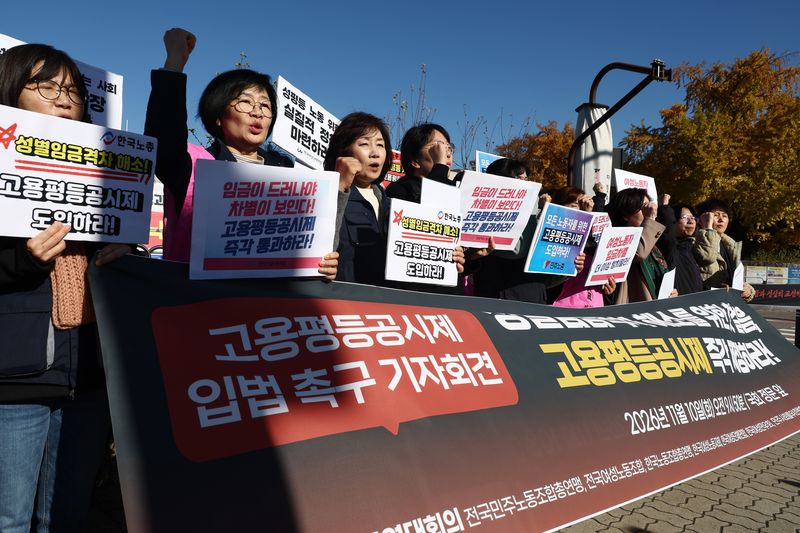
[Financial News] Labor groups and civic organizations called on the National Assembly to pass legislation establishing the Employment Equality Disclosure System by the end of the year to address the gender pay gap.
The Women’s Labor Solidarity Conference, which includes the Federation of Korean Trade Unions (FKTU), the Korean Confederation of Trade Unions (KCTU), the Korean Women’s Trade Union, the Korea Women Workers Association, Korean Women’s Associations United (KWAU), Korean Womenlink, and the Women’s Human Rights Committee of Lawyers for a Democratic Society (Minbyun), held a press conference calling for legislation on the Employment Equality Disclosure System in front of the National Assembly’s main gate in Yeouido, Seoul, on the 10th.
The Employment Equality Disclosure System, which is also included in the government’s policy agenda, is intended to disclose companies’ gender-based employment and pay figures so that the causes of the gap can be identified and addressed. Related bills are pending before the National Assembly’s Gender Equality and Family Committee.
Choi Mi-ra, standing vice president of the Federation of Korean Trade Unions (FKTU), said, “In 2025, South Korea’s gender pay gap was 27.8%, about three times the OECD average,” and identified it as the result of structural discrimination accumulated in hiring, job assignments and promotions.
She added, “The bills must pass this year to secure next year’s budget and allow the system to be implemented starting in 2027,” and said, “The longer legislation is delayed, the more the burden falls on women workers facing discrimination and job insecurity.”
Go Eun-ha, vice president of the Korean Metal Workers’ Union (KMWU), criticized companies for refusing to disclose information on the grounds of trade secrets or personal data, even when unions at manufacturing workplaces try to engage with them to address pay discrimination. Go said, “Information that is not disclosed transparently has ultimately become a shadow concealing unfair and discriminatory pay systems,” and stressed, “The gender pay gap can never be reduced without making opaque pay structures within companies transparent.”
There were also calls to extend disclosure requirements to small and medium-sized businesses and to enshrine companies’ obligation to address pay gaps in law. Kim Du-na, a lawyer with the Women’s Human Rights Committee of Minbyun, said, “Several bills are designed primarily around companies with 500 or more employees,” adding, “If small and medium-sized businesses are excluded from the companies required to disclose information, it will be difficult to accurately reveal the structure and extent of the gender pay gap.”
She also proposed, “We must not stop at disclosing the figures,” adding, “The law should establish a framework requiring companies to identify the causes of the gender pay gap, draw up improvement plans and have their implementation monitored.”
Kim said the right of individual workers to request pay information should also be guaranteed, explaining, “Company-level disclosures alone cannot tell workers whether they are being paid less for doing the same work. The system will work in practice only if workers can check for themselves and demand corrections.” She added, “The government and ruling party said at their previous consultation that they would complete revisions to the relevant laws by September this year and implement the system starting next March, but it is already November,” and called for the swift consolidated review of related bills introduced by 11 lawmakers in the 22nd National Assembly.
Rep. Park Hong-bae of the Democratic Party of Korea, who spoke in solidarity, said, “A survey by my office last September found an average gender pay gap of 30.1% at 38 financial companies, and confirmed the seriousness of the situation, with the gap at one securities firm reaching as high as 53.9%.” Rep. Son Sol of the Progressive Party urged Kim Jeong-jae, chair of the Gender Equality and Family Committee, to “convene the bill subcommittee as soon as possible so it can review the Employment Equality Pay Disclosure System.”
In their press statement, the participating organizations blamed the opposition party for the delay in legislation. They claimed, “The People Power Party is obstructing legislation by delaying deliberations and refusing to reach a compromise,” adding, “Now they are even telling us to wait until they introduce their own bill.” They also said they had requested meetings with People Power Party lawmakers to discuss the bill, but all those requests were rejected.
[email protected] Park Sung-hyun Reporter