“Korean Peninsula agenda expected to take a back seat at U.S.-China-Russia trilateral talks,” Joseph Yun predicts at Korea-U.S. Diplomacy Forum
- Input
- 2026-11-10 13:01:11
- Updated
- 2026-11-10 13:01:11
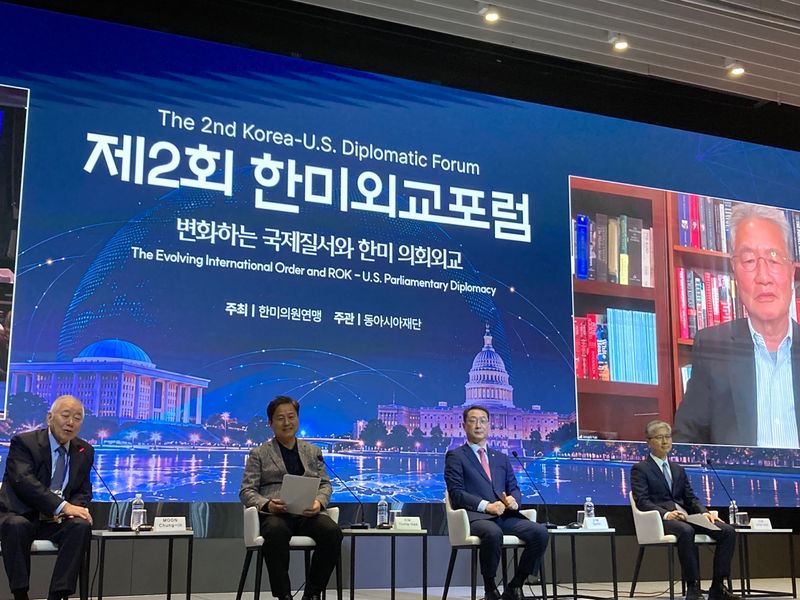
Joseph Yun, a former chargé d'affaires at the U.S. Embassy in South Korea and former special representative for North Korea policy, known as a “Korean Peninsula expert,” made the remarks at the second Korea-U.S. Diplomacy Forum, hosted by the Korea-U.S. Parliamentary Association at the Glad Hotel in Yeouido, Seoul, on the 10th. He is well known in the United States as one of the leading North Korea hands, having visited Pyongyang, among other things, to secure the return of Otto Warmbier, an American college student detained in North Korea.
Yun predicted that “at a trilateral meeting among Trump, President Putin and President Xi Jinping, Ukraine will be the first major agenda item, followed by Iran,” adding, “The Korean Peninsula issue may be included in a statement, but I don’t think it will be addressed as an agenda item beyond that.”
He also rated the chances of North Korea-U.S. dialogue taking place as low. “The North Korean and U.S. leaders met three times, but North Korean leader Kim Jong Un got nothing out of it. He was only humiliated at the Hanoi summit,” he said. “North Korea is getting a great deal from China and Russia and is no longer an isolated country. It is an important country in the fields of conventional and nuclear weapons. It has no interest in meeting President Trump.” The Trump administration could recognize North Korea as a nuclear-weapon state and hold talks with it, but concern was also raised about opposition from the U.S. Democratic Party.
The discussion also touched on fulfilling commitments agreed between the two countries on investment in the United States and defense cost-sharing to ensure the Korea-U.S. alliance endures. In her congratulatory remarks that day, U.S. Ambassador to South Korea Michelle Steel invoked the Miracle on the Han River and stressed, “South Korea is no longer a country receiving aid; as a global player, it must take on greater responsibility.” Steel called on South Korea to increase defense spending to 3.5% of gross domestic product (GDP) and to ensure the smooth implementation of its investment commitments in the United States.
Steel also said, “As the two presidents have pledged, we must create a level playing field for U.S. companies in South Korea.” She was asked by reporters about the possibility of a North Korea-U.S. summit, but a staff member in the U.S. Embassy’s press office intervened before she could answer. Republican senators Bill Hagerty and Todd Young also stressed the importance of investment in the United States and strengthening the Korea-U.S. alliance in video messages of congratulations that day.
Concerns were also voiced about changes to the Korea-U.S. alliance, including the transfer of wartime operational control (OPCON), after the U.S. midterm elections. Yun said, “South Koreans want OPCON transferred but do not want the alliance to weaken, and that is impossible,” adding, “South Korea needs to take into account that the Korea-U.S. alliance will weaken as it takes over OPCON.”
People Power Party lawmaker Kim Geon said, “It is difficult to predict how things will change after the U.S. midterm elections,” and called for nimble diplomacy with the United States, saying, “If President Trump focuses more on domestic issues because of concerns about lawsuits after he leaves office, among other things, he may not have the capacity to focus on foreign affairs.” Kim expressed regret, however, that the South Korean Embassy in Washington, on the front line of diplomacy, seemed unable to fully demonstrate its capabilities.
Kim also said, “There is no point person for negotiations with the United States, and our response is all over the place. Talks on matters such as the Korea-U.S. nuclear agreement are not even underway.” DPK lawmaker Kim Young-bae immediately responded to Kim’s concerns, saying, “This is an issue the president is personally handling. There is absolutely no problem with our channels of communication with the United States.”
National Assembly Speaker Cho Jung-sik said of the Korea-U.S. alliance, “The role of parliament is growing. I am preparing to visit the United States next year as National Assembly speaker. I will do my utmost to strengthen the Korea-U.S. alliance.”
[email protected] Kim Kyung-soo Reporter