[Exclusive] With Coupang included, lawsuits over fines imposed by the Personal Information Protection Commission (PIPC) total in the 900-billion-won range ... “Criteria for imposing fines are unclear”
- Input
- 2026-11-10 13:47:44
- Updated
- 2026-11-10 13:47:44
[Financial News] Over the past three years and 10 months, the amount at issue in lawsuits seeking to overturn fines imposed by the Personal Information Protection Commission (PIPC) is estimated to have exceeded 900 billion won. That is close to 90% of the combined amount of previously collected fines and the new fines imposed on Coupang. As legal disputes over hefty fines continue, uncertainty over revenue in the event of a loss is also growing.
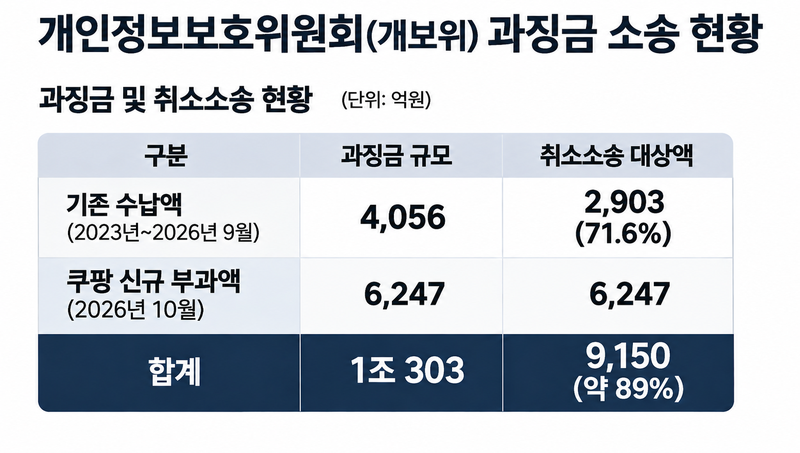
According to the National Assembly’s National Policy Committee report reviewing the 2027 budget proposal, obtained by Financial News on the 10th, the PIPC collected approximately 405.6 billion won in fines from 2023 through September this year, and lawsuits seeking to overturn fines totaling approximately 290.3 billion won (71.6%) of that amount were filed. Of the 168 cases in which fines were collected, 15 were challenged in court. Adding the approximately 624.7 billion won at issue in the two lawsuits Coupang filed last month to overturn fines brings the total amount in litigation to about 915 billion won. This is about 89% of the approximately 1.0303 trillion won combined total of previously collected fines (approximately 405.6 billion won) and new fines imposed on Coupang (approximately 624.7 billion won).
The problem is that if a fine is overturned in court, the amount already collected must be returned. Refunds may also incur an annual surcharge of 3.1%, potentially leading to an additional fiscal burden.
In the report, Kwak Hyeon-jun, chief expert adviser to the National Policy Committee, pointed to this issue of revenue stability and called for clearer criteria for imposing fines. In particular, Kwak said, “The criteria for determining whether leaked information constitutes personal information and the scope of security obligations, among other standards for determining whether a violation occurred, have not been sufficiently established through case law and other precedents.” He also stressed the need to analyze key issues raised in ongoing lawsuits, clarify the criteria for determining violations and calculating fines, and strengthen factual and legal review at the stage when penalties are imposed.
In the lawsuit filed by SK Telecom seeking to overturn fines in the 134.8-billion-won range, issues include whether leaked subscriber identification numbers and USIM authentication keys qualify as personal information, as well as the scope of any breach of security obligations.
Recent Coupang applications for a stay of enforcement have also resulted in different outcomes for different fines. On the 5th, the Seoul Administrative Court denied a stay of enforcement for a fine of approximately 423.5 billion won related to a personal information leak, ruling that “Coupang’s losses can be remedied.” The following day, a separate panel granted a stay for a fine of approximately 201.1 billion won related to the unauthorized collection of users’ online activity records, finding that “irreparable harm and an urgent need have been established.”
[email protected] Choi Eun-sol, Lee Hae-ram Reporter