HD Hyundai Heavy Industries targets 80% automation by 2030; U.S. shipyard to go even further
- Input
- 2026-11-10 14:00:00
- Updated
- 2026-11-10 14:00:00
Welding physical AI next year, 3,000 robots deployed by 2030
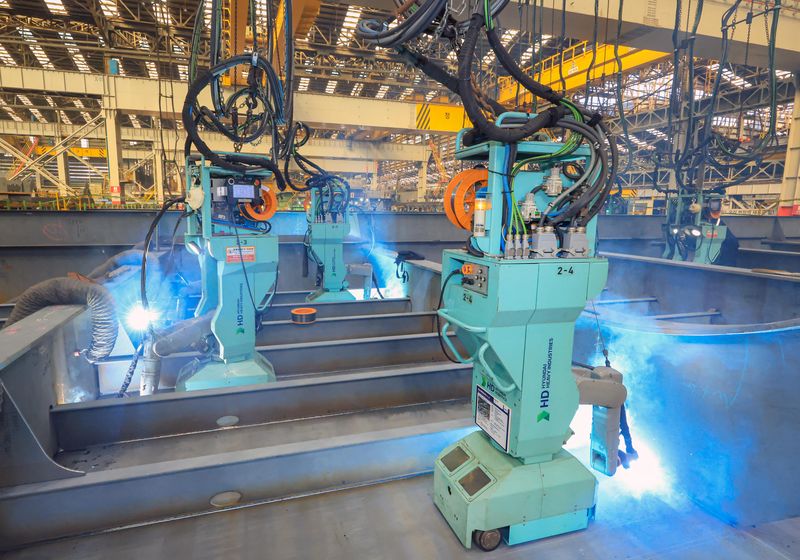
On the 10th, at HD Hyundai Heavy Industries’ Ulsan Shipyard, robot solutions powered by physical artificial intelligence (AI) were helping bring order to the complex shipyard environment. The status of each process was shared in real time, while robots assisted workers and boosted productivity.Robots were handling components with sophisticated sensors and control technology, even welding during the subassembly stage. Some collaborative robots descended from the ceiling, while others were moved into place by workers. HD Hyundai Heavy Industries said welding productivity had tripled because a single worker could carry out several tasks at once.
HD Hyundai Heavy Industries said the automation rate was 75% for in-house work, which includes making blocks—the units used to assemble ships—through welding and other processes, and 15% for on-site work assembling the blocks. It said the rate for on-site work would reach the 80% range by 2030, expressing confidence in the next-generation physical AI for welding due to be unveiled in the first half of next year and the planned deployment of 3,000 robots, including at HD Hyundai Samho Co., Ltd.’s Yeongam County shipyard.
For on-site work, which involves many non-routine tasks such as assembling curved blocks for the bow and stern and large assemblies, the current automation rate is just 15%. The company expects it can raise that to 60% by making active use of physical AI. HD Hyundai Heavy Industries said it had already secured simulation technology capable of handling non-routine tasks, leaving only the work of turning tacit knowledge—the know-how acquired by experienced workers—into data and applying robotic solutions.
New U.S. shipyard to be designed for automation, as in China
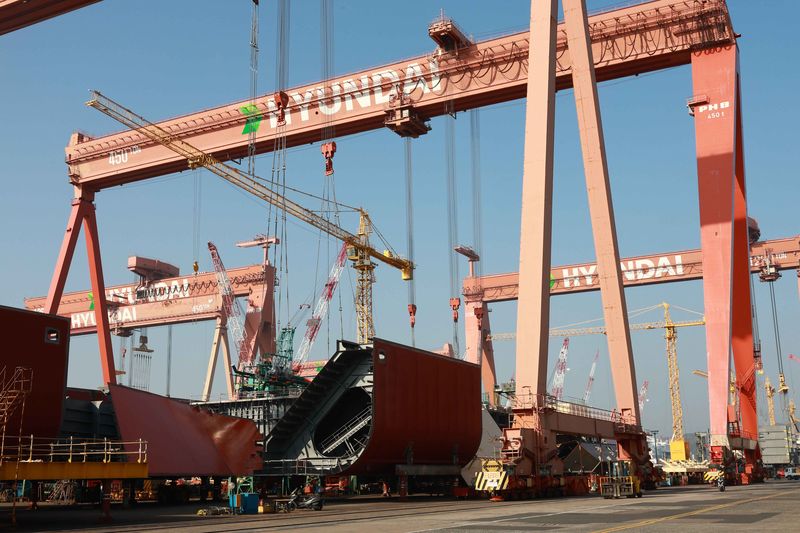
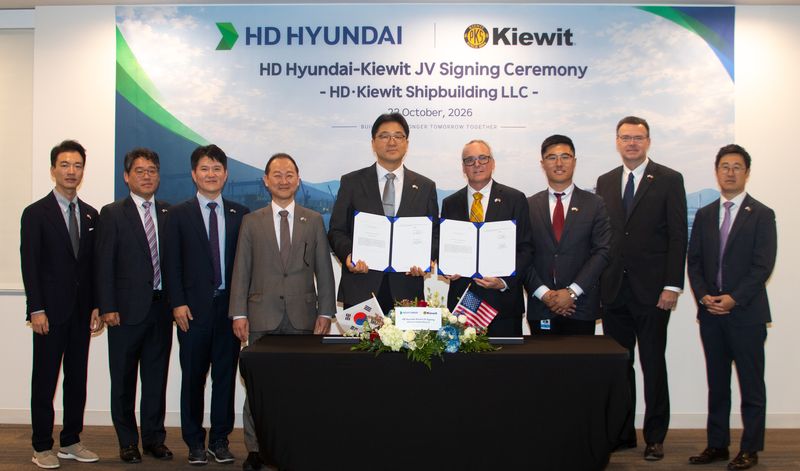
Expectations are also building for the new shipyard HD Hyundai plans to build in the United States, alongside its goal of increasing automation at existing shipyards. The plan is to partner with Kiewit, the largest construction, engineering and infrastructure company in the U.S., to build a “shipyard of the future” and bring it into operation in 2029.Shin Sang-beom, an executive leading the Automation Innovation Department in HD Hyundai Heavy Industries’ Shipbuilding Division, cited the fact that Chinese shipyards were designed and built with automation in mind from the outset as a reason China’s shipbuilding industry has moved ahead of South Korea in automation. That is why attention is focused on the shipyard of HD Kiewit Shipbuilding, which HD Hyundai plans to build as what it calls a “shipyard of the future.”
Because the new shipyard is being built in the U.S., where conditions differ in many ways, it is difficult to specify or compare a target automation rate. Still, industry observers expect it to achieve greater automation than existing shipyards, as it is being designed and built with automation in mind from the outset, as in China.
[This article was written with support from the Bada-ui-pum Foundation and the Korea Maritime Journalists Association.
[email protected] Kim Yun-ho Reporter