One Pack Could Exceed the Daily Sodium Limit... A Look at the Nutrition in Spicy Ramen
- Input
- 2026-11-10 12:00:00
- Updated
- 2026-11-10 12:00:00
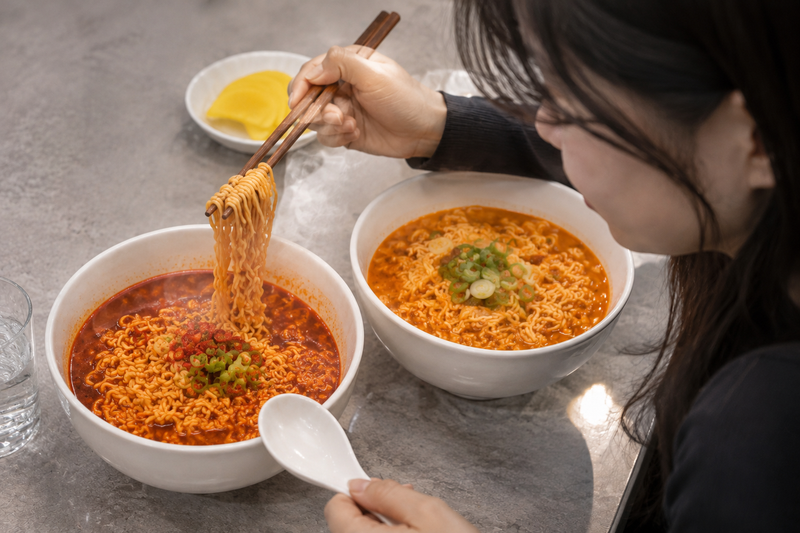
[Financial News] Most spicy ramen products sold on the market contain more than half the daily nutrient reference value for sodium per pack, and some soup ramen products exceed the daily reference value in a single pack, a comparison found. The intensity of the spiciness also varies by as much as 6.9 times between products.
According to industry sources on the 10th, the Korea Consumer Agency tested and evaluated 12 spicy ramen products that are popular with consumers. The capsaicinoid content in the ramen seasoning powders and sauces ranged from 94 to 650 mg/kg, a difference of up to 6.9 times between products. The survey covered seven soup ramen products and five stir-fried ramen products.
Among the soup ramen products, Paldo's Teumsae Ramen Ppalgyedduk had the highest content at 650 mg/kg, while Samyang Foods Co., Ltd.'s Samyang 1963 had the lowest at 117 mg/kg. Among the stir-fried ramen products, Samyang Foods Co., Ltd.'s Buldak Ramen had the highest at 285 mg/kg, while NONGSHIM CO., LTD. (Nongshim)'s Shin Ramyun Toomba had the lowest at 94 mg/kg.
Under the Korean Industrial Standards (KS) scale for the spiciness of fried instant noodles, the 12 products ranged from Level 2, “moderately spicy,” to Level 4, “very spicy.” Four products were classified at the highest level, Level 4: Teumsae Ramen Ppalgyedduk; Nongshim's Shin Ramyun The Red; and Samyang Foods Co., Ltd.'s Samyang Ramen Spicy Flavor and Buldak Ramen.
However, the difference in spiciness of the noodles as actually eaten was relatively small. While the capsaicinoid content in the seasoning powders and sauces differed by as much as 6.9 times, the content in the noodles after cooking ranged from 20 to 37 mg/kg, a difference of no more than 1.9 times. The perceived spiciness can also vary depending on how much broth or sauce is consumed.
Sodium levels were high across all products. Per pack, the soup ramen products contained 1,611–2,080 mg, or 81–104% of the daily reference value of 2,000 mg; the stir-fried ramen products contained 1,009–1,349 mg, or 50–67%.
Shin Ramyun The Red, in particular, contains 2,080 mg of sodium per pack, meaning that consuming the entire pack, including the broth, provides 104% of the daily reference value. The Korea Consumer Agency explained that, since about 70% of the sodium in soup ramen is in the broth, it is necessary to use less seasoning or reduce the amount of broth consumed.
Saturated fat also amounted to 7–10 g per pack, or 47–67% of the daily reference value. Nongshim's Shin Ramyun Toomba had the highest amount, at 10 g. Sugar content was 3–6 g in soup ramen and 6–11 g in stir-fried ramen, making it relatively higher in the latter.
All products met the relevant standards for heavy metals, benzo[a]pyrene, ethylene oxide, aflatoxins and other harmful substances, as well as microbial safety. Prices ranged from 684 to 1,300 won per pack for soup ramen, a difference of up to 1.9 times, and from 995 to 1,420 won for stir-fried ramen, a difference of up to 1.4 times.
A Korea Consumer Agency official said, “Spicy ingredients can cause gastrointestinal discomfort, such as abdominal pain and heartburn, depending on the individual, so people should adjust their intake based on their sensitivity,” and emphasized, “Drinking all the ramen broth may also increase sodium and spicy-ingredient intake, so it is best to prepare the ramen according to personal preference.”
[email protected] Kim Hyun-ji Reporter