President Lee: “External environment to change after US midterm elections ... bipartisan cooperation with US Congress”
- Input
- 2026-11-10 10:49:16
- Updated
- 2026-11-10 10:49:16
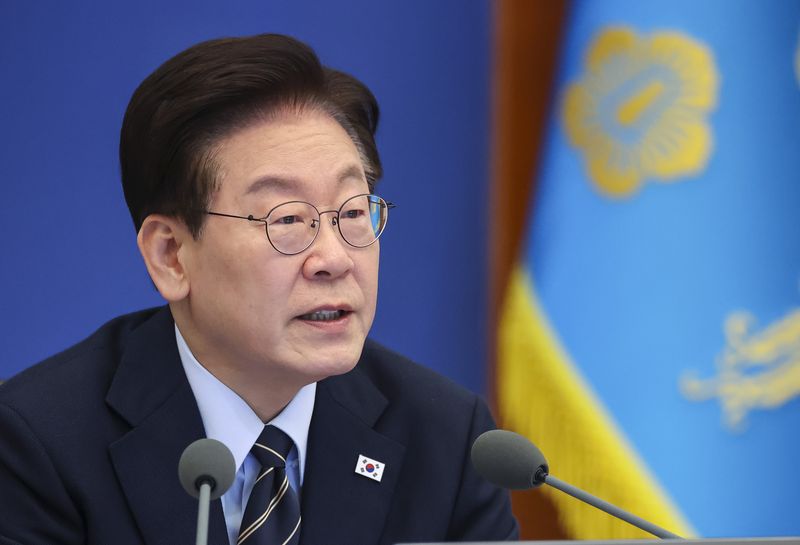
[Financial News] President Lee Jae Myung said on the 10th, referring to changes in the external environment following the US midterm elections, “We should continue close coordination with the US executive branch while also building a foundation for bipartisan cooperation in the US Congress and broadening communication to include state governments and the business community.”
At the 48th Cabinet meeting he presided over at Cheong Wa Dae that day, President Lee said, “Various changes in the external environment are expected after the US midterm elections,” and called on relevant ministries and agencies to analyze the range of possible variables from multiple angles and carefully prepare response plans for different scenarios.
Regarding diplomacy with the United States, he stressed, “The most important thing is to focus our diplomatic efforts on building and expanding the foundation of trust and cooperation between South Korea and the United States from a mutually beneficial perspective.” He added, “We should pool our wisdom to ensure that matters agreed upon by the two countries in the diplomatic and security fields are properly implemented, while robustly protecting our national interests and companies’ investments.”
He also called for financial market stability and a swift response. President Lee said, “We must do our utmost to minimize the negative impact that external uncertainties may have on the domestic and global economies,” adding, “I ask you to closely monitor the situation in the United States and the global economy, strengthen monitoring to prevent turmoil in financial markets, and ensure that a rapid-response system is in place.”
President Lee said, “It is also essential to strengthen our fundamentals if we are to avoid being buffeted by external pressures,” adding, “We should further refine the competitiveness of key strategic industries such as semiconductors and artificial intelligence, and keep up our efforts to foster new growth industries.”
He also stressed, “The greater the uncertainty in the international situation, the more important it is to strike a balance between consistent principles and a flexible response.” The government said it would not be swayed by every change and would focus all its efforts on pragmatic, national-interest diplomacy and governance that puts people’s livelihoods first.
He stressed the need to accelerate reform of public institutions. President Lee said, “Especially now, as we face the challenges of a major transformation in the industrial structure and balanced development across the country, innovation in the public sector is a core national and historic task that can no longer be postponed.”
He continued, “Under no circumstances should the interests of individual organizations obstruct reform for the people and the community as a whole,” adding, “I ask members of each organization to give a little more consideration to the people and the country, even if doing so causes some discomfort.”
President Lee said, “The key factor determining the success or failure of reform is speed,” and instructed officials to “actively pursue groundbreaking incentives to achieve rapid structural reform.” He stressed that, on matters where disagreements among ministries and agencies were delaying coordination, the prime minister should swiftly lead discussions and find solutions.
Meanwhile, President Lee urged Cabinet members attending the Regular National Assembly session to accept legitimate criticism but actively rebut unreasonable arguments. He said, “When you look at things from a somewhat critical perspective or from the opposing side, problems that were not readily visible can become clear,” adding, “I think we should accept such criticism with gratitude and make corrections.”
However, he added, “For unreasonable arguments such as, ‘Why do you eat rice with a spoon?’ you should rebut them with confidence. If you are unconditionally on the defensive, people may think, ‘Was that really wrong?’”
[email protected] Choi Jong-geun Reporter