Criteria for establishing public daycare centers left to local governments’ discretion
- Input
- 2026-11-10 12:29:19
- Updated
- 2026-11-10 12:29:19
[Financial News] The mandatory establishment criteria for public daycare centers, previously applied uniformly regardless of local conditions, will now be left to the discretion of local governments. The government will also conduct an official annual survey, on a clear legal basis, of the increasingly overheated market for private early childhood education.
The Ministry of Education said that partial amendment decrees to the Enforcement Decree of the Infant and Toddler Care Act and the Enforcement Decree of the Early Childhood Education Act, which center on these changes, were deliberated and approved at the State Council of South Korea on the 10th. The amendments were pursued to reflect changes in local childcare conditions, including a decline in the population of infants and young children, and to improve the safety and efficiency of kindergarten and daycare center operations.
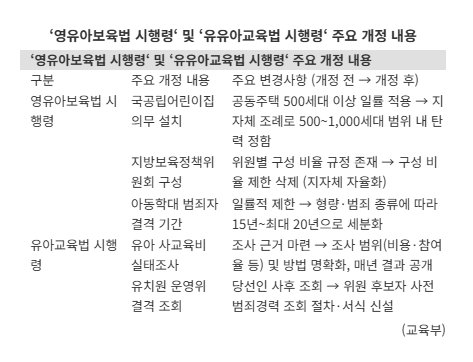
First, the mandatory establishment criteria for public daycare centers, which had applied uniformly to multi-unit housing complexes with at least 500 households, will be substantially revised. Going forward, local governments will be able to set different criteria by ordinance within the range of 500 to 1,000 households, depending on the population of infants and young children or demand for childcare. This is expected to resolve the unreasonable requirement that public daycare centers be built even in areas with few infants and young children. Restrictions on the proportions of different types of members on the Local Childcare Policy Committee, which reviews local governments’ childcare policies, have also been removed, allowing policy decisions to reflect local characteristics.
The scope and methods of the survey on private education expenses for young children have also been clearly defined. The Minister of Education must survey the cost of private education for young children, market size, participation rates and reasons for participation each year and publish the results on the ministry’s website. The first full-scale survey of private education expenses for young children, designated as an officially approved national statistic this year and now underway, is expected to be conducted more systematically starting next year, when the amended legislation takes effect.
Measures have also been introduced to enhance the safety of infants and young children and administrative efficiency. In response to a Constitutional Court ruling, the periods during which people convicted of child abuse-related crimes are disqualified from establishing or operating daycare centers, and during which reissuance of their childcare teacher qualifications is prohibited, have been broken down according to the sentence imposed, ranging from 15 years to a maximum of 20 years. In addition, procedures and forms have been introduced allowing kindergarten principals to check candidates’ criminal records with relevant agencies before the candidates are elected to the kindergarten’s governing committee, in order to prevent administrative delays.
Minister of Education Choi Kyo-jin said, “Through these amendments, we will improve administrative efficiency in the field and support the thorough conduct of the survey on private education expenses for young children,” adding, “We will continue to communicate with those in the field and identify regulations that need improvement.”
[email protected] Kim Man-gi Reporter