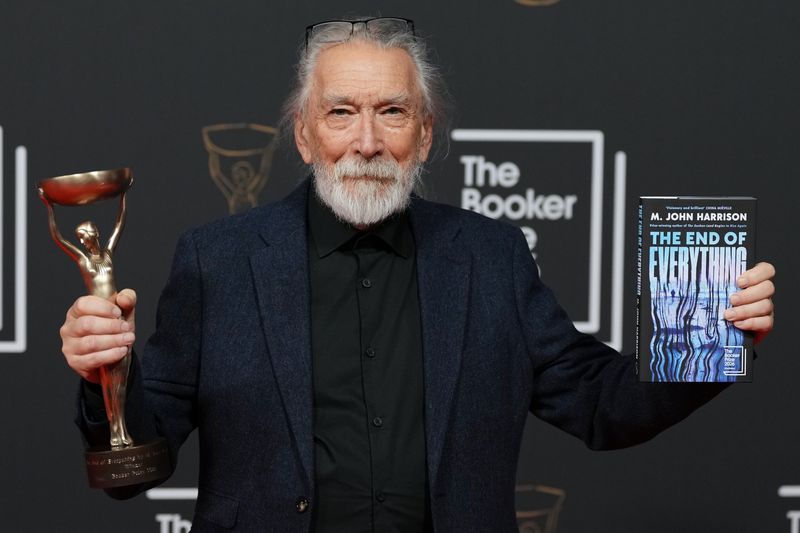
M. John Harrison wins Booker Prize, the UK’s most prestigious literary award; first SF writer to do so
- Input
- 2026-11-10 10:09:58
- Updated
- 2026-11-10 10:09:58
The Booker Prize Foundation named Harrison, regarded as a master of fantasy and science fiction (SF), the winner of this year’s Booker Prize on the 9th (local time).
Set on the coast of Kent in southeastern England, The End of Everything tells a story set in the future, decades after a catastrophe whose cause cannot be explained.
In the book, the protagonist, Philip Tennant, and his elderly aunt, Mani, struggle to survive the threat posed by the huge, bizarre, unidentified being known as the “iGhetti.”
In an article he contributed to the British outlet The Guardian last week, Harrison explained that The End of Everything is a story in which the inability to understand the catastrophe is itself a catastrophe.
The bizarre beings in the novel are depicted as migrants from another dimension. Harrison likened them to the gentrification taking place on England’s southeastern coast, where an influx of outsiders pushes out local residents.
He said he “wanted to convey the characters’ bewilderment and confusion” to readers, and explained that what he wanted to highlight also included the collapse of rationality brought about by Trumpism and the internet.
Harrison’s win is significant in several ways.
At 81, he is the oldest winner in Booker Prize history. He is also the first traditional SF writer to win the prize. He previously served as a Booker Prize judge in 2022.
Gaby Wood, director of the Booker Prize Foundation, said that although many previous winning works had incorporated some elements of science fiction, “Harrison is the first Booker winner to come from the traditional SF literary world.”
She added that this was “a historic win for a writer whose literary abilities, built up over decades, are woven throughout the work.”
Speaking on BBC radio last month, Harrison said, “As a novelist and critic, I’ve spent the past 40 to 50 years trying to change the balance of the literary world,” adding, “There’s no reason well-written SF shouldn’t be recognized as literature.”
Mary Beard, chair of this year’s judging panel, described The End of Everything as “a novel that looks at today’s politics through the lens of the future” and said it was selected as the winner unanimously by the judges.
The Guardian described the win as a rare moment of official literary recognition for a writer who had remained on the margins of the mainstream literary establishment, and as a timely award in the age of artificial intelligence (AI).
Beard thought the “i” in iGhetti might hint at something digital, though she could not be sure, while Wood thought the post-apocalyptic landscape in the book looked as if large language models (LLMs) were scattered throughout it.
Born in Warwickshire, England, in 1945, Harrison has worked steadily as a writer for more than six decades since publishing his first short story in 1965.
He won the Arthur C. Clarke Award, an SF literary prize, for Nova Swing in 2007, and the Goldsmiths Prize for The Sunken Land Begins to Rise Again in 2020.
[email protected] Lee Seok-woo, International Affairs Correspondent Reporter