“Eight in 10 special judicial police officers have less than 3 years of investigative experience” ... Corporate investigation risks flagged
- Input
- 2026-11-10 10:26:40
- Updated
- 2026-11-10 10:26:40
[Financial News] As the criminal justice system is being overhauled following the abolition of the Prosecutors’ Office and the separation of investigation and prosecution, it has emerged that eight in 10 special judicial police officers (SJPOs) have less than three years of investigative experience. Concerns have also been raised that gaps in case management could arise because some SJPO agencies are not properly connected to the criminal justice information system.
One Law Partners said that differences in expertise and procedures among investigative agencies could pose criminal legal risks for companies, stressing that they should develop response strategies tailored to each agency from the earliest stage of an investigation.
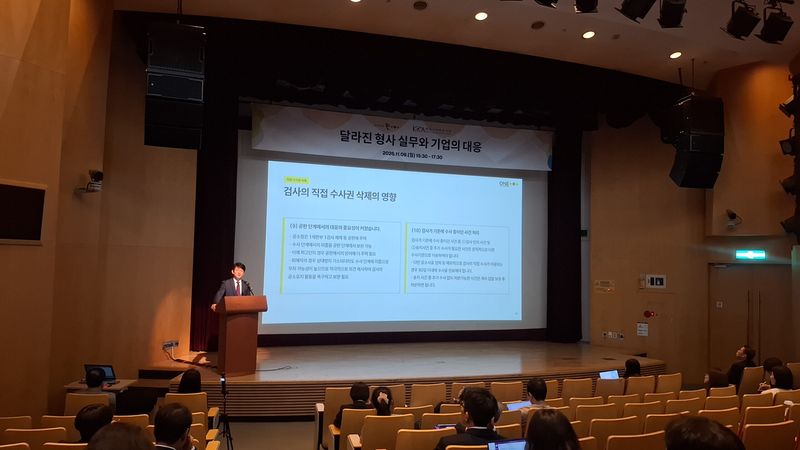
Legal sources said on the 10th that One Law Partners and the Korea In-house Counsel Association had held a seminar titled “Changes in Criminal Practice and Corporate Responses” the previous day at POSCO Center Yeoksam in Gangnam District, Seoul. Lawyers with backgrounds as prosecutors and police officers analyzed practical changes resulting from the overhaul of the investigative system and ways for companies to respond.
Only 20.6% of SJPOs are dedicated to investigations ... Concerns over case-management gaps
In a presentation titled “The Special Judicial Police Investigative System and Corporate Response Strategies,” Go In-seon, an attorney with One Law Partners, discussed issues surrounding SJPOs’ investigative expertise and staffing.
According to statistics presented by attorney Go based on Supreme Prosecutors’ Office data, as of 2025, 16,442 of the 20,419 SJPOs had less than three years of investigative experience, accounting for 80.5% of the total. A further 9,632, or 47.2%, had less than one year of experience. By contrast, only 4,203 personnel, or 20.6% of the total, were dedicated to investigative work.
SJPOs exercise limited investigative authority in specialized fields such as labor, the environment, food, finance and intellectual property. However, ordinary administrative officials are often assigned to investigative work through personnel transfers, and many also handle administrative guidance and public complaints, which can lead to differences in investigative experience and capabilities.
Attorney Go said that a lack of understanding of investigative procedures can lead to unexpected problems when handling actual SJPO cases. Go also pointed out that the disparity in investigative capabilities across agencies and individual officers is greater than among regular police.
Inadequate case-management systems were also cited as a problem. Some agencies, including the Korea Customs Service (KCS) and the Ministry of Employment and Labor, link their own work systems to the Korea Information System of Criminal Justice Services (KICS), but some SJPO agencies reportedly do not use the system or have not properly integrated with it.
Go explained, “Some of these agencies manage cases using Microsoft Excel, separate files or paper records, which can expose them to risks such as delays in cases and inadequate management of evidence.”
Although the revised Criminal Procedure Act establishes rules for managing investigative documents and evidence through KICS, Go predicted that full implementation in the short term would be difficult given the budgets and system-building conditions at each agency.
Go advised that it is important for companies to first check the investigative powers and jurisdiction of SJPOs. Since SJPOs may investigate only crimes specified by law, companies should carefully examine whether the officer in charge was lawfully appointed, the scope of the officer’s duties and the relevant territorial jurisdiction.
Go also stressed the need to distinguish the legal nature of administrative investigations from that of criminal investigations, and to examine the legality of using materials obtained during an investigation for other purposes, such as licensing or administrative measures.
Obtaining investigative records in cases police declined to refer ... Using new rights-redress procedures
Specific examples of responses that companies can use during the police investigation stage were also presented.
Son Byeong-ho, an attorney with One Law Partners, explained police investigative procedures and remedies available under the revised Criminal Procedure Act in a presentation titled “Everything In-house Counsel Need to Know About Police Investigations.”
Attorney Son presented an example from an actual corporate case in which the newly established procedure for inspecting and copying investigative records was used. A complaint was filed over allegations that the CEO of a company that had received investment set up a separate family company and transferred key business assets and patent rights, among other things, but the police decided not to refer the case to prosecutors.
Son’s side explained, “On the 12th of last month, we applied to the police to inspect and copy the investigative records. We then reviewed the list of case records and proceeded to obtain relevant materials, including an accounting firm’s audit report and documents submitted by the suspect’s side.”
Son said they had been able to review materials they could not obtain even through previous civil proceedings, and were preparing an objection after examining the police investigation and the grounds for its decision.
Until now, complainants have generally challenged police decisions not to refer cases based mainly on the written decisions. But the revised Criminal Procedure Act has established a basis for requesting access to and copies of investigative records, broadening the means available to respond.
Son also outlined remedies including filing an objection to a decision not to refer a case, raising an objection when there has been no substantive progress in an investigation for six months or more, and requesting an investigation review.
With a system now in place that allows police to request a prosecutor’s opinion on matters such as legal assessments and the appropriateness of evidence gathering, Son stressed the importance of parties involved in a case submitting thorough written opinions and relevant evidence from the early stages of an investigation.
Repeated case transfers and supplementary investigations between investigative agencies also possible
In a presentation titled “Understanding the Revised Investigative System and Corporate Response Measures,” Lim Chang-guk, an attorney with One Law Partners, analyzed how the abolition of prosecutors’ powers to conduct direct investigations and their authority to direct investigations may affect the handling of corporate cases.
Lim raised the possibility that, when prosecutors cannot investigate directly, requests for supplementary investigations may increase or so-called “ping-pong investigations” may occur, with cases repeatedly passing between investigative agencies.
Lim said that differences in investigative capabilities and expertise among the police, the Serious Crimes Investigation Agency (SCIA) and SJPOs could affect case outcomes.
Since the SCIA can exercise priority investigative authority over serious crimes and require other investigative agencies to transfer cases, coordination of jurisdiction and consultation procedures among investigative agencies have become more important, Lim said.
Lim advised companies to systematically collect and retain work-related materials in preparation for situations in which they become targets of an investigation or need to claim that they have been victims of a crime. After an incident occurs, companies should analyze the characteristics of the investigative agencies involved and the nature of the case, and, where necessary, also seek to secure evidence through civil proceedings.
The seminar is noteworthy for addressing not only institutional changes resulting from the overhaul of the investigative system, but also disparities in investigative expertise, limitations of case-management systems and real-world examples of remedies.
The seminar highlighted how the importance of criminal risk management is expanding from responding after the fact to conducting advance reviews and responding from the early stages of investigations, while distinguishing the powers and procedures of different investigative agencies and setting out specific options available to companies. As the new criminal justice system takes hold following the separation of investigation and prosecution, securing investigative expertise, cooperation among agencies and protection of companies’ right to mount a defense are expected to remain key challenges.
[email protected] Yu Seon-jun Reporter