Semiconductor stocks hit by data center regulations—why are they rising again? KOSPI briefly tops 5,300
- Input
- 2026-11-10 09:53:31
- Updated
- 2026-11-10 09:53:31
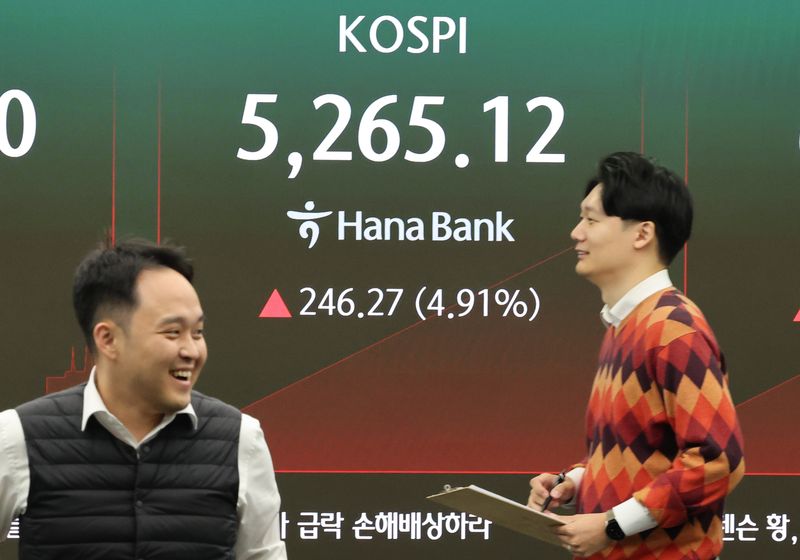
[Financial News] The KOSPI is up nearly 5% in early trading on the 10th. As analysts say the impact of U.S. data center regulations on semiconductor demand may have been overestimated, Samsung Electronics and SK hynix are leading gains in the index.
As of 9:40 a.m. that day, the KOSPI was up 244.77 points (4.88%) from the previous trading day at 5,263.62. The index opened at 5,247.22, up 228.37 points (4.55%), and briefly climbed as high as 5,300.92 before paring some of its gains.
At the same time, Samsung Electronics was trading up 5.06% at 199,500 won, while SK hynix was up 7.83% at 1,225,000 won. On the KOSPI Market, the number of advancing stocks was more than five times the number of declining stocks. The large-cap index rose 5.07%, while mid-cap and small-cap stocks gained 3.07% and 1.73%, respectively.
The KOSDAQ was up 25.45 points (3.98%) from the previous trading day at 664.42. The general services and manufacturing indexes rose 4.28% and 4.24%, respectively.
The PHLX Semiconductor Sector (SOX) surged 6.85% overnight. Yang Hyun-kyung, an analyst at iM Securities, said, “KOSPI night futures also rose 5.77%,” adding, “The key to this rebound is the reassessment of concerns about data center regulations.”
He explained, “The suspension of new permits in Texas had been in effect since before the midterm elections, and the main issues are the power grid, water use, and the costs borne by residents. Major investment banks also see constraints on expanding regulation at the federal level and expect its impact on facilities already under construction to be limited.” He went on to say, “It was excessive to interpret the possibility that regulation could change the timing and location of investment as an immediate contraction in semiconductor demand.”
The decline in international oil prices also supported investor sentiment. Yang said, “West Texas Intermediate (WTI) prices fell as U.S. President Donald Trump lowered the likelihood of further attacks on Iran.” He forecast, “Considering the Democrats’ expanded investigations and moves to impeach administration officials, Trump has greater incentive to prioritize negotiations to end the war in order to reduce the political burden of a prolonged conflict.”
Yang also said that, given gains across all sectors of the U.S. S&P 500, investors should watch whether the strength of large-cap semiconductor stocks in South Korea spreads to other sectors. He stressed, “Whether foreign investors’ selling pressure eases is also a key factor in gauging how sustainable the rebound will be.”
[email protected] Choi Doo-seon Reporter